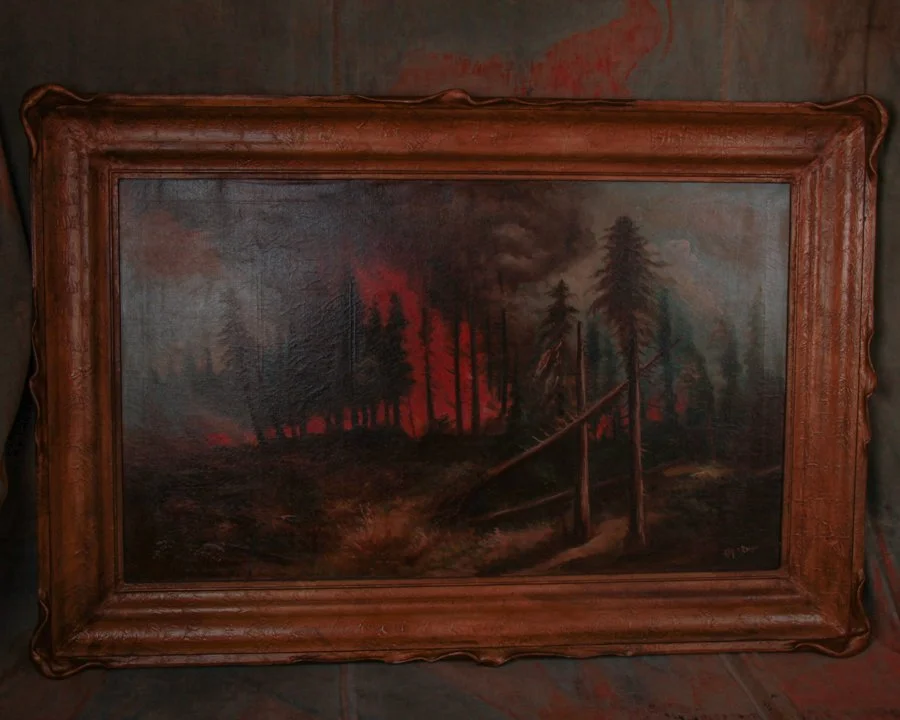
Created in the first quarter of the 20th century by William M. Lemos, this oil painting draws clear inspiration from Robert Schade’s 1908 depiction of the Great Peshtigo Fire of 1871 in Wisconsin—one of the deadliest wildfires in American history.
A pine forest stands mid-burn, its tall, dark silhouettes cutting through a sky stained with red and smoke. The fire isn’t shown as chaos exploding outward, but as something creeping and inevitable. Red-orange light glows from within the trees, bleeding into the ground and climbing the trunks, while a heavy haze hangs above like a held breath. It’s the moment just before everything gives way. You can almost feel the heat radiating off the surface.
The brushwork is moody and deliberate, favoring atmosphere over detail. Shadows dominate. The palette stays restrained except where the fire breaks through, making those glowing areas feel all the more unsettling. It walks that fine line between beauty and destruction, the kind of scene that’s hard to look away from even when it makes you uncomfortable.
The painting is housed in its original, thick pie crust frame, worn to a rich, crusty patina that suits the subject perfectly. It feels substantial, architectural, and period-correct, grounding the drama of the image with real physical presence. There are two minor, unnoticeable repairs on the back, nothing that distracts from the front-facing impact.
It’s a serious, cinematic painting that commands the room and doesn’t apologize for it.
Measures: W 59” x D 4” x H 42”
Category History
Late 19th to early 20th century oil paintings sit right at a turning point, where tradition meets a growing appetite for looseness and speed. Artists were still working within long-established studio practices—stretching canvas, sizing it with glue, then building up layers of ground—but the way paint was handled began to shift. Academic painters layered thin glazes, slowly building depth and polish. Others, especially influenced by Impressionism, worked more directly, laying down color in thicker, visible strokes.
Oil paint itself made all of this possible. It dries slowly, giving artists time to blend, adjust, scrape back, or completely rethink a passage. Many would begin with a loose underdrawing or tonal block-in, establishing composition and light before committing to color. From there, the painting could evolve in stages or be pushed forward all at once, depending on the artist’s approach.
What’s compelling about works from this period is the tension between control and freedom. You often see areas that are tightly rendered sitting right next to passages that feel almost unfinished. Brushwork becomes part of the story, not something to hide. These paintings don’t just show what the artist saw—they show how they worked, decision by decision, layer by layer.
Created in the first quarter of the 20th century by William M. Lemos, this oil painting draws clear inspiration from Robert Schade’s 1908 depiction of the Great Peshtigo Fire of 1871 in Wisconsin—one of the deadliest wildfires in American history.
A pine forest stands mid-burn, its tall, dark silhouettes cutting through a sky stained with red and smoke. The fire isn’t shown as chaos exploding outward, but as something creeping and inevitable. Red-orange light glows from within the trees, bleeding into the ground and climbing the trunks, while a heavy haze hangs above like a held breath. It’s the moment just before everything gives way. You can almost feel the heat radiating off the surface.
The brushwork is moody and deliberate, favoring atmosphere over detail. Shadows dominate. The palette stays restrained except where the fire breaks through, making those glowing areas feel all the more unsettling. It walks that fine line between beauty and destruction, the kind of scene that’s hard to look away from even when it makes you uncomfortable.
The painting is housed in its original, thick pie crust frame, worn to a rich, crusty patina that suits the subject perfectly. It feels substantial, architectural, and period-correct, grounding the drama of the image with real physical presence. There are two minor, unnoticeable repairs on the back, nothing that distracts from the front-facing impact.
It’s a serious, cinematic painting that commands the room and doesn’t apologize for it.
Measures: W 59” x D 4” x H 42”
Category History
Late 19th to early 20th century oil paintings sit right at a turning point, where tradition meets a growing appetite for looseness and speed. Artists were still working within long-established studio practices—stretching canvas, sizing it with glue, then building up layers of ground—but the way paint was handled began to shift. Academic painters layered thin glazes, slowly building depth and polish. Others, especially influenced by Impressionism, worked more directly, laying down color in thicker, visible strokes.
Oil paint itself made all of this possible. It dries slowly, giving artists time to blend, adjust, scrape back, or completely rethink a passage. Many would begin with a loose underdrawing or tonal block-in, establishing composition and light before committing to color. From there, the painting could evolve in stages or be pushed forward all at once, depending on the artist’s approach.
What’s compelling about works from this period is the tension between control and freedom. You often see areas that are tightly rendered sitting right next to passages that feel almost unfinished. Brushwork becomes part of the story, not something to hide. These paintings don’t just show what the artist saw—they show how they worked, decision by decision, layer by layer.