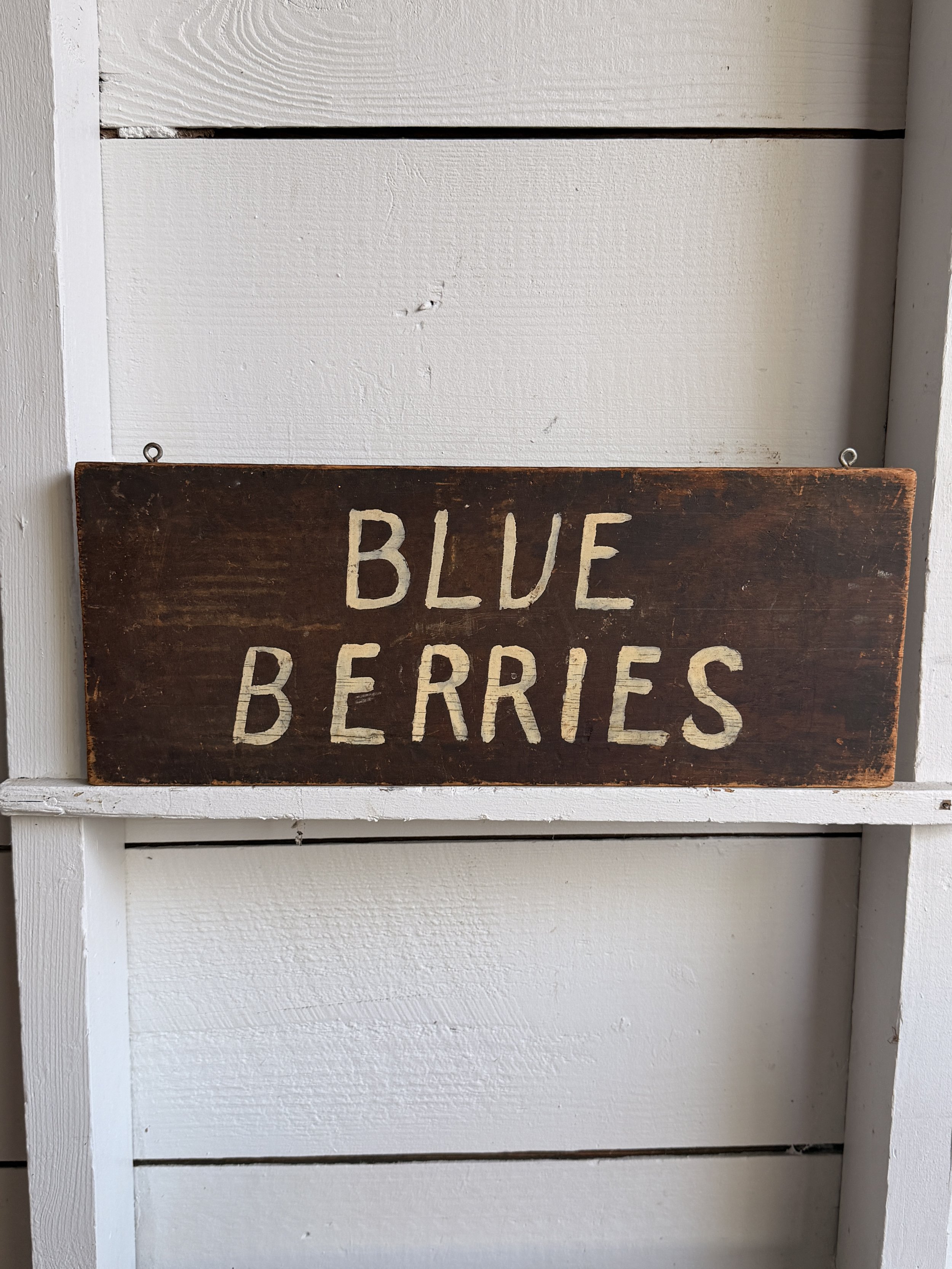
This simple hand-painted “BLUE BERRIES” sign has exactly the kind of straightforward charm you want from an old roadside or farm-market sign. Made from a single rectangular wooden board, it has a dark brown painted ground with large cream-colored lettering applied by hand. The uneven spacing, slightly irregular letterforms, and visible brushwork give it a warm, homemade quality that printed signage simply doesn’t have. The surface shows plenty of age, including scuffs, scratches, edge wear, and areas where the darker paint has thinned to reveal the wood beneath. Two small hanging eyes along the top edge suggest it was originally suspended rather than permanently mounted.
The wording itself is wonderfully direct. No logo, no price, no sales pitch, just “BLUE BERRIES.” That simplicity points to the kind of sign that may have hung at a farm stand, produce market, roadside fruit stand, or seasonal berry patch.
Hand-painted produce signs like this were especially common through the first half and middle of the 20th century, when roadside agriculture and small independent markets depended on bold, readable signage to catch the attention of passing motorists. Farmers often made their own signs using whatever lumber and leftover paint were available, which is why surviving examples can feel so individual.
Blueberries became increasingly important as a cultivated American crop during the early 20th century. Commercial cultivation expanded rapidly after successful breeding work in New Jersey beginning in the 1910s, helping turn what had largely been a wild-harvested fruit into a widely farmed seasonal crop.
Today, signs like this sit comfortably between advertising, folk art, and rural Americana. The spelling as two words, “BLUE BERRIES,” adds another small dose of personality. It is plain, useful, slightly quirky, and beautifully worn.
This simple hand-painted “BLUE BERRIES” sign has exactly the kind of straightforward charm you want from an old roadside or farm-market sign. Made from a single rectangular wooden board, it has a dark brown painted ground with large cream-colored lettering applied by hand. The uneven spacing, slightly irregular letterforms, and visible brushwork give it a warm, homemade quality that printed signage simply doesn’t have. The surface shows plenty of age, including scuffs, scratches, edge wear, and areas where the darker paint has thinned to reveal the wood beneath. Two small hanging eyes along the top edge suggest it was originally suspended rather than permanently mounted.
The wording itself is wonderfully direct. No logo, no price, no sales pitch, just “BLUE BERRIES.” That simplicity points to the kind of sign that may have hung at a farm stand, produce market, roadside fruit stand, or seasonal berry patch.
Hand-painted produce signs like this were especially common through the first half and middle of the 20th century, when roadside agriculture and small independent markets depended on bold, readable signage to catch the attention of passing motorists. Farmers often made their own signs using whatever lumber and leftover paint were available, which is why surviving examples can feel so individual.
Blueberries became increasingly important as a cultivated American crop during the early 20th century. Commercial cultivation expanded rapidly after successful breeding work in New Jersey beginning in the 1910s, helping turn what had largely been a wild-harvested fruit into a widely farmed seasonal crop.
Today, signs like this sit comfortably between advertising, folk art, and rural Americana. The spelling as two words, “BLUE BERRIES,” adds another small dose of personality. It is plain, useful, slightly quirky, and beautifully worn.