
Antique Toys+ Games
Handmade or hard to find, they’re all original old toys sourced from private collections and forgotten playrooms.
Our collection of antique toys brings together a carefully selected range of playthings spanning the nineteenth and early twentieth centuries. From hand-carved folk toys and painted colonial toys to early manufactured collectibles, these pieces reflect the craft traditions and material culture of the eras in which they were made.
Many of the vintage toys in this collection were produced before mass manufacturing changed how objects were made. Early 20th century toys were built from wood, tin, and cloth by craftspeople who applied the same care to a child's plaything as they would to any functional object. Historical folk toys in particular tell a deeper story. Made locally, often anonymously, from whatever materials were at hand.
Today antique toys are sought after by collectors for their craftsmanship, rarity and the window they offer into domestic life from earlier periods. Each piece in the Heimwee collection is selected for its originality, condition and historical character. No reproductions, no licensed reissues, only the genuine article.
Toys
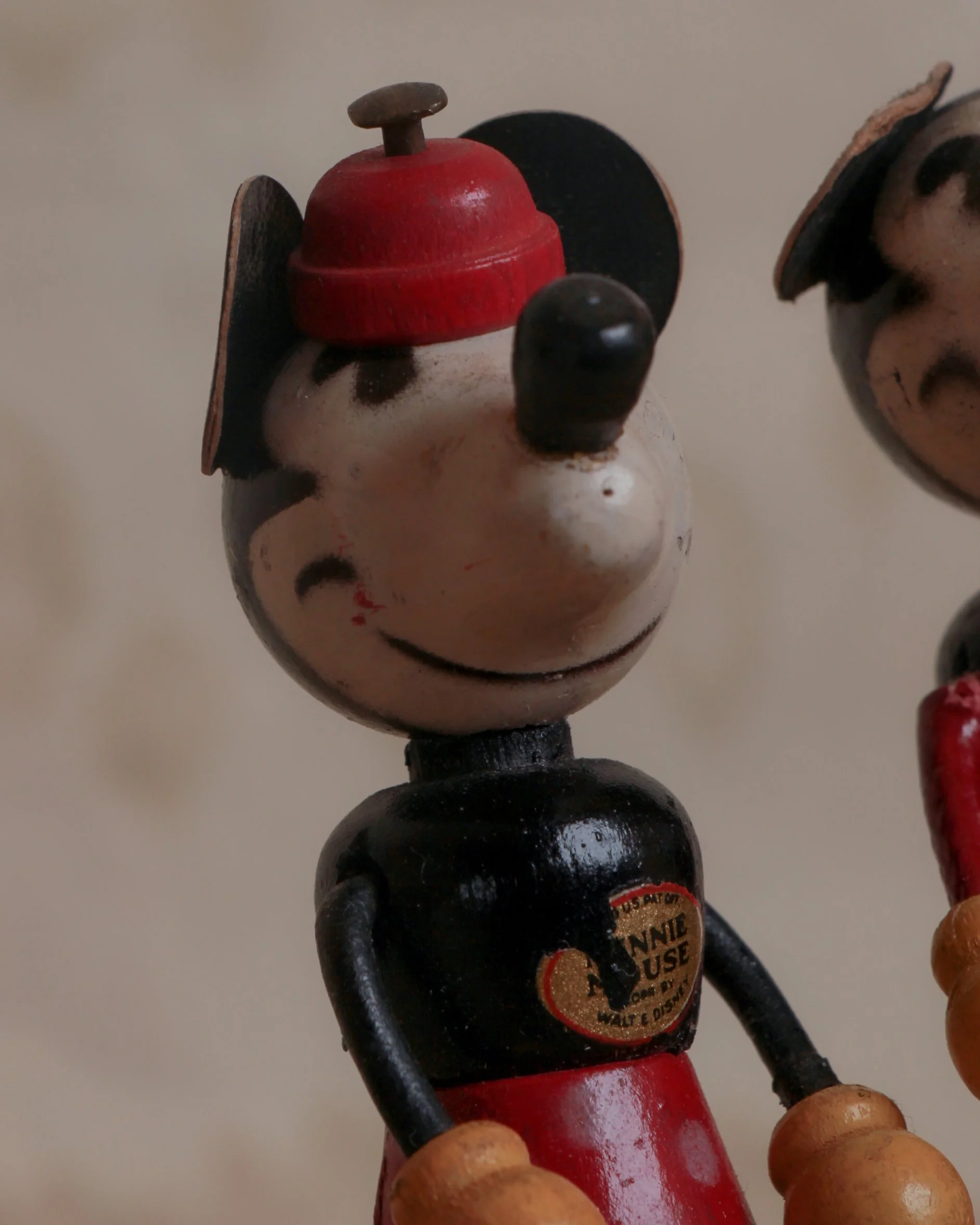
This pair of Fun-E-Flex wooden Mickey and Minnie Mouse figures dates to the 1930s and has the wonderfully quirky look of early licensed Disney merchandise. Both are built from turned and shaped wooden parts, with flexible cord joints at the arms and legs that let the figures be posed. Their oversized round heads, long projecting noses, flat ears, yellow hands, red lower bodies, and black torsos capture the simplified graphic language of early Mickey animation. Minnie wears a small red hat, while Mickey has the familiar two-button detail on his red shorts. Each still retains part of its original paper chest label identifying the character and Walt Disney connection.
The wear is exactly what you would hope to see on toys of this age: rubbing to the painted surfaces, losses along the ear edges, fading, scuffs, and some deterioration around the flexible joints. Nothing feels over-restored or overly precious. They still look like toys that were actually handled.
Mickey Mouse made his public debut in 1928, and his success quickly created one of the earliest large-scale character merchandising phenomena. By the early 1930s, Mickey was appearing on everything from watches and books to dolls, toys, school supplies, and household objects. Minnie followed right alongside him.
Fun-E-Flex figures are especially charming because they sit between doll, toy, and early animation souvenir. Their jointed construction gave children a way to physically pose characters they had previously only seen moving on screen.
That connection to animation is what makes these so appealing today. They are not slick later reproductions of an established icon. They come from the period when Mickey and Minnie were still relatively new characters, and manufacturers were figuring out how to translate those elastic cartoon bodies into three-dimensional form. The result is slightly crude, highly graphic, and full of personality.
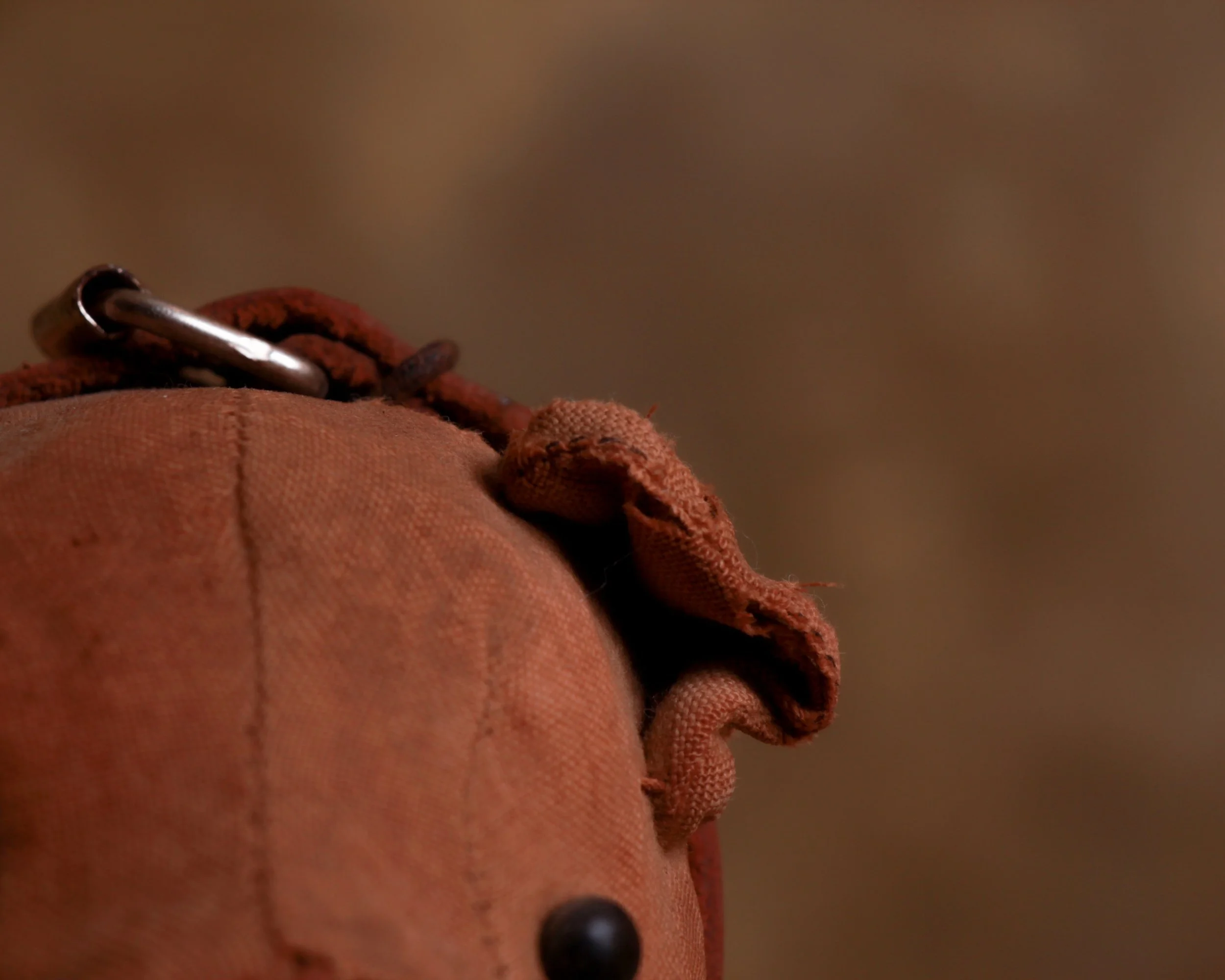
This late 19th pull toy bear has exactly the sort of worn, handmade presence that makes old toys so compelling. The bear is formed from a sturdy brown textile stretched and stitched over a stuffed body, with simple rounded ears, dark button-like eyes, a stitched mouth, and a heavily worn snout where the underlying material shows through. A leather collar with metal buckle circles the neck, while the whole figure stands over a simple iron carriage fitted with four wooden wheels.
The condition tells a good part of the story. There are scattered tears, old repairs, staining, and areas of loss to the fabric, all consistent with a toy that was genuinely handled rather than tucked away. The exposed stuffing and worn seams give it a slightly battered, almost homemade quality that is much more interesting than something pristine.
Pull toys were a major part of the toy world by the late 19th century. Manufacturers in Europe and America produced horses, dogs, elephants, bears, and other animals mounted on wheeled platforms so children could pull them along by a string or cord. Before plastics and stamped metal took over the market, these toys were commonly made from wood, cloth, papier-mâché, leather, and simple iron hardware.
Bears became especially popular as toy subjects around the turn of the 20th century, helped by a growing fascination with wild animals, traveling circuses, zoos, and eventually the teddy bear craze that followed in the early 1900s.
This example feels a bit earlier and more utilitarian than the soft teddy bear type. It sits closer to the tradition of rolling animal toys, with its rigid stance, substantial body, and straightforward mechanical base. The contrast is what works so well: a tough little bear built to move, now softened by more than a century of wear.
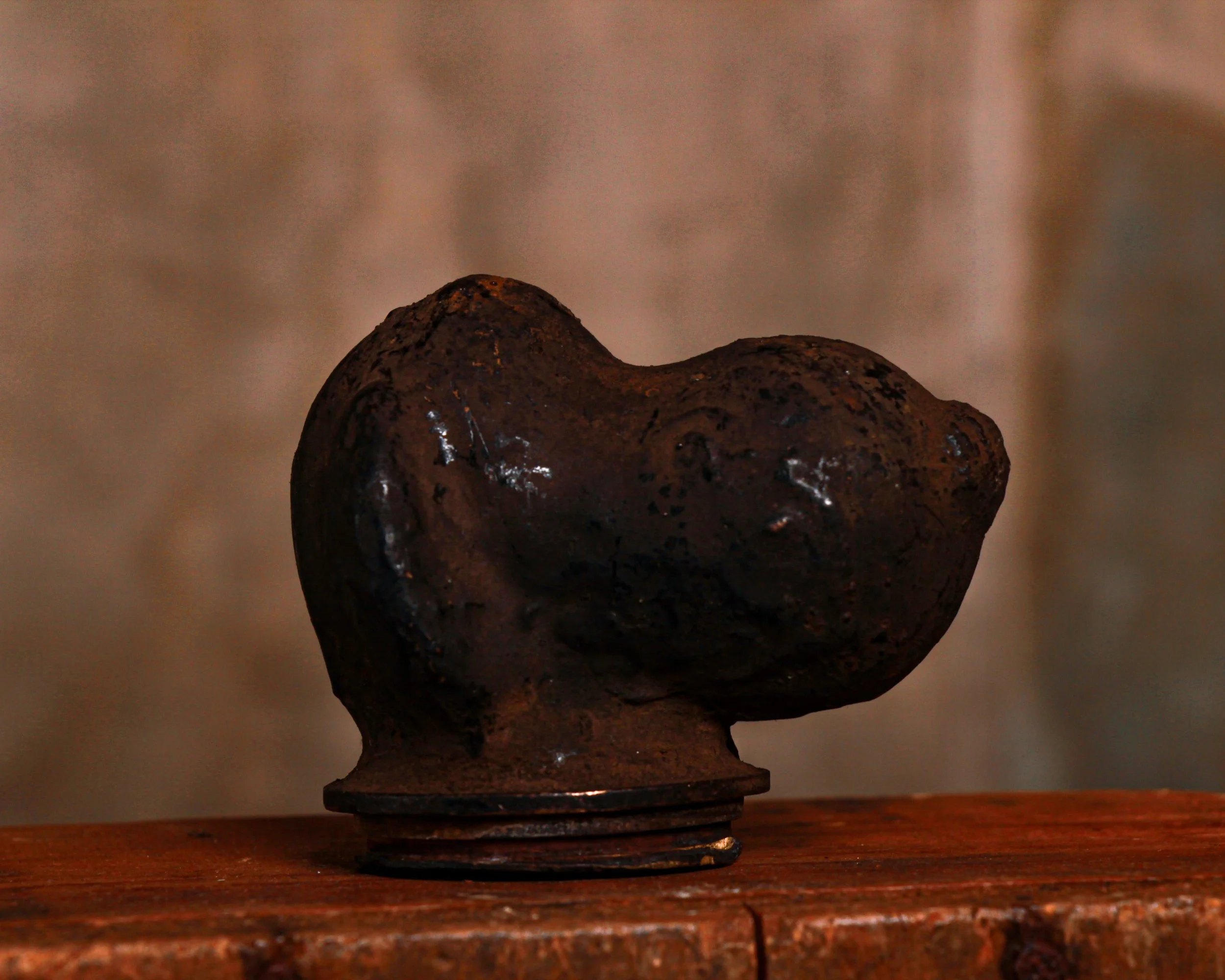
This is one of those objects that feels equal parts industrial tool and accidental sculpture. A metal toy mold in the unmistakable shape of Snoopy’s head, it was once part of a production line—likely used to form hollow figures or banks, where molten material would be poured in, cooled, and popped out as a finished piece ready for paint and personality.
Now stripped of that context, what you’re left with is something far more raw. The form is all there—those rounded cheeks, the drooping ears, the bulbous snout—but reduced to a heavy, utilitarian mass of cast metal. It’s Snoopy, but seen through the lens of function rather than charm.
The surface tells the real story. Dark, pitted, and richly oxidized, it carries decades of use and exposure. There are small irregularities, areas where the metal has worn or built up, traces of heat and handling that hint at repetition—open, close, fill, release, again and again.
Mounted or left as-is, it reads like a quiet nod to manufacturing history. A recognizable form, caught in its most unpolished state—less about the finished toy, more about how it came to be.
Toy Molds
Toy cast metal molds are the quiet workhorses behind some of the most recognizable playthings of the 19th and early 20th centuries. Before plastics took over, toys were often made by pouring molten metal—typically iron, tin, or lead alloys—into hinged molds like these, then cooling, trimming, and painting the result by hand. The molds themselves were built for repetition: durable, heat-resistant, and precisely carved to capture detail without slowing production.
What’s interesting is how these molds sit at the intersection of craft and industry. Early examples were often hand-finished, with subtle variations that carried through to the toys themselves. Later, as demand grew, molds became more standardized, allowing for faster output but still requiring skill to operate. Today, they read less like tools and more like negative sculptures—objects that hold the memory of every figure they helped bring into the world.
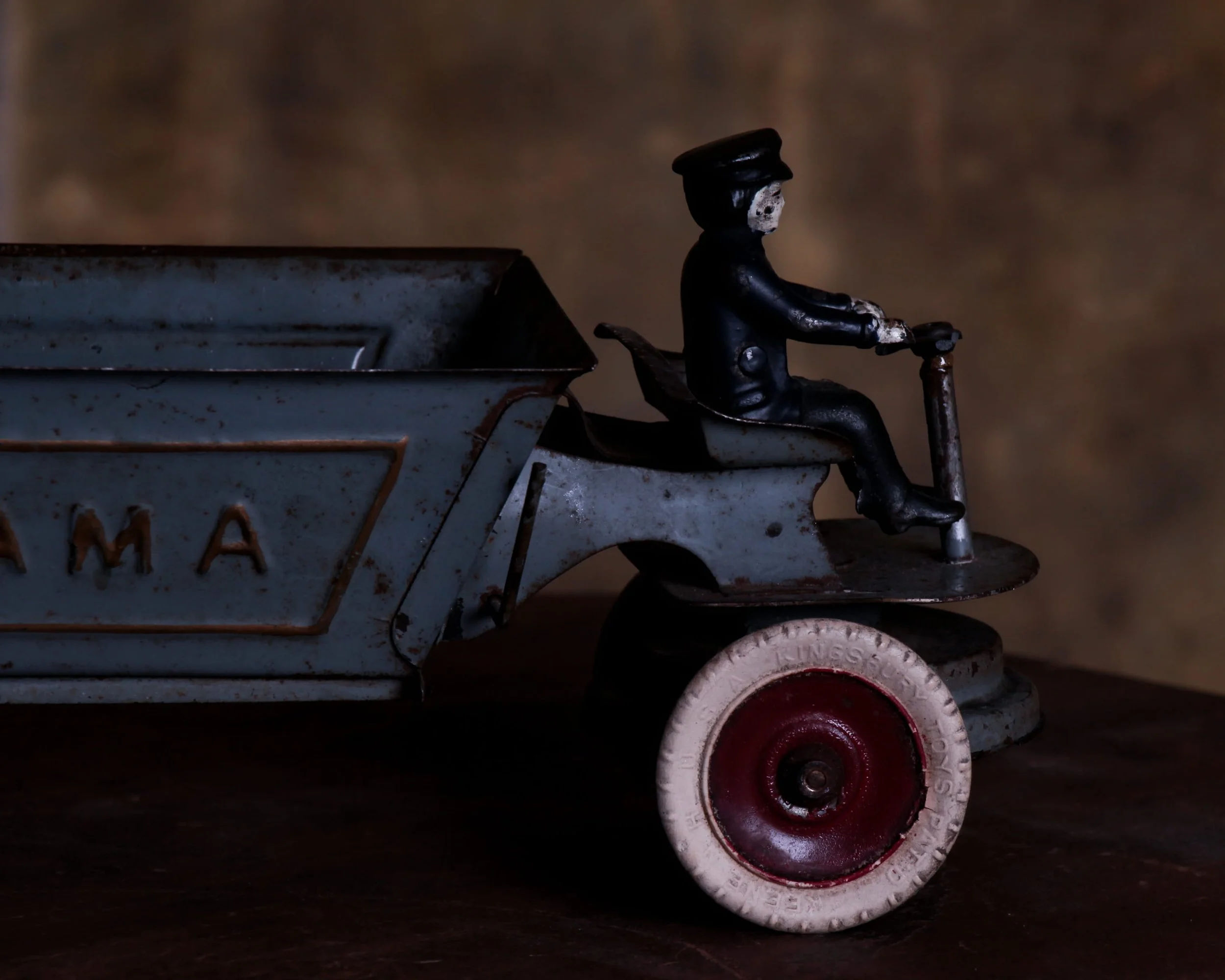
The Kingsbury "Panama" pressed steel wind-up dump truck, rolled out in 1923 and is still ready for action. This 14-inch brute has a steel body with a deep blue-grey paint job, "PANAMA" embossed proudly on both sides, and those thick original white rubber tires stamped with the Kingsbury Toys logo. The driver, cast in black and a deep blue with just enough face paint left to still look a little haunted, grips his handlebars with a fixed determination.
Kingsbury
Kingsbury pressed steel toys land right at the intersection of early industrial muscle and childhood imagination. Produced in the 1910s and 1920s by the Kingsbury Manufacturing Company in Keene, New Hampshire, these toys were built using the same techniques shaping full-scale industry—pressed sheet steel, riveted construction, and no-nonsense assembly.
Unlike cast iron toys, which were heavy and brittle, pressed steel allowed for larger forms without the same weight. Trucks, construction equipment, and vehicles were the stars—objects that mirrored the rapidly changing American landscape, where roads, machines, and infrastructure were becoming part of everyday life.
The design language is straightforward. Bold shapes, minimal ornament, and just enough painted detail to suggest function—grilles, headlights, company markings. They weren’t trying to be delicate or overly realistic. They were built to be used, pushed, dragged, and occasionally knocked around without falling apart.
What makes Kingsbury pieces stand out is their scale and presence. Even smaller examples feel substantial, with a kind of industrial honesty that reflects how they were made. Over time, the paint wears down, edges soften, and the metal picks up dents—each mark a record of play rather than neglect.
Today, they read as both toys and artifacts of early manufacturing. Practical, durable, and tied closely to the world they came from—where making things strong mattered just as much as making them fun.
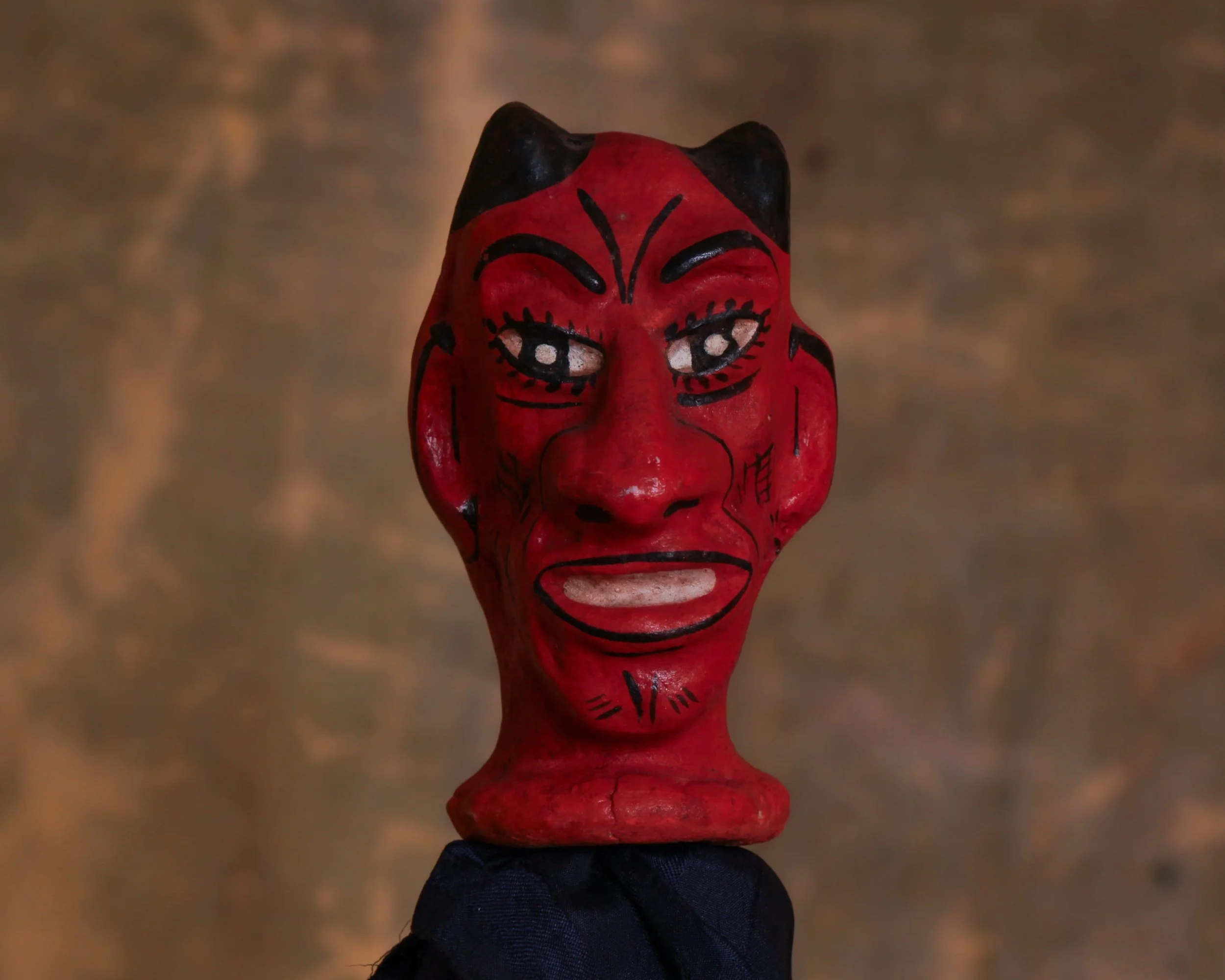
This early 20th century papier-mâché devil puppet has the kind of presence that doesn’t stay quiet on a shelf. Likely German and dating to the 1910s, it’s built as a hand puppet mounted on a wooden rod, originally meant to pop up, stir the crowd, and disappear just as quickly.
The head is hand-painted in a bold, almost mischievous red, with black horns, sharp brows, and a grin that lands somewhere between charming and slightly suspect. The features have that great, slightly exaggerated folk quality—expressive, a touch uneven, and full of character. It still wears its dark cloth costume, with flashes of red underneath.
At 16 inches tall, it reads more like a small sculpture now than a toy.
Puppet Shows
Early puppet shows sit somewhere between storytelling and sleight of hand. Long before film or television, they were a way to bring characters to life with simple means—wood, cloth, string, and a bit of voice work. Found across Europe, Asia, and beyond, these performances adapted easily to their surroundings, whether staged in marketplaces, small theaters, or traveling booths.
The mechanics were straightforward but effective. Hand puppets, rod puppets, marionettes—each with its own style of movement and control. What mattered wasn’t realism, but rhythm. A good puppeteer could suggest emotion and action with just a tilt of the head or a well-timed gesture.
Stories ranged widely. Folk tales, moral lessons, satire, even political commentary slipped in under the guise of entertainment. Because the figures were one step removed from real actors, they could say and do things that might not land the same way otherwise.
What makes early puppet shows compelling now is their immediacy. Everything is visible—the strings, the hands, the stage—yet the illusion still works.
They’re less about hiding the trick and more about inviting you into it, where imagination does most of the heavy lifting.
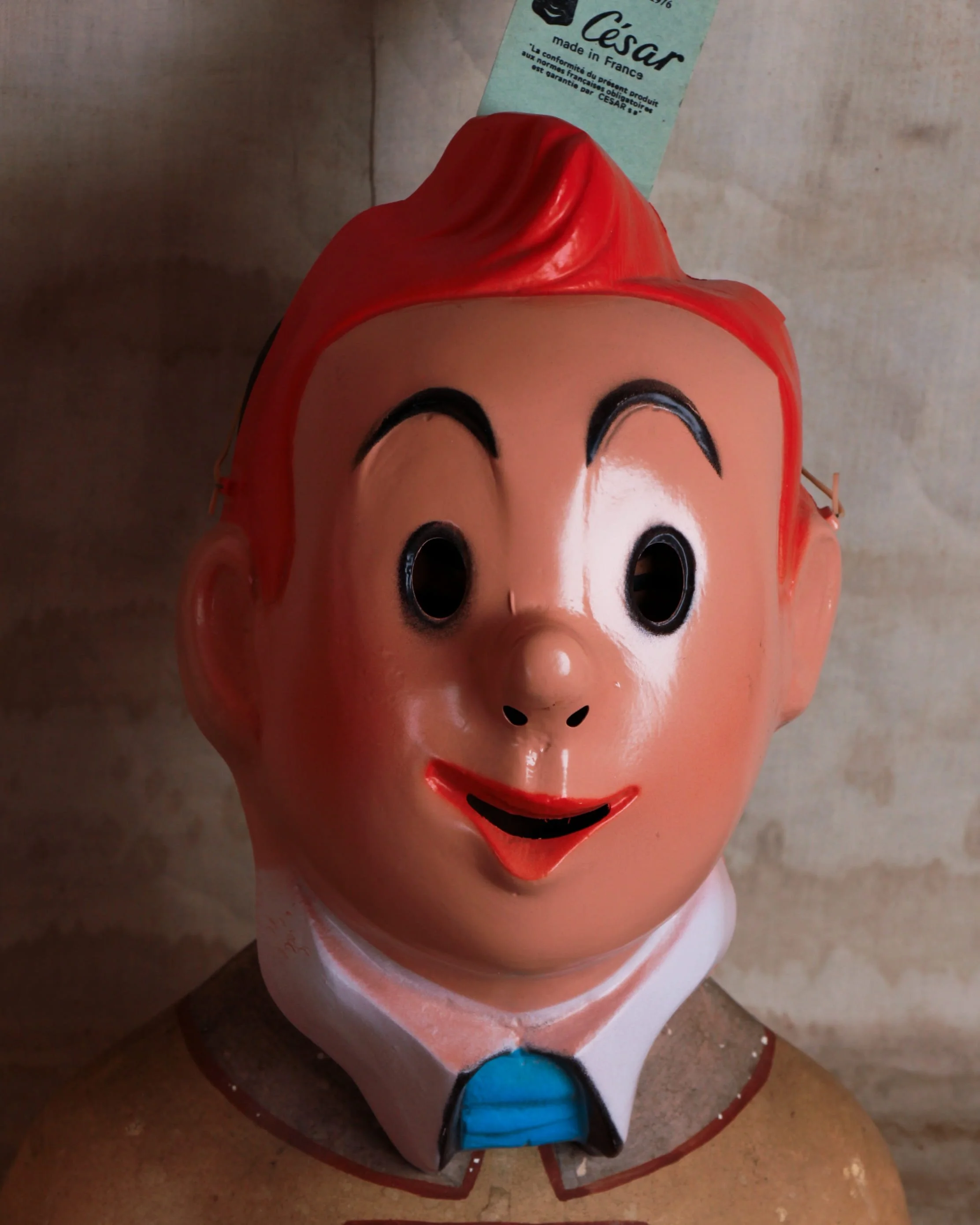
A full cast, frozen somewhere between childhood play and quiet display—this set of three original 1970s Tintin masks by French maker Cesar brings together Tintin, Milou, and Captain Haddock in all their slightly uncanny, wonderfully graphic charm. Bright molded plastic, bold lines, and those unmistakable faces that feel pulled straight from the page.
Tintin still wears his signature quiff and comes with visible interior tape repairs—honest fixes that keep him intact without pretending otherwise. Milou is the cleanest of the bunch, with crisp detail and strong presence. Captain Haddock, ever a bit rough around the edges, is missing his elastic but otherwise holds his gruff expression just fine.
They’re getting harder to find as a group, especially with original tags still present. More sculptural than wearable at this point.
Mannequin bust not included.
Tintin
Tintin begins with a clean line and a curious mind. Created in 1929 by Hergé, the character is a young reporter who seems less interested in writing stories than in chasing them. Each adventure moves quickly—travel, mystery, danger—yet the storytelling is tightly controlled.
Visually, Tintin is defined by the “ligne claire” style: clear outlines, flat colors, minimal shading. It keeps everything readable, almost deceptively simple, while allowing complex scenes to unfold without clutter. The precision extends to settings too—cars, ships, cities—all rendered with careful attention.
What makes Tintin interesting is the balance between realism and imagination. The stories often draw from real-world events and places, but they’re filtered through a sense of adventure that keeps them light on their feet.
Over time, the series expanded into a cast of characters—Captain Haddock, Snowy, Professor Calculus—each adding texture and humor.
It’s a world that feels orderly, even when things go off track. Direct, visual, and consistently paced, Tintin holds its shape—clear, confident, and built to move.
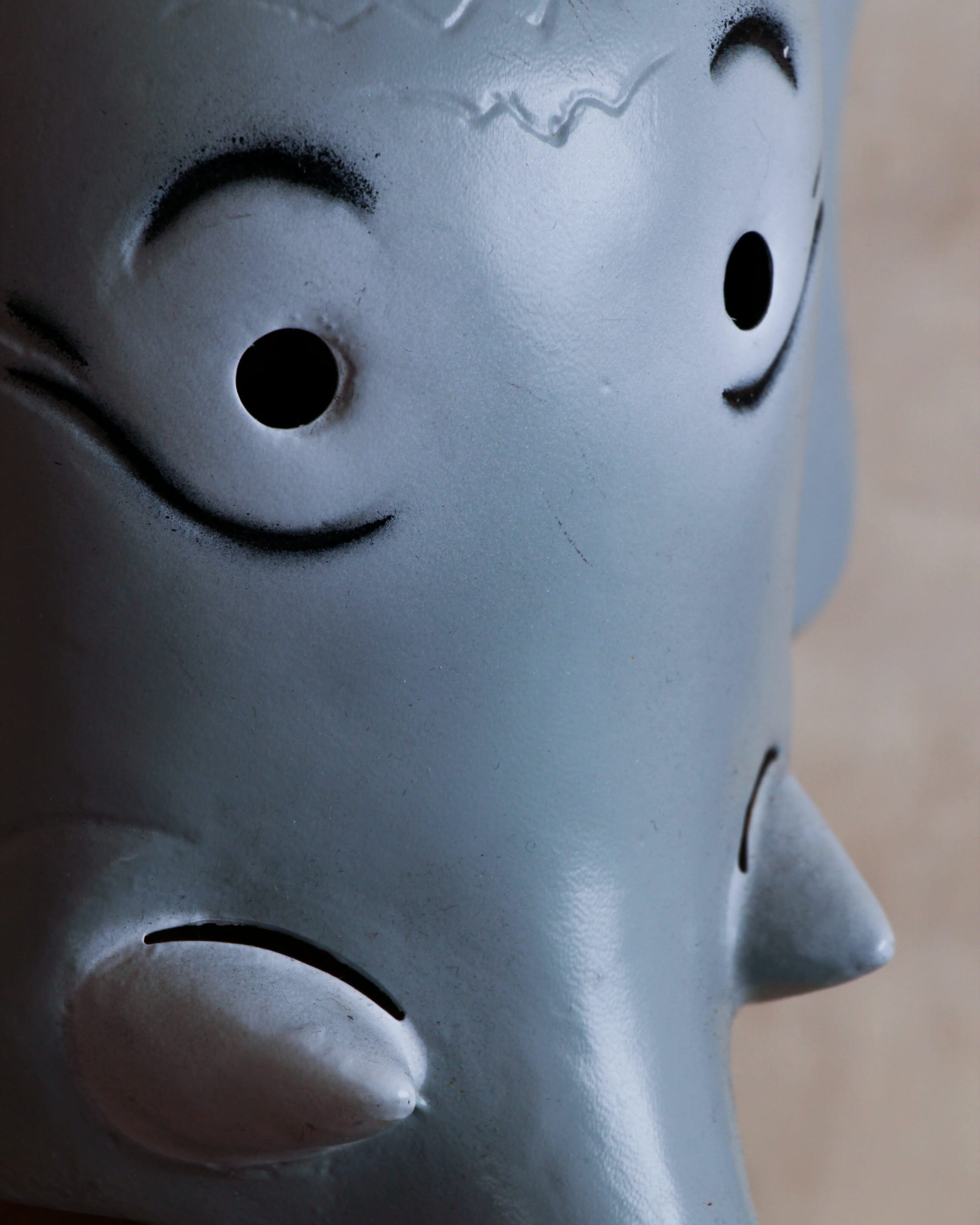
This official 1970s Babar mask by French maker Cesar has all the quiet charm of the storybook king, with just enough wear to prove it’s lived a life. Soft blue plastic, wide ears, and that long, unmistakable trunk, topped with the bright yellow crown that somehow survived the decades intact.
It’s a tough one to come by, especially in this kind of honest condition. There are a few tape repairs from the inside—visible at the head, ear, and along the trunk—done to keep things together but structurally sound. Surface shows light age wear and handling, but the overall look still lands exactly where you want it.
Mannequin bust not included.
Babar
Babar begins with a simple story and quietly expands into a world. Created in the 1930s by Jean de Brunhoff, the character first appeared as a children’s tale told within a family, then turned into a series of illustrated books that balanced charm with a surprisingly structured narrative.
At its core, Babar is an elephant who leaves the forest, encounters human society, and returns to build something new—part jungle, part city. The stories move between innocence and order, blending adventure with ideas about culture, learning, and leadership.
Visually, the books are just as important as the text. Clean lines, soft colors, and composed scenes give everything a calm, almost architectural feel. Nothing is overcrowded. Each page has space to breathe.
What makes Babar interesting is that duality. It’s a children’s story, but it carries layers—colonial influence, ideas of progress, and a certain European perspective on structure and civility. It’s gentle on the surface, more complex underneath.
Over time, Babar moved beyond books into toys, animations, and merchandise, but the original appeal holds. Simple, deliberate, and quietly distinctive—an imagined world that still feels carefully constructed.
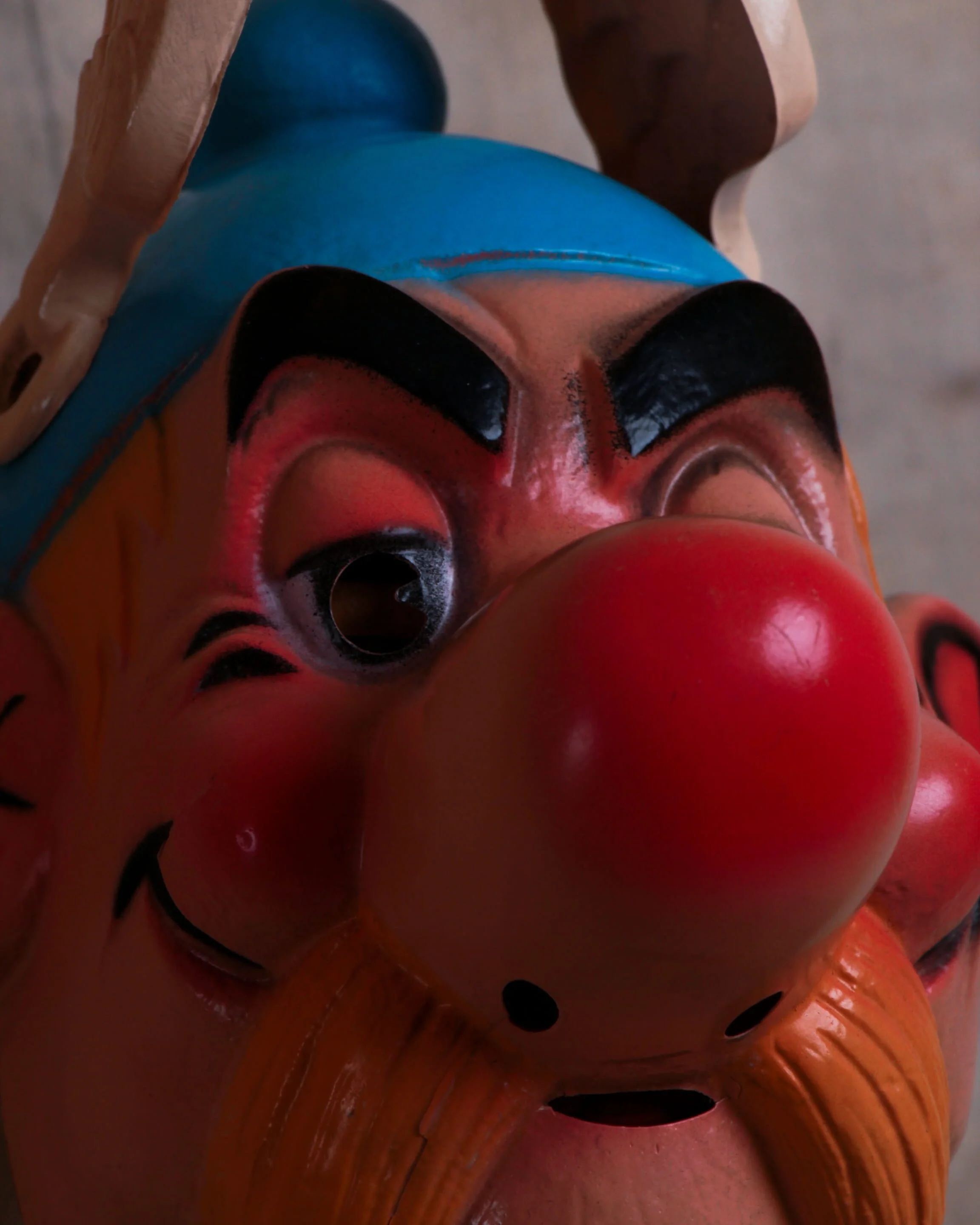
A proper Gaulish duo—this pair of official 1970s Asterix and Obelix plastic masks by French maker Cesar brings the whole village with them. Obelix leads with that unmistakable bulbous nose, red braids, and calm, heavy-lidded stare, while Asterix counters with sharper features, arched brows, and a slightly more mischievous expression. Together, they feel less like costumes and more like sculptural character studies straight out of the comic panels.
Both are new old stock with strong, saturated color and a clean, glossy finish. Each is missing its original elastic, and both show a small, honest tape repair from the inside that keeps them sturdy without affecting how they present. Light surface wear in spots, consistent with age.
Best suited today as wall pieces or shelf display.
Mannequin bust not included.
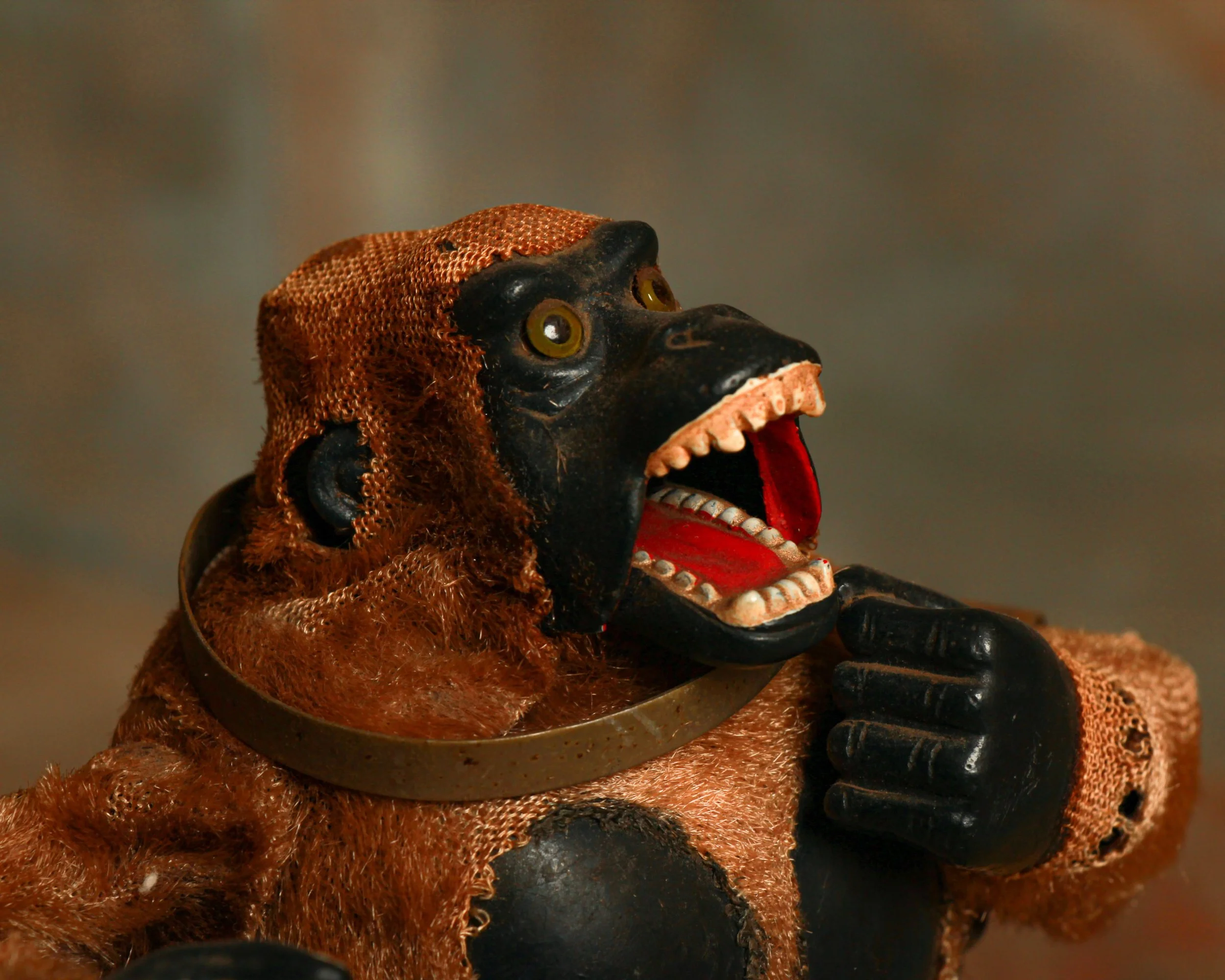
Mouth wide open, teeth bared, eyes locked in that classic mid-roar expression, this King Kong wind-up toy by Marx captures the giant ape in all his wonderfully dramatic glory.
Produced in the 1960s by Louis Marx & Co., the toy is a great example of the company’s knack for turning pop-culture icons into charming mechanical playthings. Covered in brown faux fur with molded black hands, feet, and snarling head, Kong stands upright with a metal collar and chain detail across his chest. Wind the key and he lurches forward with stiff-armed determination, looking every bit like he’s just stepped off a miniature movie set and into your living room.
The back still retains the original Marx Toys label, marked “Made in Japan,” and the mechanism is in working condition.
Measures 7.5" tall.
Category History
Louis Marx & Co. built its reputation on one simple idea: make toys that move, and make them affordable. Founded by Louis Marx in the early 20th century, the company became one of America’s largest toy makers by turning stamped tin, simple mechanics, and clever design into pure entertainment.
Their wind-up toys are where that philosophy really clicks. A twist of the key sets everything in motion—marching soldiers, waddling animals, clattering cars—each driven by a compact spring mechanism and a handful of gears. Nothing hidden, nothing overly complicated, just enough engineering to keep things lively.
What sets Marx toys apart is their personality. Bright lithographed surfaces, expressive faces, and a slightly exaggerated sense of movement give them a charm that feels immediate. They weren’t trying to be perfect replicas; they were built to delight.
They were also built to be used. Many show scratches, worn paint, and the occasional repair—evidence of play rather than storage.
Today, they read as small mechanical performances. Wind them up, and they still do what they were designed to do: move, entertain, and hold your attention just a little longer than expected.
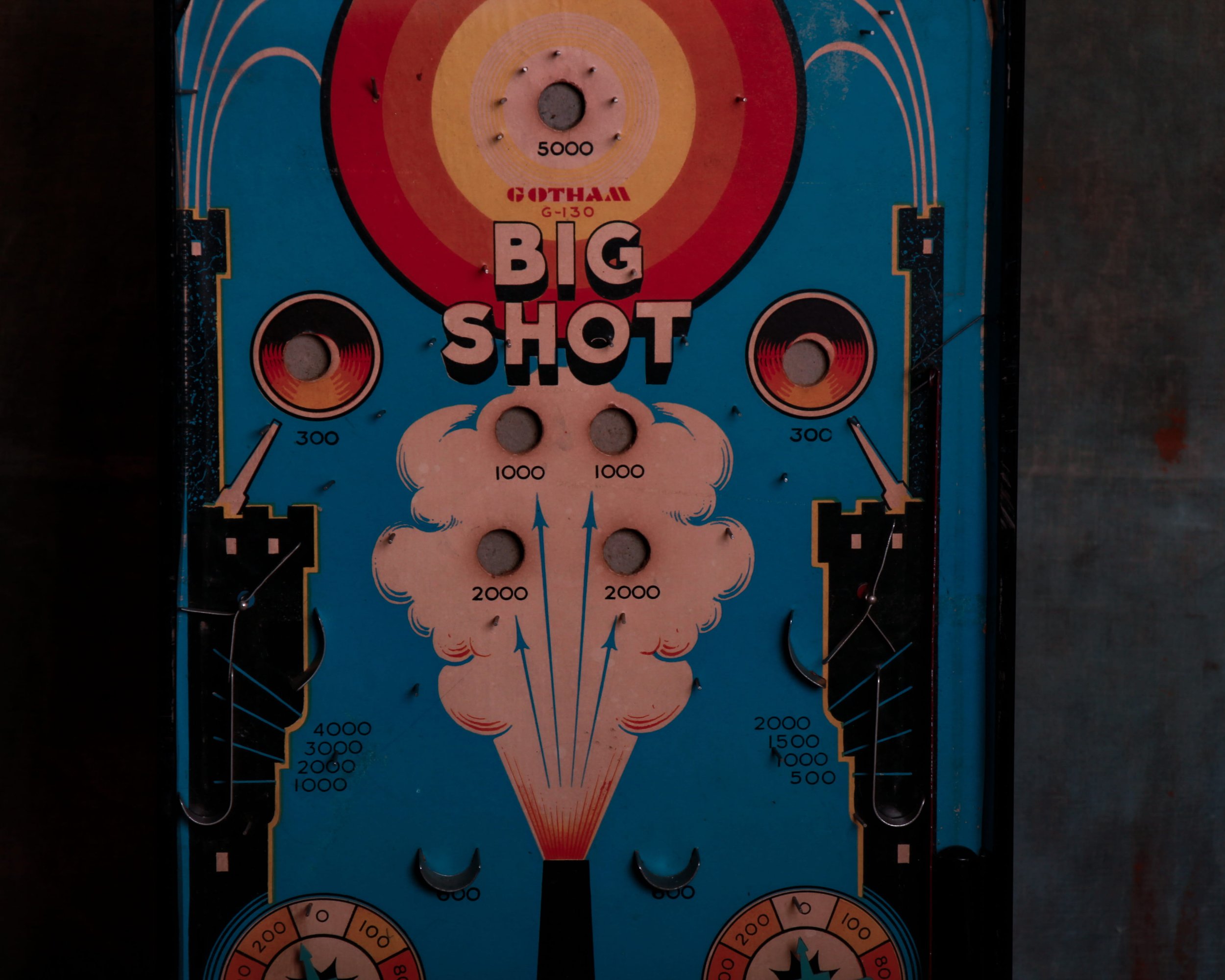
There’s something wonderfully theatrical about this 1937 Gotham G-130 Big Shot tabletop pinball game. The moment you look at it, the board reads like a tiny Art Deco stage set—it’s bold, colorful, and unapologetically graphic in that way only pre-war lithography seems to manage.
Manufactured by Gotham Pressed Steel Corporation in New York, the game is a classic bagatelle-style pinball toy from the era before electric machines took over arcades. Instead of lights and buzzers, everything here is mechanical and immediate: launch the steel ball, let gravity do the rest, and watch it ricochet off pins toward the scoring pockets.
Category History
Vintage tabletop pinball games sit right at the beginning of arcade culture—before flashing lights, before electricity, before anything buzzed or blinked. Often called bagatelle games, they relied on simple physics: a spring-loaded plunger sends a steel ball into a field of pins, bumpers, and scoring holes, and from there it’s all gravity and chance.
Most were made from wood with lithographed metal playfields, especially from the 1920s through the 1940s. The graphics did a lot of the heavy lifting—bold colors, targets, numbers, sometimes dramatic themes—designed to keep your eye moving as the ball bounced unpredictably across the board.
What makes them compelling is how tactile they are. No circuits, no sound effects—just the click of the plunger and the soft rattle of the ball finding its way. You can follow every movement, every near miss, every lucky shot.
They were often played casually on tabletops in homes, bars, or small shops, making them more personal than the larger arcade machines that came later.
Today, they read as both game and graphic object. Slight wear to the surface, a bit of patina on the metal, all adding to the experience. Simple, direct, and surprisingly engaging—proof that a good idea doesn’t need much to work.
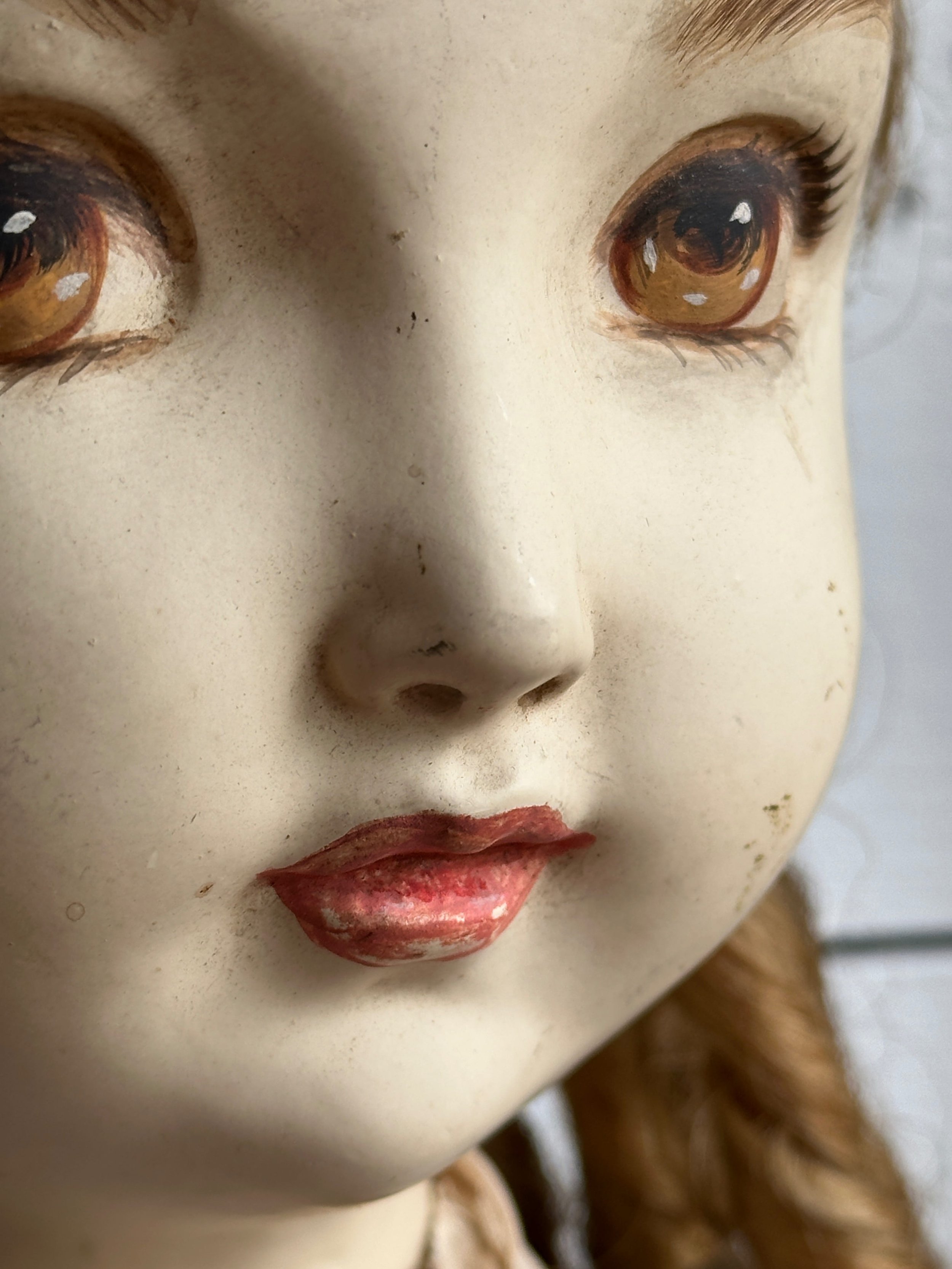
Dating to the late 1800s, this early styling doll head was once a training ground for curls, braids, and bows. Mounted to a wooden cabinet with a single drawer, she comes with her original horsehair and leather rollers tucked neatly inside. The cabinet itself has sweet turned finials on each corner and a warm, worn finish that pairs beautifully with her glassy stare. Her hair is shiny and still full of bounce after more than a century. It’s creepy in all the right ways.
Measures 14" tall, 14" wide, 7.5" deep.
Category History
An 1800s hair styling teaching aid for children is equal parts etiquette lesson and hands-on training tool. In a time when personal grooming was tied closely to social expectation, young girls were often taught early how to care for hair—both their own and others’. These teaching aids, sometimes in the form of small mannequins, partial heads, or even mounted hairpieces, gave them something to practice on before working with real clients or family members.
Human hair was commonly used, carefully attached to cloth, wax, or wooden forms. The goal wasn’t play, but repetition—learning how to part, braid, coil, and pin hair neatly and efficiently. Styles could be elaborate, and precision mattered. A well-set arrangement reflected discipline and attention to detail, qualities that carried social weight at the time.
What makes these objects interesting now is how direct they are. No abstraction, no simplification—just real materials shaped for instruction. They often show heavy use: loose strands, reworked sections, evidence of being handled again and again.
They sit somewhere between domestic life and early vocational training. Not quite toy, not quite tool—more like a quiet introduction to skill, patience, and presentation, all centered around something as everyday, and as telling, as hair, shaping habits, expectations, and confidence from a young age.
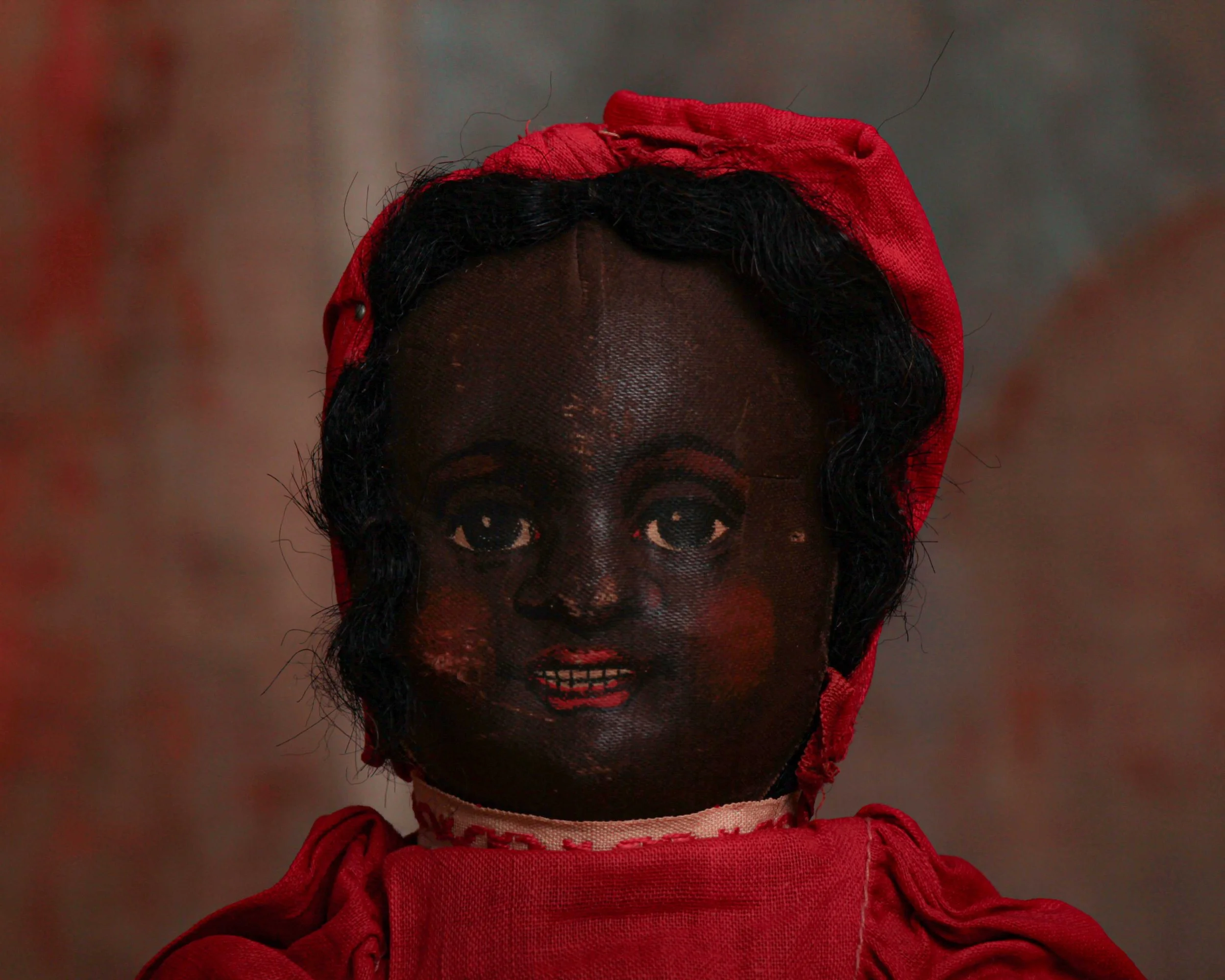
A classic topsy-turvy doll, thoughtfully constructed and quietly complex, designed to flip from one figure to the other with a simple turn of the skirt. Two personalities, one body, stitched together not as a trick, but as a reflection of the world it came from.
On one side, a young girl dressed in a red gingham dress with a softly gathered skirt and apron, her printed cotton face framed by a matching bonnet. Her expression is calm and steady, with delicately painted features that have mellowed beautifully over time. The fabric shows its age honestly, with gentle fading, soft wear, and the kind of surface texture that only comes from decades of handling.
Turn her upside down and the second figure is revealed, emerging from beneath the skirt like a secret kept in plain sight. This figure wears a red dress with puffed sleeves and a matching head covering, the face painted directly onto dark fabric, expressive and direct, with carefully rendered eyes and a small, knowing smile. The contrast between the two figures is striking, and intentionally so, but the craftsmanship remains consistent. Both sides are made with care, balance, and a surprising sense of dignity.
The construction is solid and well thought out. The stitching is sturdy, the proportions pleasing, the transformation seamless. When displayed, it feels sculptural, almost architectural, the skirts pooling naturally and concealing the hidden half until invited to reveal itself. It’s a doll meant to be interacted with, not just observed.
Historically, topsy-turvy dolls occupy a complicated space, blending folk art, childhood play, and social history into a single object.
Category History
The topsy-turvy doll is two dolls in one—flip it over and the character changes. Popular in the 19th century, it’s part toy, part ingenuity, with hidden skirts and dual identities stitched into a single form. Playful on the surface, it often carried deeper cultural and social narratives beneath.
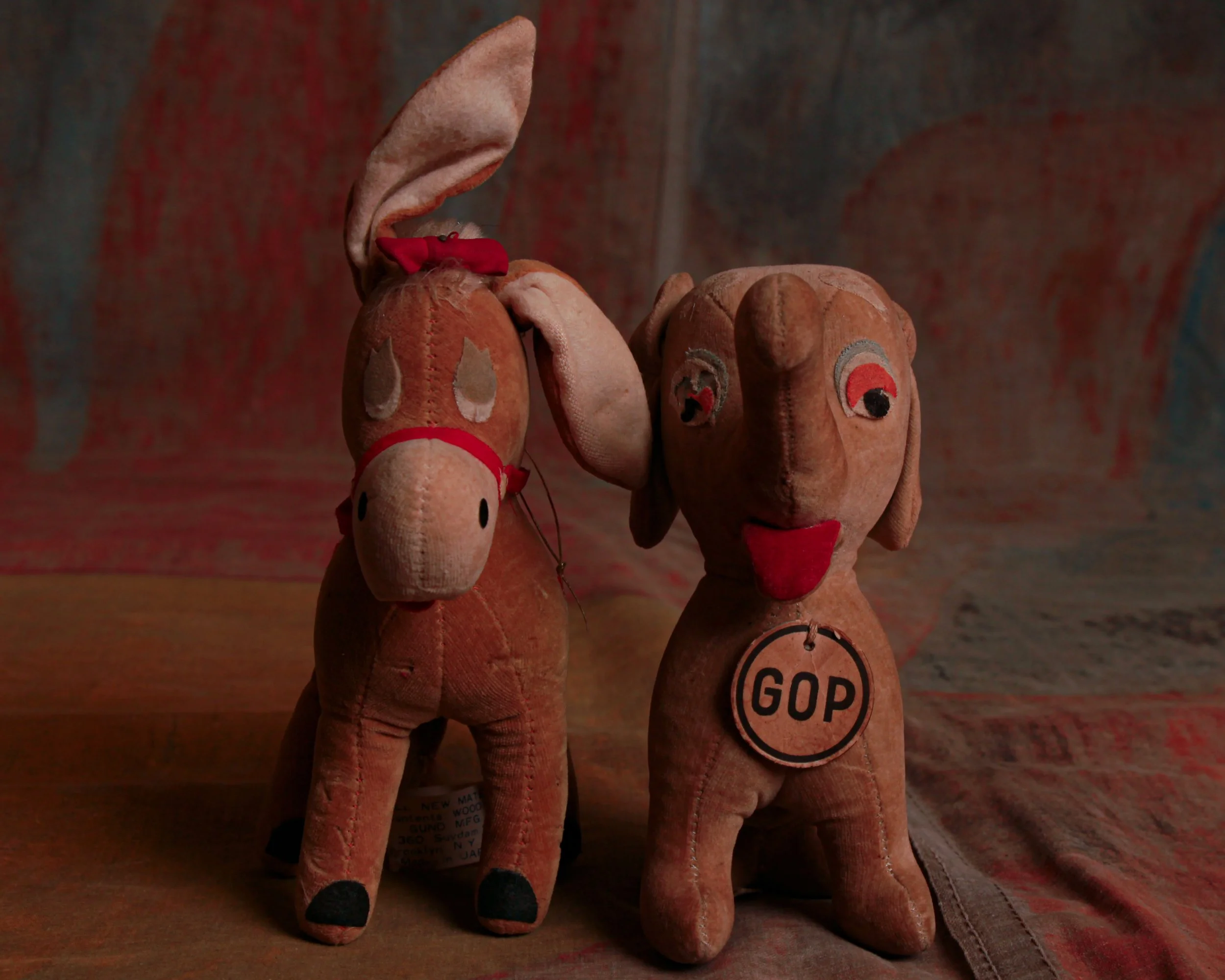
This pair feels like it wandered straight out of a 1940s campaign trail and never quite left. Two soft-spoken mascots of American politics, rendered not as firebrands but as slightly lopsided, endearing stuffed toys.
On one side you’ve got the Republican elephant, sturdy and upright, wearing a round “GOP” tag like a campaign button pinned just a little too earnestly to the chest. The expression is classic and calm, with those long ears and stitched features doing all the talking.
Standing beside it is the Democratic donkey, made by Gund and still proudly carrying its original manufacturing label. At some point, someone decided the message needed a little extra clarity and took a marker to its side, adding “DEM” by hand. It’s an unsanctioned update, and that’s exactly what makes it great. The felt eyes, red mouth, and slightly mischievous posture give it more personality than any printed slogan ever could.
Both are made from soft, velvety fabric with visible hand stitching, subtle wear, and the kind of patina that only comes from decades of handling. The donkey’s ears and trunk-like snout lean ever so slightly, while the elephant stands a bit more squarely.
Category History
The Republican elephant and Democratic donkey started less as official symbols and more as visual shorthand that stuck. The donkey gained traction in the 1820s when critics mocked Andrew Jackson as a “jackass”—a label he embraced. Decades later, Thomas Nast cemented both animals in the public imagination through his widely circulated cartoons in the late 19th century, pairing Democrats with the stubborn donkey and Republicans with a powerful, steady elephant.
Neither party formally adopted the animals at first, but repetition did the work. Over time, they became recognizable stand-ins—simple, graphic, and easy to read at a glance. Today, they function less as literal mascots and more as visual shorthand for identity and ideology.
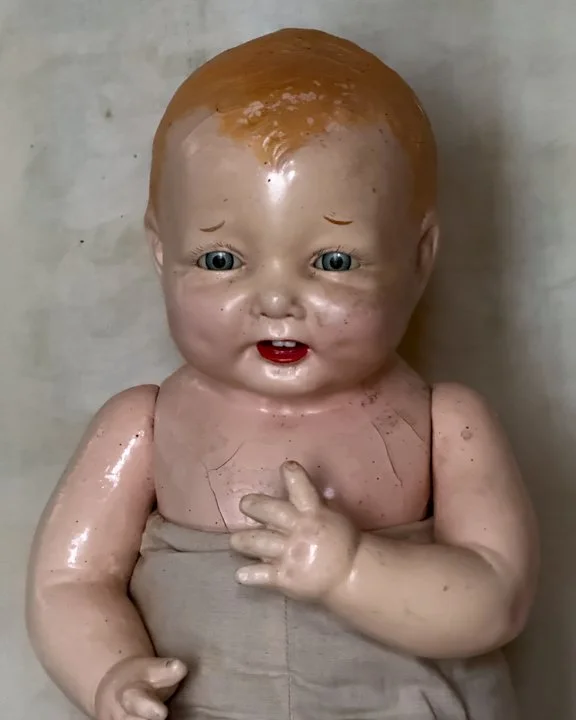
Meet Bubbles.
This is an antique Effanbee “Bubbles” composition baby doll, first introduced in 1924, and it’s one of those pieces that instantly explains why early character dolls were such a hit. Chubby, expressive, and full of charm, Bubbles was designed to feel more like a real baby than the stiff porcelain dolls that came before it, and nearly a century later, that intention still comes through loud and clear.
The head, arms, and legs are made from composition, that early 20th-century mix of sawdust and glue that allowed doll makers to sculpt softer, rounder features without the fragility of bisque. The result is a wonderfully plump form, complete with thick thighs, rounded cheeks, and tiny molded toes. The surface shows honest age in the form of fine crazing and wear, the kind that only comes from years of handling and play.
Bubbles’ face is where the personality really lives. Sleep eyes that open and close, a slightly open mouth, and painted molded hair give it a sweet, mildly curious expression that feels frozen mid-thought. The cloth torso is original to the design, stitched and softly stuffed.
Category History
Old dolls tend to outgrow their original purpose. Made from wood, cloth, composition, or early plastics, they were built to be handled—dressed, carried, occasionally forgotten, then found again. Styles shifted with the times, from simple handmade figures to more detailed factory-made examples with painted features and jointed limbs.
What makes them interesting now isn’t perfection, it’s what’s changed. Worn paint, loose stitching, repairs—each mark hints at how they were used and who they belonged to. Some feel sweet, others a little uncanny, depending on how time has treated them.
They sit somewhere between toy and portrait. Not quite lifelike, but close enough to hold a presence. Less about play now, more about memory and the quiet weight of time.
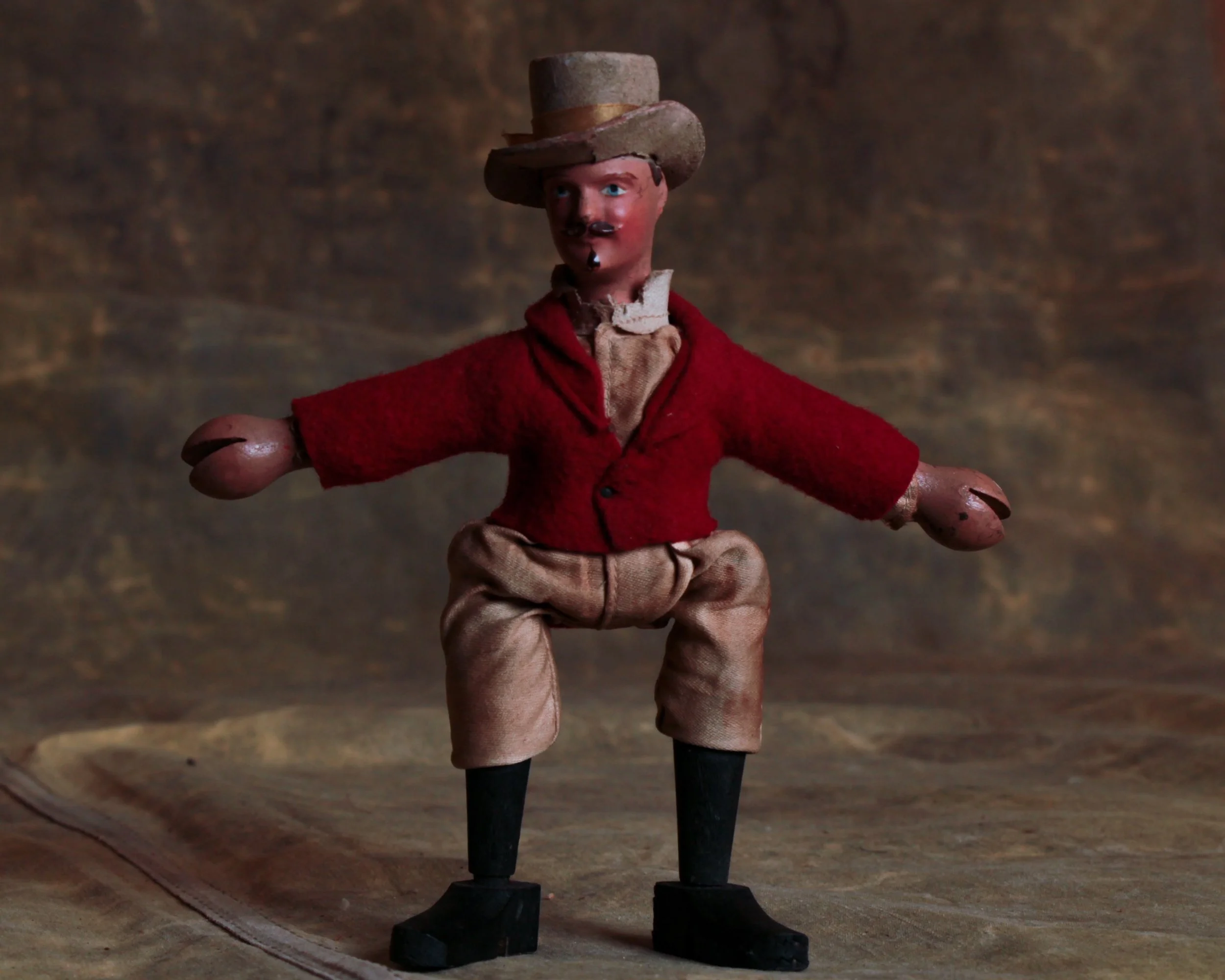
Early 20th-century Schoenhut Humpty Dumpty Circus ringmaster, complete with articulated wooden limbs, hand-painted details, and enough old-school charm to steal the whole show.
This dashing fellow is dressed to impress in a red wool felt jacket over a tan cotton shirt and matching breeches. A well-worn top hat (with just the right amount of tilt) tops off his painted mustache-and-goatee combo, giving him a look somewhere between ringmaster and rakish vaudevillian. His carved wooden hands—more like pincers, really—are posed wide open, ready to corral tigers, giraffes, or whatever chaos the big top demands.
Like most Schoenhut pieces, he’s jointed and posable, built with integrity and a real sense of play. His black-painted boots still have a firm stance, and there’s an earnestness to his bright blue eyes that suggests he’s been calling acts for over a century and still hasn’t lost his edge.
Category History
The Schoenhut Humpty Dumpty Circus is one of those early American toys that feels closer to a stage set than a plaything. Introduced in the early 1900s by the Schoenhut Piano Company of Philadelphia, it featured hand-carved wooden figures with jointed limbs, dressed in bright costumes and built to perform. Clowns, acrobats, animals—all arranged around a miniature circus ring that invited kids to direct the show.
The name “Humpty Dumpty” comes from the unique construction. Instead of fragile stringing, the figures used elastic cording threaded through wooden joints, allowing them to be posed and handled without easily falling apart. It was a smart bit of engineering that made the set durable enough for real play.
What stands out now is the balance between craftsmanship and imagination. Each figure carries a slightly naive, hand-painted quality, full of character. These weren’t just toys—they were portable performances, ready to be rearranged, restaged, and brought to life over and over again.
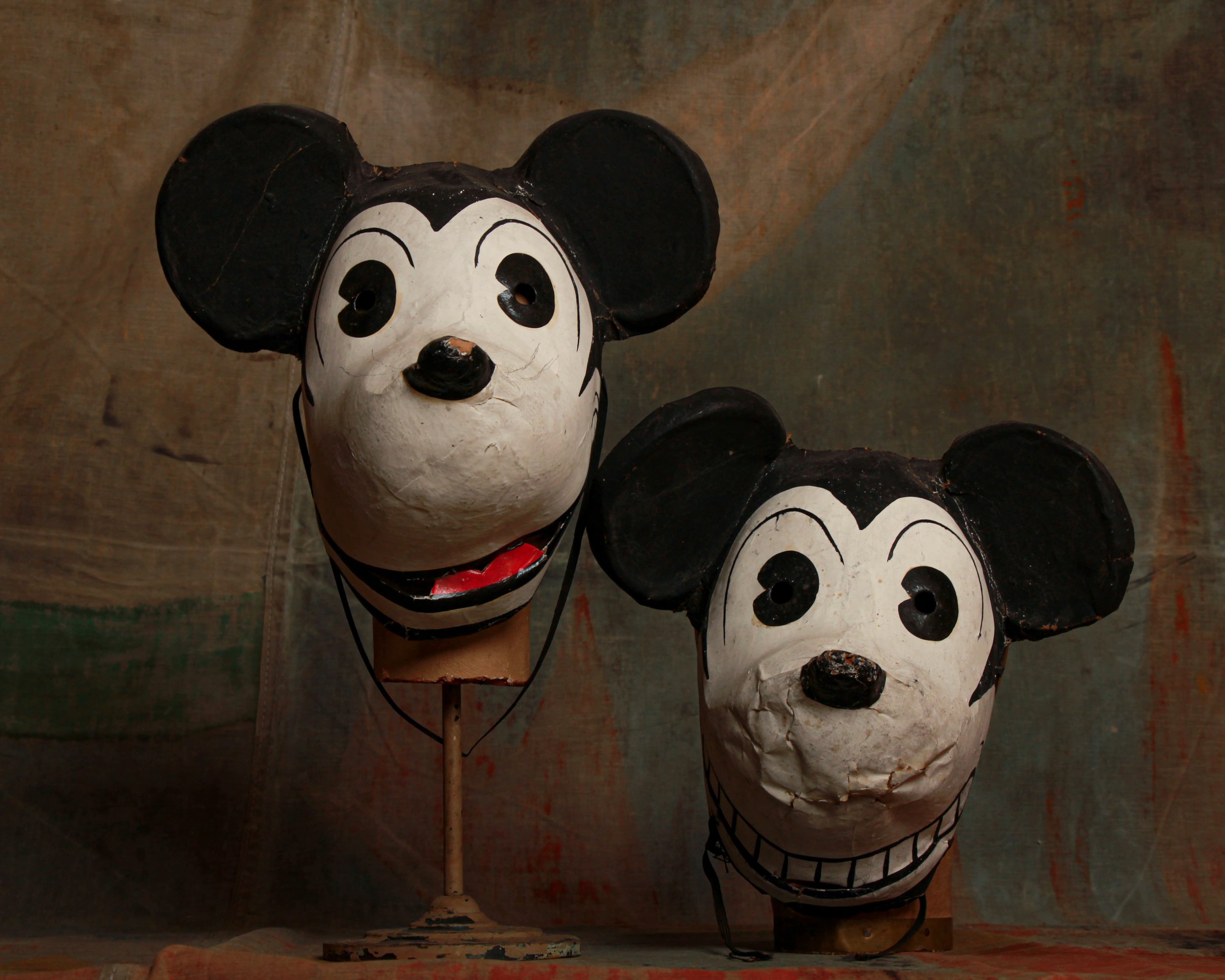
Golly! Just imagine these Mickey Mouse masks from the 1930s bringing joy and wonder to the early days of the Mickey Mouse Club. Made in Germany, these paper mache masks were most likely worn at exciting movie screenings and special club events. Sure, they’ve got a few dents, small tears, and minor repairs, but that’s just part of their magical journey through time! Each mask measures W 11” x D 6.5” x H 10” and is brimming with history and Disney spirit. Stand not included.
Category History
The Mickey Mouse Club started in 1955 as a television show, but it quickly turned into something bigger—a daily ritual for a generation of kids. Produced by Walt Disney Productions and built around the growing reach of television, it blended variety show energy with a sense of belonging. The Mouseketeers—kids just a little older than the audience—sang, danced, acted in serialized adventures, and made it all feel accessible.
What set it apart was structure. Each day had its theme—music, guest stars, serials—and the now-iconic roll call and ear hats gave it a rhythm that stuck. It wasn’t just entertainment; it was branding in real time. The show created a world kids could step into, whether through merchandise, fan clubs, or simply learning the songs.
At its core, it captured a postwar moment when television was becoming the center of the home. Clean-cut, optimistic, and tightly produced, it reflected the tone of the era while quietly shaping youth culture and marketing strategies for decades to come.
The Club has been revived multiple times since, but the original run holds a certain clarity—simple, direct, and endlessly catchy. A clubhouse that existed on a screen, but felt like a place you could join.
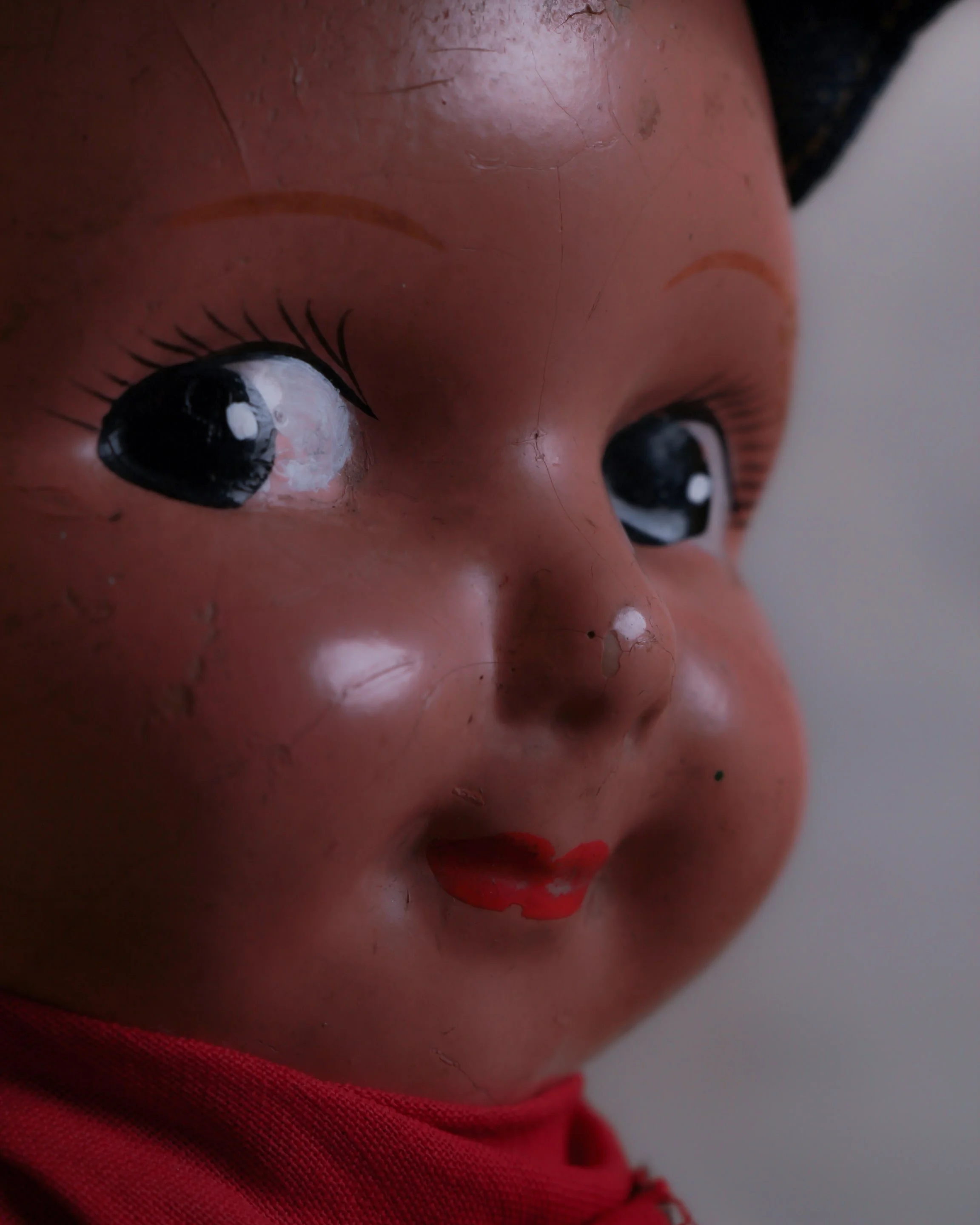
Meet the original denim influencer: a 1920s Buddy Lee composition advertising doll decked out in full Union Made Lee overalls, complete with embossed copper buttons, red neckerchief, and matching denim engineer cap. At just under 14 inches tall, he may be pint-sized, but he’s dressed to union-spec perfection. These dolls were originally made as store displays, helping Lee jeans market their workwear, and this little guy still delivers plenty of charm nearly a century later.
The painted composition face is all rosy cheeks, sly smile, and side-eye confidence—like he knows he's the best-dressed doll on the shelf. His hands show signs of wear, and the top of his head has a patch where the original paint has flaked off—visible when the hat is removed, but totally hidden when he’s dressed. The denim is original and in great condition, with that unmistakable old-school Lee label stitched right across the back.
Category History
Buddy Lee dolls first appeared in the early 1920s as pint-sized pitchmen for the H.D. Lee Company, a Kansas workwear brand built on durability and no-nonsense design. Instead of glossy ads, Lee put their product in people’s hands—literally—through these small, dressed-to-the-nines figures wearing miniature versions of their overalls, jackets, and uniforms.
The earliest examples were made of composition, a mix of sawdust and glue pressed into molds, giving them a solid, slightly textured feel. They were meant for store counters, not toy chests—handled often, picked up, examined, and remembered. That wear you see today—fine cracks, softened paint—isn’t a flaw, it’s proof they did their job.
What makes them interesting is how they blur the line between advertising and object. They’re equal parts salesman’s sample, display piece, and cultural snapshot of American labor at the time. Later versions moved into plastic, but the 1920s composition dolls carry a warmth—and a bit more soul—that’s hard to fake.
There is more to explore. Browse the full collection.
Frequently Asked Questions
-
Antique toys are generally considered to be playthings that are over one hundred years old, typically produced during the nineteenth or early twentieth century. This includes hand-carved folk toys, painted wooden figures, early tin toys and other objects made using traditional craft techniques before the advent of mass production.
-
This collection includes folk toys and colonial toys made by hand from wood and natural materials, early 20th century toys produced from tin and cloth, and collectible antique toys spanning a range of subjects including figures, animals and domestic objects. Each piece reflects the craft traditions and play culture of its period.
-
Historical folk toys are playthings made outside of commercial manufacturing, typically by local craftspeople or within family traditions. They were produced using available materials and reflect regional craft practices. Today they are valued by collectors for their handmade character, historical significance and the direct connection they offer to everyday life in earlier centuries.
-
Early 20th century toys represent a transitional period in manufacturing, when traditional craft techniques began to give way to industrial production. Toys from this period are valued for their quality of materials, individual character and historical context. Many were made in limited quantities and have survived in small numbers, making them increasingly rare finds.
-
Antique toys and vintage collectibles are best stored away from direct sunlight and humidity to preserve their original materials and finishes. Many collectors display them in cases or on open shelving as objects of historical interest, alongside other antique collectibles that reflect a similar period or craft tradition.
This 1939 Pinocchio figure was made by the Ideal Novelty & Toy Co. and has all the wonderfully odd character you want from an early Disney toy. Constructed from a mix of composition and wood, he has jointed arms and legs, oversized hands and feet, a molded head with big blue eyes and that unmistakable long nose, plus his red-painted outfit, fabric bow, and felt hat with feather. The hat is especially nice to see, since it is often missing on surviving examples.
There is plenty of honest age throughout, including crazing, paint loss, surface wear, small cracks, and general handling marks. Rather than hurting the piece, it gives him the right kind of lived-in look for a toy that is now well over 80 years old. The partial Ideal Novelty & Toy Co. label is still visible on the body.
Pinocchio was already a well-known literary character long before Disney got hold of him. Carlo Collodi’s story first appeared in serialized form in Italy in the early 1880s, but Walt Disney’s animated adaptation, released in 1940, is what turned Pinocchio into a permanent pop-culture figure. Production on the film had been underway for years, and licensed toys began appearing around the time of its release.
Ideal Novelty & Toy Co., founded in New York in the early 20th century, became one of America’s major toy manufacturers. The company was particularly important in the development of character dolls and licensed figures, using materials such as composition, wood, cloth, and later plastics.
Early Disney character toys like this sit right at the intersection of animation history and American toy making. They were produced before character merchandising became the enormous industry it is today, and their handmade-looking construction gives them a personality later mass-produced toys rarely have. Pinocchio feels especially fitting in this form, being a wooden puppet translated back into an actual jointed toy.