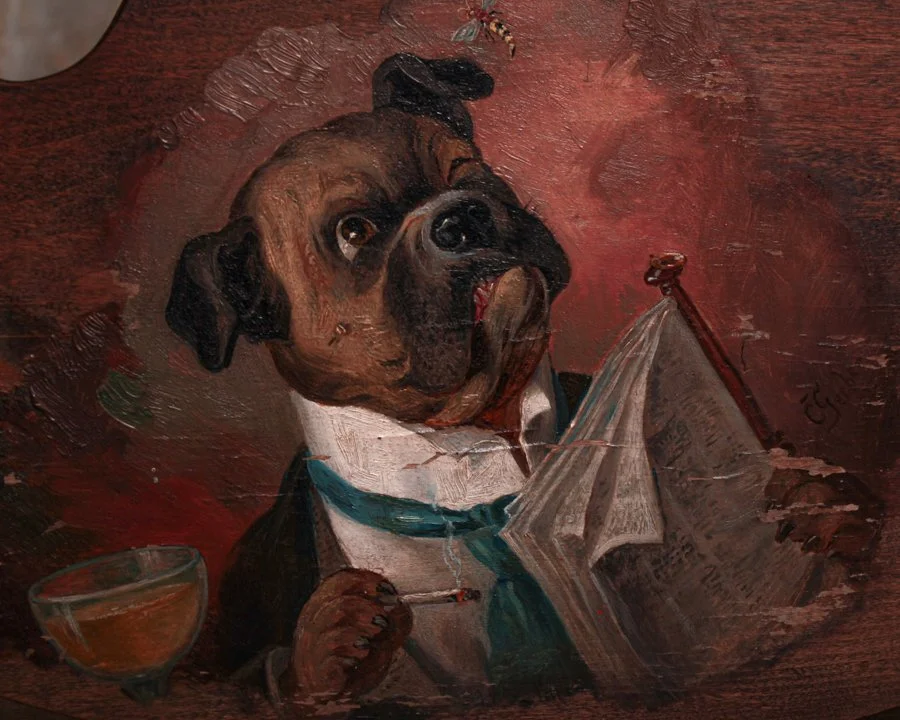
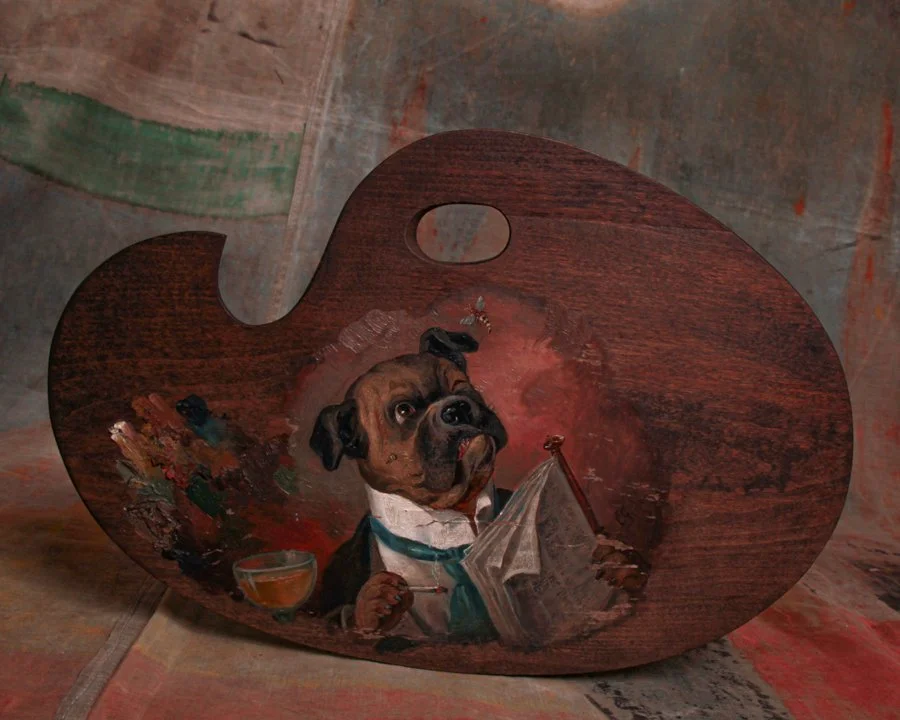
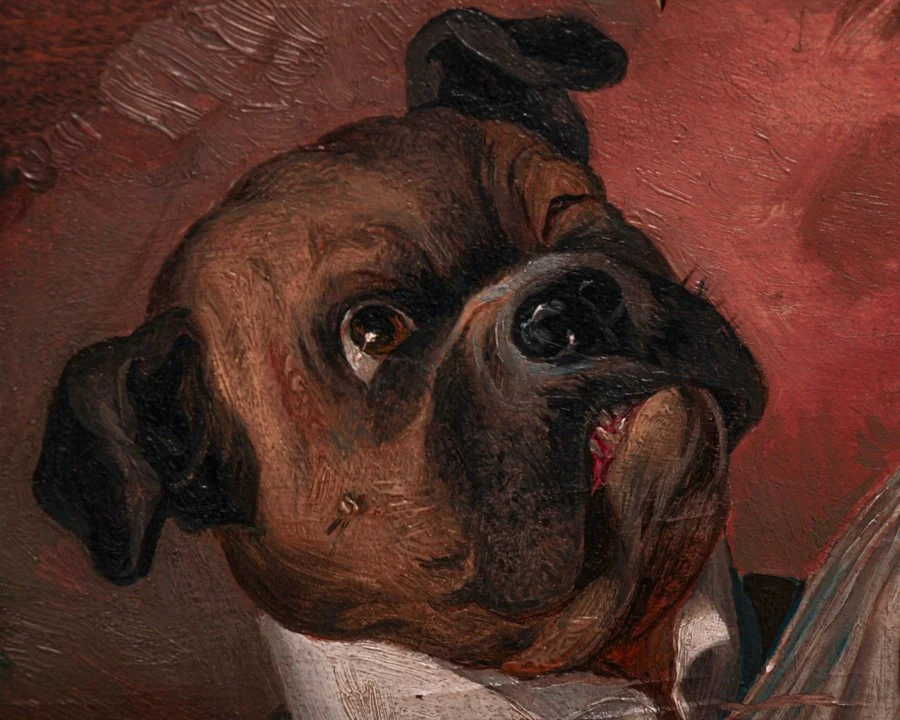
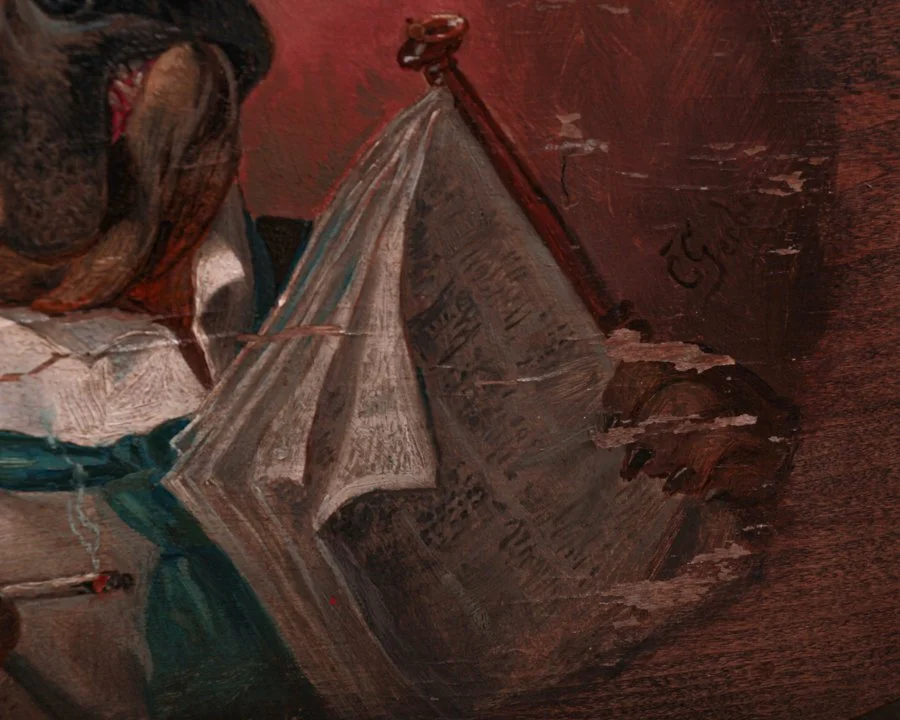
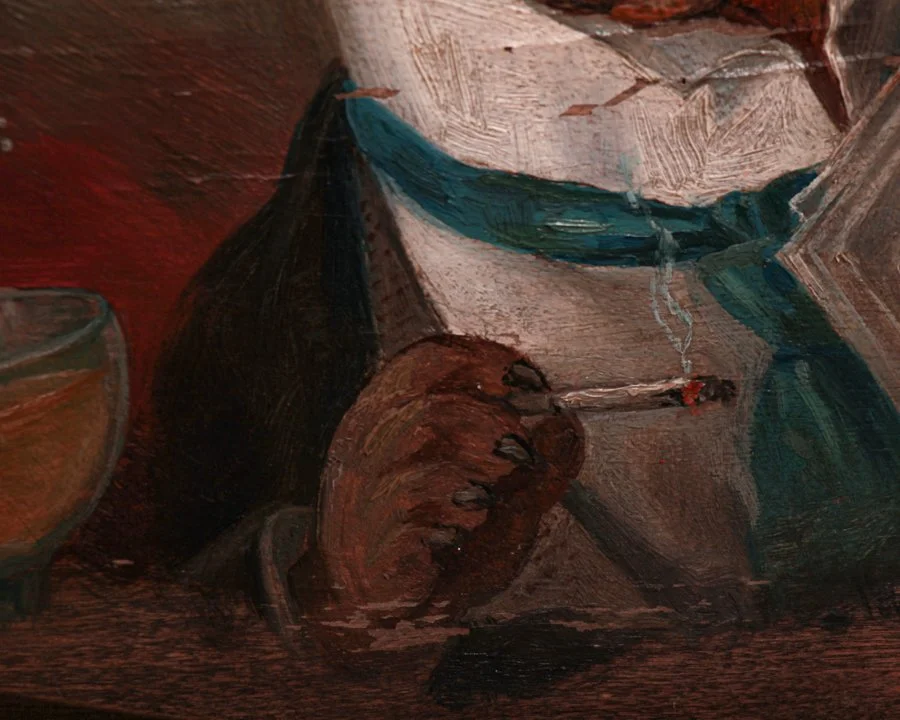
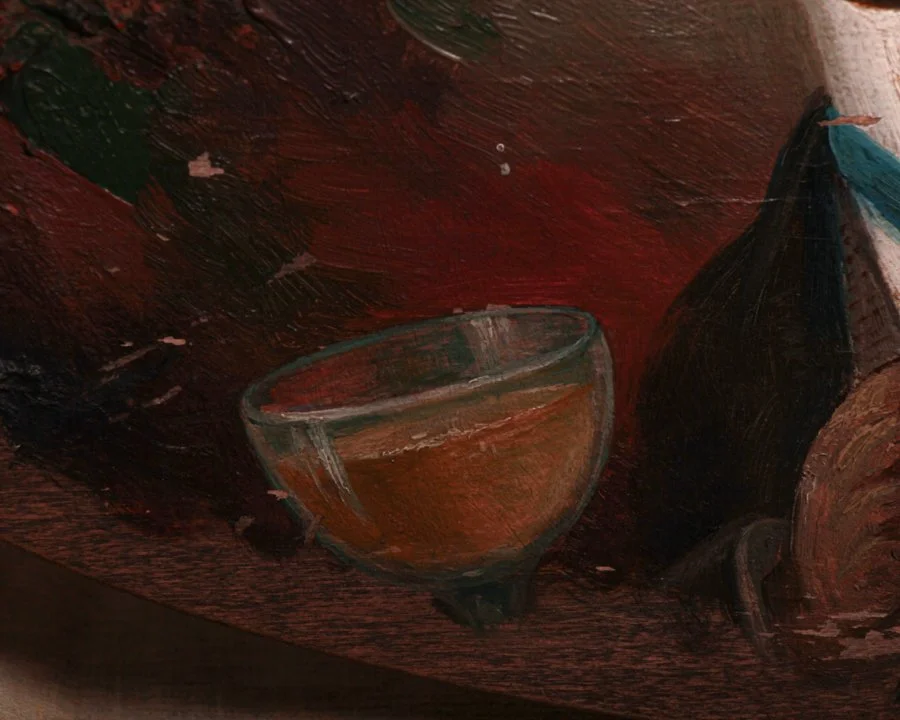
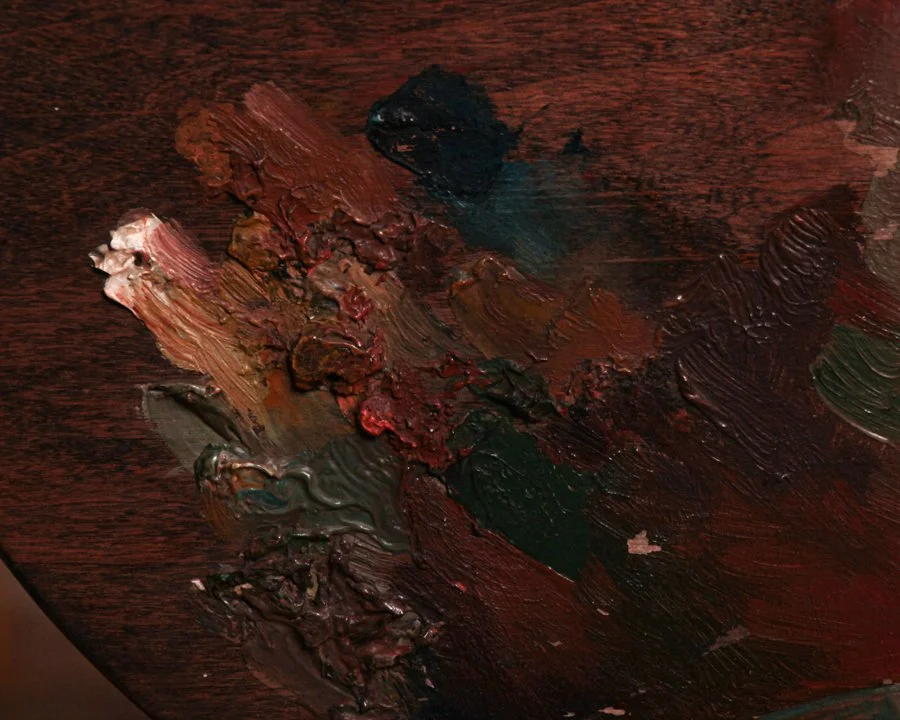
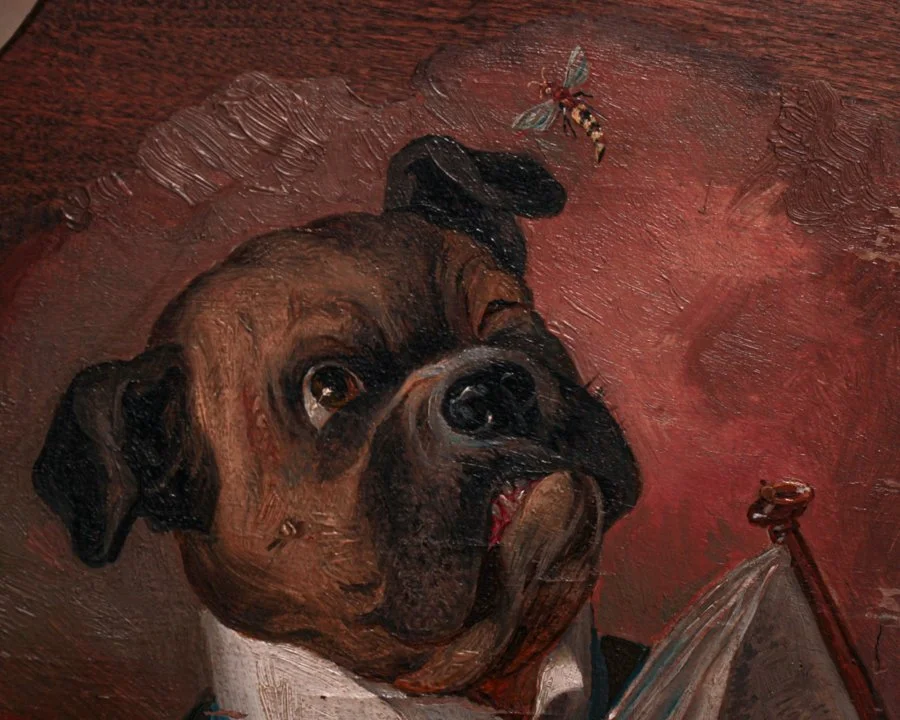
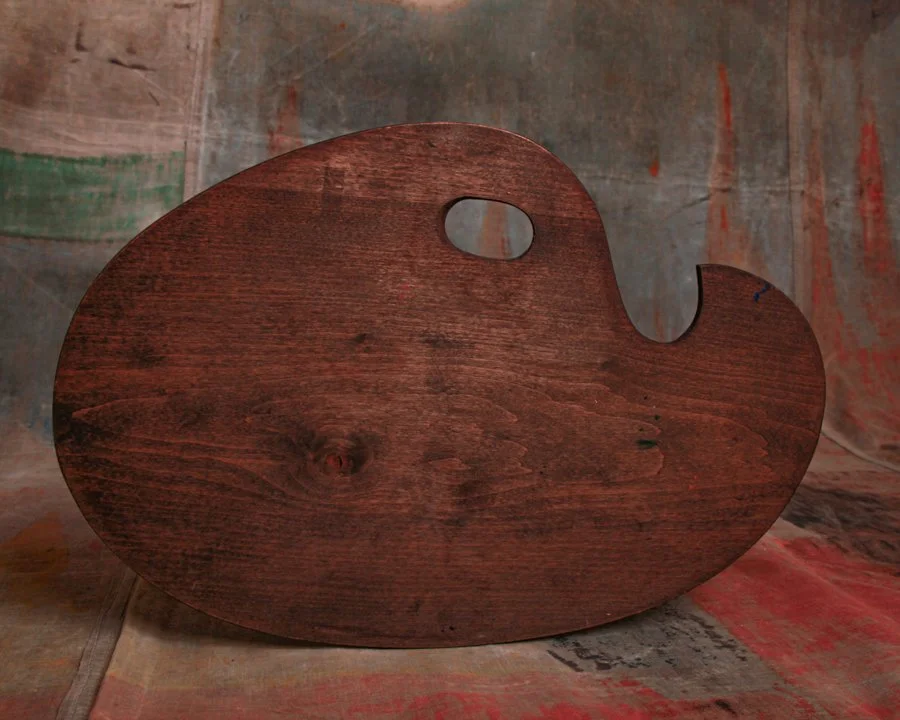
Painted around 1860 by German artist Carl Gerber, this unusual piece takes an actual wooden painter’s palette and turns it into a charmingly absurd little scene: a bulldog, dressed to the nines in white collar and cravat, is caught mid-moment reading the paper, cocktail in one paw and cigarette in the other, all while side-eyeing a curious bee buzzing just above his head. Original oil dabs and thick brushstrokes still smear one side, reminding you this was once a working tool—not just a canvas for whimsy.
There’s a playful irreverence here, where fine painting meets humor, turning an everyday studio object into something unexpectedly narrative and full of personality.
Category History
Oil paintings on artists’ palettes sit in that strange, compelling overlap between tool and artwork. The palette starts as a working surface—wood, glass, or board—where paint is mixed, adjusted, and tested before it ever reaches the canvas. Over time, layers build up. Colors are pushed together, scraped back, left to dry, then painted over again, creating a surface that records the artist’s decisions in real time.
Occasionally, that surface becomes too interesting to ignore. Some artists would lean into it, turning the palette itself into a finished piece—either by shaping the existing paint into an image or by intentionally painting over the built-up ground. Others left them as they were, accidental abstractions formed through use.
What makes these objects stand out is that they carry both process and result. You’re not just seeing a composition—you’re seeing the leftovers, the transitions, the moments where color shifted or didn’t quite work. The edge of a portrait might sit next to a smear of something entirely unrelated.
They’re intimate in a way traditional paintings aren’t. Less formal, more immediate. A palette painting doesn’t separate the act of making from the final image—it folds them together, leaving the whole conversation visible.
Painted around 1860 by German artist Carl Gerber, this unusual piece takes an actual wooden painter’s palette and turns it into a charmingly absurd little scene: a bulldog, dressed to the nines in white collar and cravat, is caught mid-moment reading the paper, cocktail in one paw and cigarette in the other, all while side-eyeing a curious bee buzzing just above his head. Original oil dabs and thick brushstrokes still smear one side, reminding you this was once a working tool—not just a canvas for whimsy.
There’s a playful irreverence here, where fine painting meets humor, turning an everyday studio object into something unexpectedly narrative and full of personality.
Category History
Oil paintings on artists’ palettes sit in that strange, compelling overlap between tool and artwork. The palette starts as a working surface—wood, glass, or board—where paint is mixed, adjusted, and tested before it ever reaches the canvas. Over time, layers build up. Colors are pushed together, scraped back, left to dry, then painted over again, creating a surface that records the artist’s decisions in real time.
Occasionally, that surface becomes too interesting to ignore. Some artists would lean into it, turning the palette itself into a finished piece—either by shaping the existing paint into an image or by intentionally painting over the built-up ground. Others left them as they were, accidental abstractions formed through use.
What makes these objects stand out is that they carry both process and result. You’re not just seeing a composition—you’re seeing the leftovers, the transitions, the moments where color shifted or didn’t quite work. The edge of a portrait might sit next to a smear of something entirely unrelated.
They’re intimate in a way traditional paintings aren’t. Less formal, more immediate. A palette painting doesn’t separate the act of making from the final image—it folds them together, leaving the whole conversation visible.