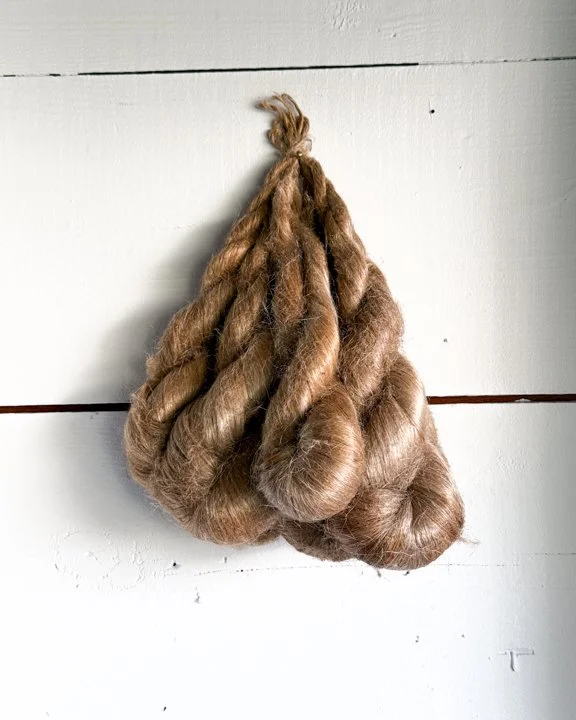
This bundle of unspun flax stricks sit in undisturbed condition, tied up just as it would have been more than a century ago, waiting patiently for the spinning wheel. The glossy, straw-colored fibers twist together in soft, rope-like strands, catching the light with a sheen that reminds you flax once rivaled silk for its luster. Before it became linen sheets, shirts, or tablecloths, flax looked exactly like this—raw, earthy, and full of potential. Circa late 19th century.
Category History
Unspun flax stricks are the starting point of linen—raw, slightly unruly, and full of potential. Before thread, before fabric, there’s this bundle of long, combed fibers tied near the top and left to hang loose. In the 18th and 19th centuries, these stricks would be dressed onto a distaff, positioned beside a spinning wheel, ready to be drawn out by hand and twisted into yarn.
Getting flax to this stage was already a process. Stalks were harvested, retted to loosen the fibers, then broken, scutched, and hackled to separate the long, usable strands from the rest. What remains in a strick is the best of it—smooth, strong, and capable of producing fine linen if handled with care.
What’s compelling is how tactile it is. The fibers catch light, shifting from pale gold to silvery gray, and they move just enough to remind you they’re still close to the plant they came from. Spinning required rhythm and control—drawing a consistent thickness, adding twist, building thread from something that barely holds together on its own.
Today, a flax strick reads almost sculpturally, but it carries the memory of labor. Every bundle represents hours of preparation, waiting, and skill—textile making in its most direct, hands-on form.
This bundle of unspun flax stricks sit in undisturbed condition, tied up just as it would have been more than a century ago, waiting patiently for the spinning wheel. The glossy, straw-colored fibers twist together in soft, rope-like strands, catching the light with a sheen that reminds you flax once rivaled silk for its luster. Before it became linen sheets, shirts, or tablecloths, flax looked exactly like this—raw, earthy, and full of potential. Circa late 19th century.
Category History
Unspun flax stricks are the starting point of linen—raw, slightly unruly, and full of potential. Before thread, before fabric, there’s this bundle of long, combed fibers tied near the top and left to hang loose. In the 18th and 19th centuries, these stricks would be dressed onto a distaff, positioned beside a spinning wheel, ready to be drawn out by hand and twisted into yarn.
Getting flax to this stage was already a process. Stalks were harvested, retted to loosen the fibers, then broken, scutched, and hackled to separate the long, usable strands from the rest. What remains in a strick is the best of it—smooth, strong, and capable of producing fine linen if handled with care.
What’s compelling is how tactile it is. The fibers catch light, shifting from pale gold to silvery gray, and they move just enough to remind you they’re still close to the plant they came from. Spinning required rhythm and control—drawing a consistent thickness, adding twist, building thread from something that barely holds together on its own.
Today, a flax strick reads almost sculpturally, but it carries the memory of labor. Every bundle represents hours of preparation, waiting, and skill—textile making in its most direct, hands-on form.