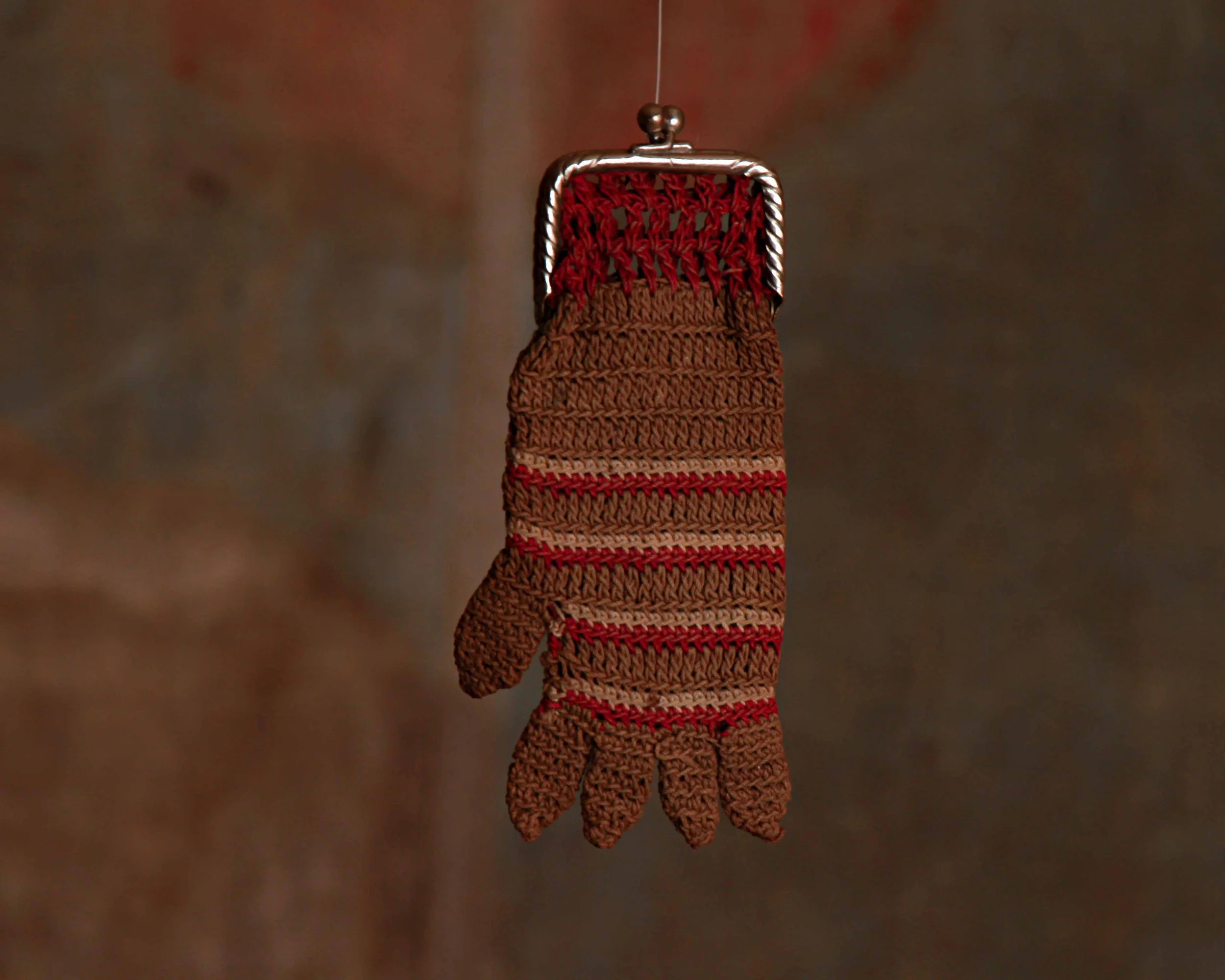
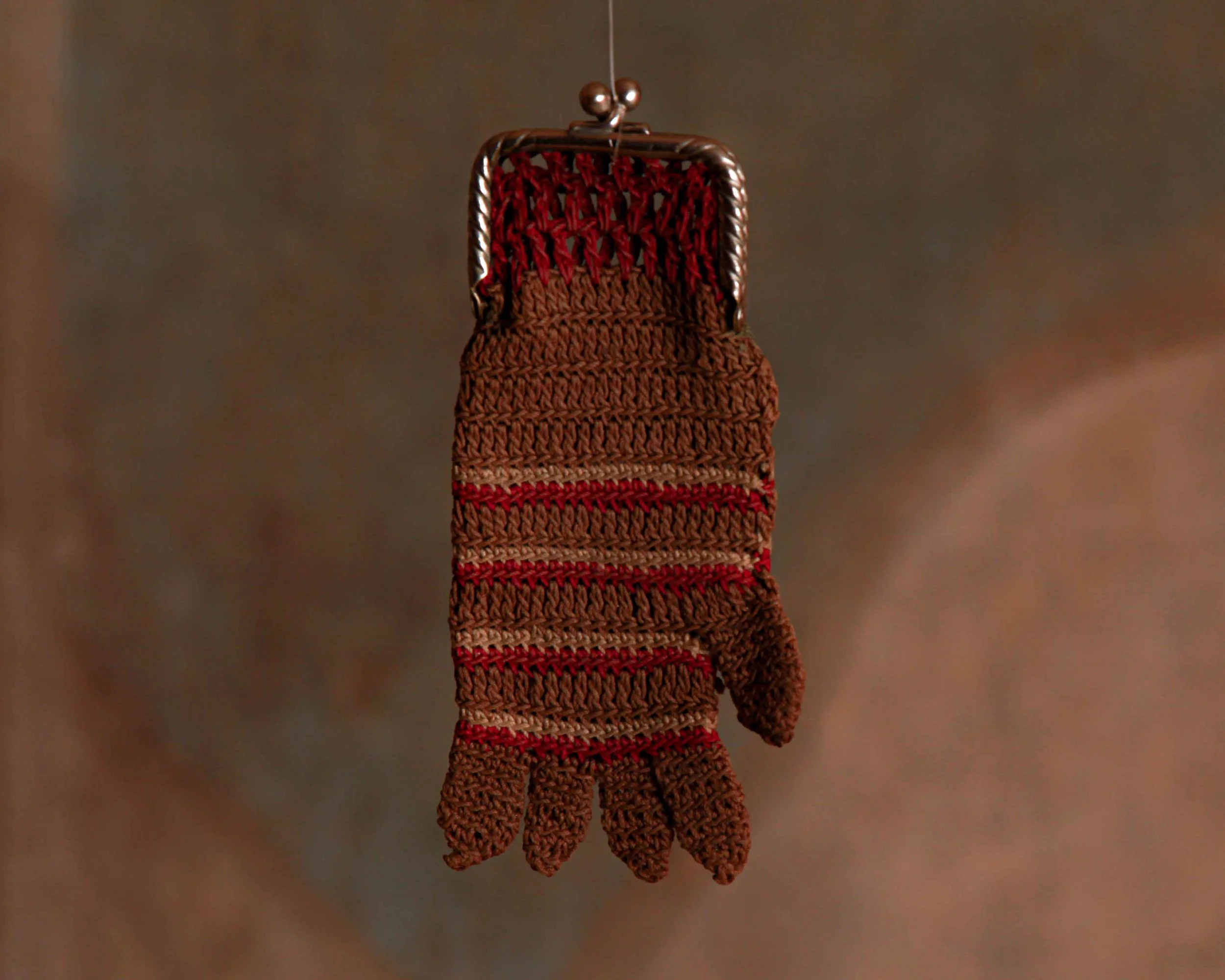
An early 20th century mini crochet purse made in the unmistakable shape of a glove, scaled down to a perfectly impractical, completely charming size. Measuring roughly 5 inches by 2 inches, it’s just big enough to hold a few coins, a small secret, or absolutely nothing of consequence.
The crochet work is tight and deliberate, at the top sits a silver-tone metal frame with a kiss-lock closure, adding a bit of sparkle and structure to the soft, handmade body below. The contrast between metal and yarn feels very of its time, when even novelty objects were expected to be thoughtfully finished.
Category History
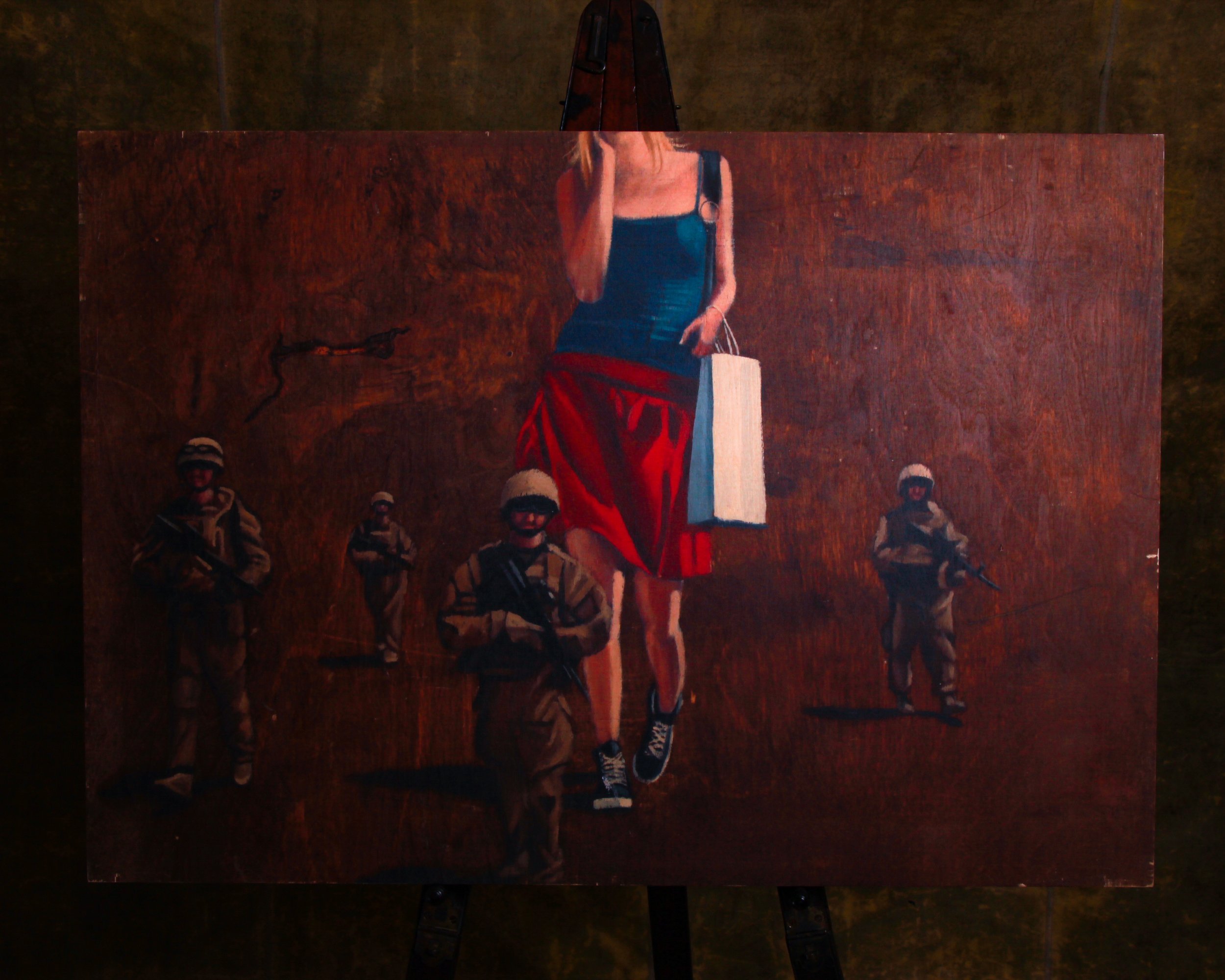
Folk art lives in that space where making isn’t about fitting into an art world—it’s about expressing something directly, often with whatever is at hand. It’s shaped by necessity, tradition, and instinct rather than formal training. You see it in carved figures, painted signs, stitched textiles, weathervanes, toys—objects that were sometimes made to be useful, sometimes just because someone felt like making them.
What sets folk art apart is its independence. Proportion might bend, perspective might flatten, colors might lean bold or unexpected—but it all works because it’s guided by the maker’s eye, not a rulebook. There’s often a strong sense of place, too. Materials and motifs reflect where it was made, whether that’s rural, coastal, urban, or somewhere in between.
Many pieces carry a kind of quiet storytelling. A carved animal that feels more like a memory than a specimen, a painted scene that captures an event or daily life without worrying about precision. Imperfections aren’t flaws—they’re part of the language.
Over time, these objects shift from everyday use into something more reflective. What was once a tool or decoration becomes a record of how someone saw the world and chose to shape it. Folk art doesn’t try to impress—it connects, directly and without much explanation.
An early 20th century mini crochet purse made in the unmistakable shape of a glove, scaled down to a perfectly impractical, completely charming size. Measuring roughly 5 inches by 2 inches, it’s just big enough to hold a few coins, a small secret, or absolutely nothing of consequence.
The crochet work is tight and deliberate, at the top sits a silver-tone metal frame with a kiss-lock closure, adding a bit of sparkle and structure to the soft, handmade body below. The contrast between metal and yarn feels very of its time, when even novelty objects were expected to be thoughtfully finished.
Category History
Folk art lives in that space where making isn’t about fitting into an art world—it’s about expressing something directly, often with whatever is at hand. It’s shaped by necessity, tradition, and instinct rather than formal training. You see it in carved figures, painted signs, stitched textiles, weathervanes, toys—objects that were sometimes made to be useful, sometimes just because someone felt like making them.
What sets folk art apart is its independence. Proportion might bend, perspective might flatten, colors might lean bold or unexpected—but it all works because it’s guided by the maker’s eye, not a rulebook. There’s often a strong sense of place, too. Materials and motifs reflect where it was made, whether that’s rural, coastal, urban, or somewhere in between.
Many pieces carry a kind of quiet storytelling. A carved animal that feels more like a memory than a specimen, a painted scene that captures an event or daily life without worrying about precision. Imperfections aren’t flaws—they’re part of the language.
Over time, these objects shift from everyday use into something more reflective. What was once a tool or decoration becomes a record of how someone saw the world and chose to shape it. Folk art doesn’t try to impress—it connects, directly and without much explanation.