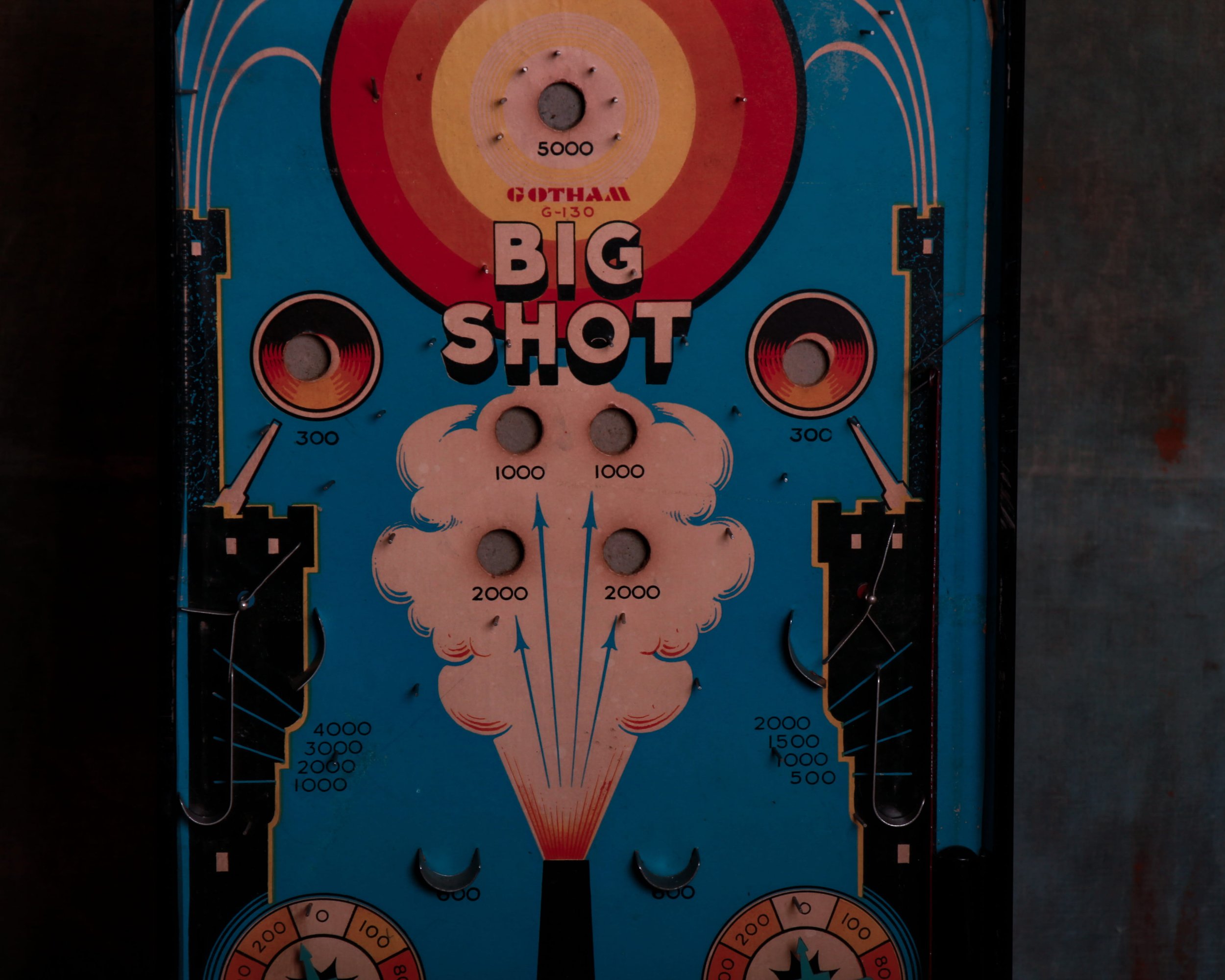
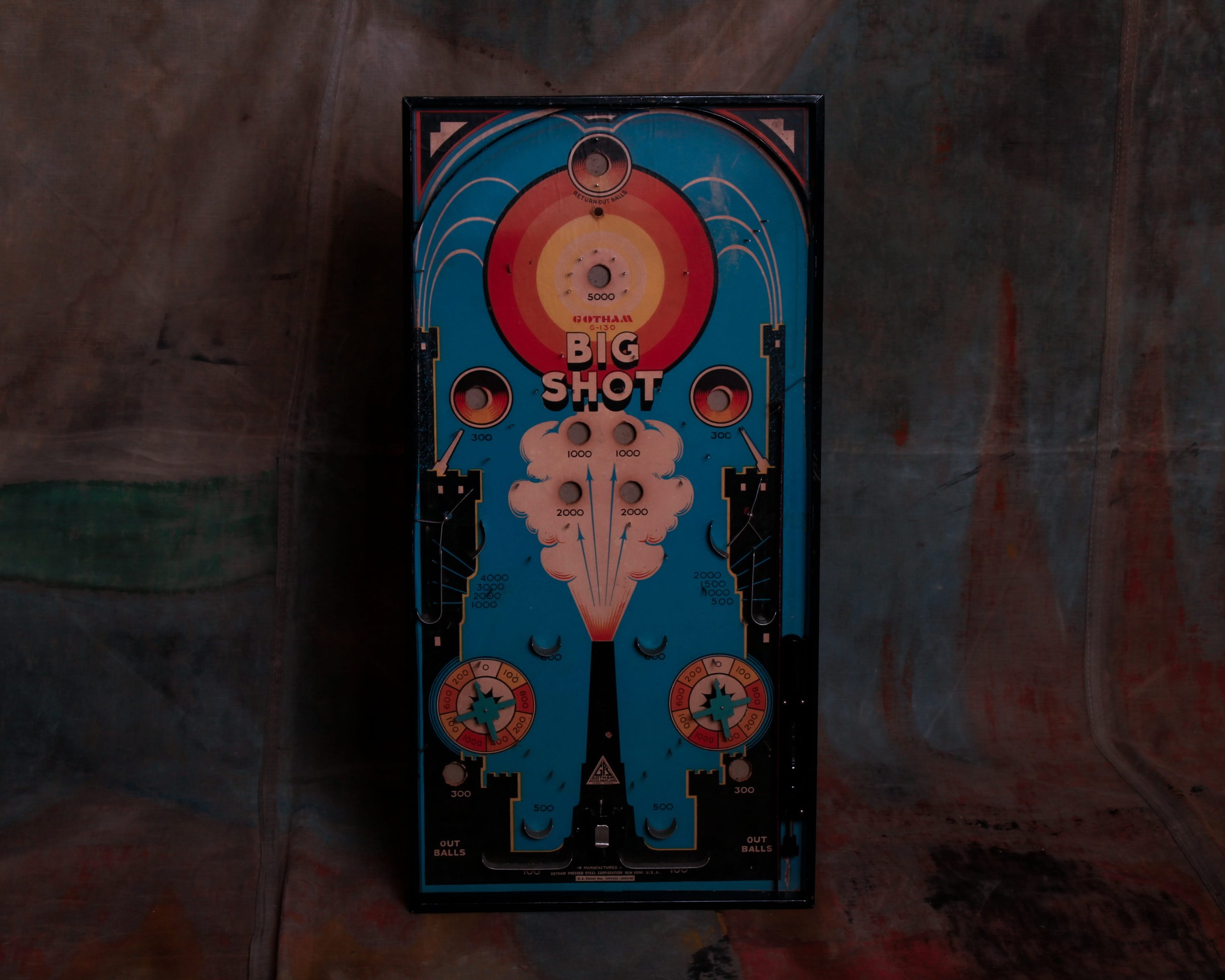
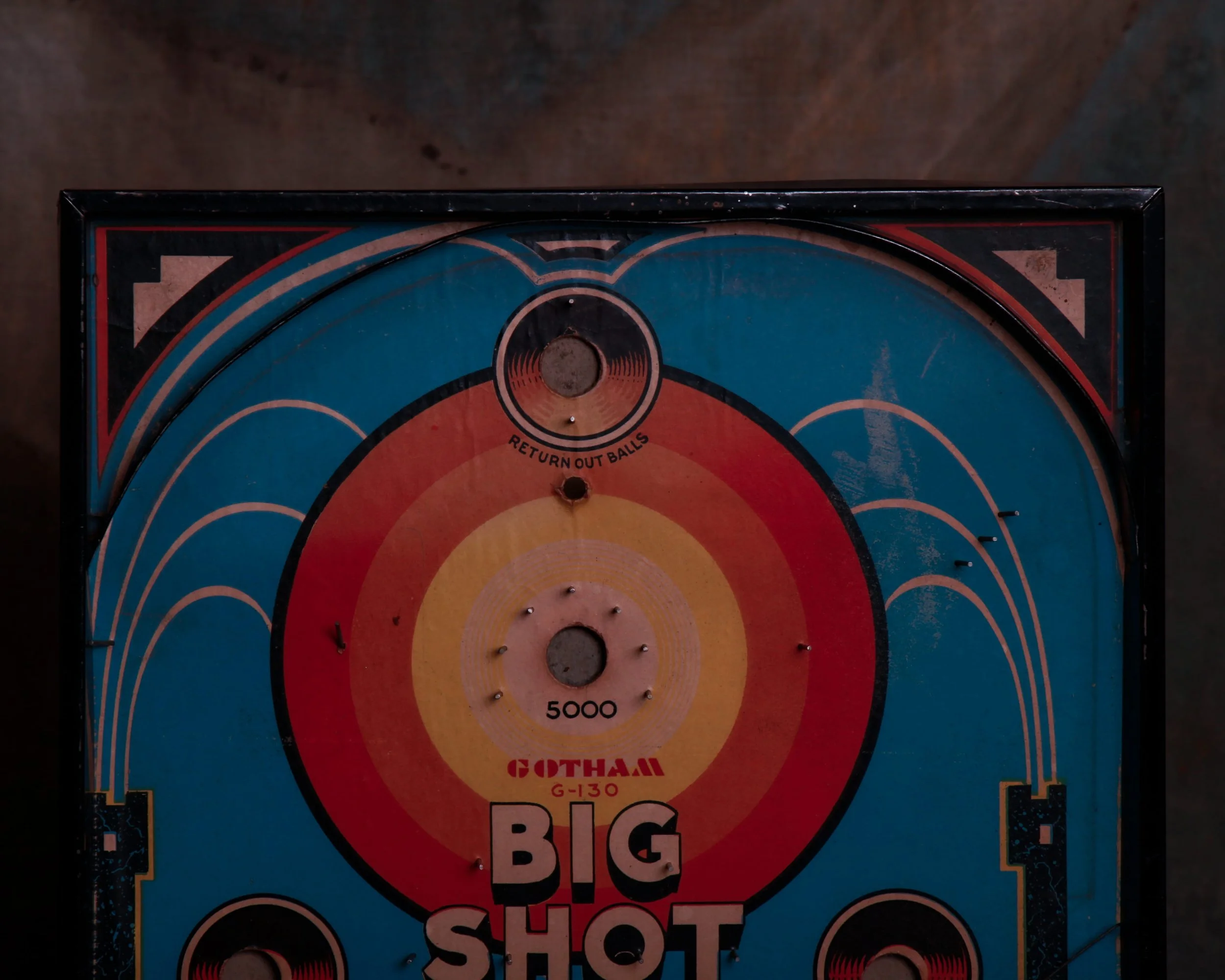
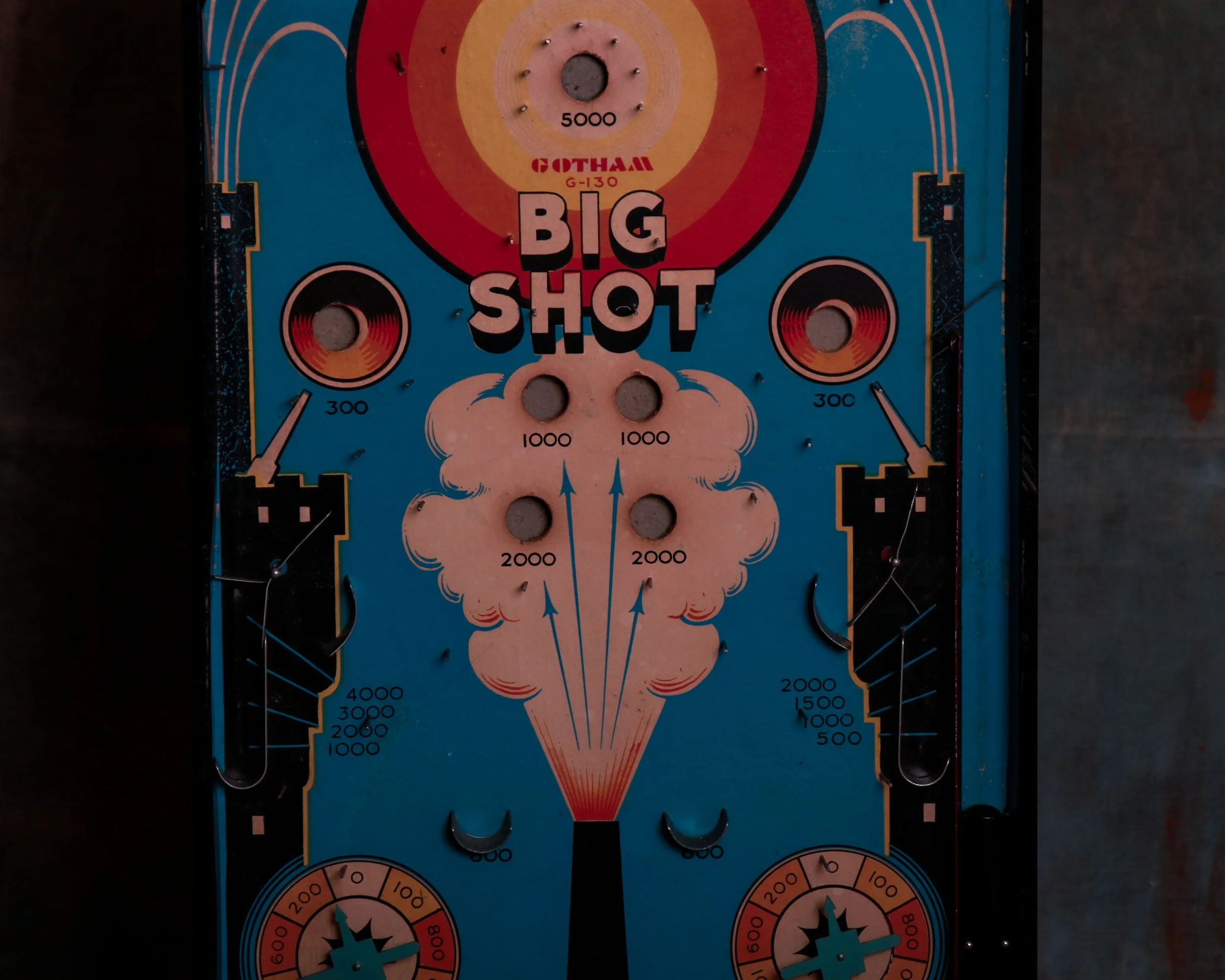
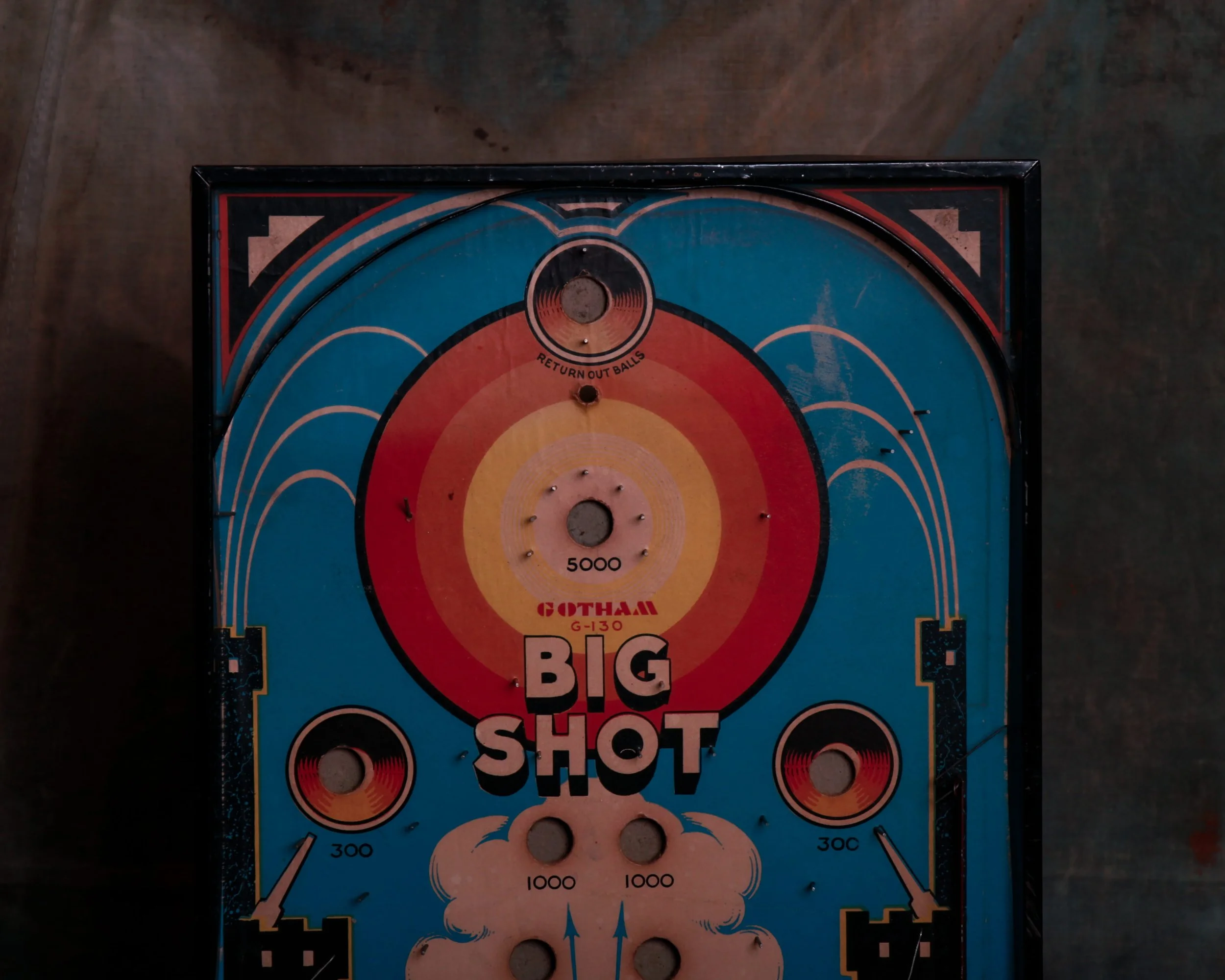
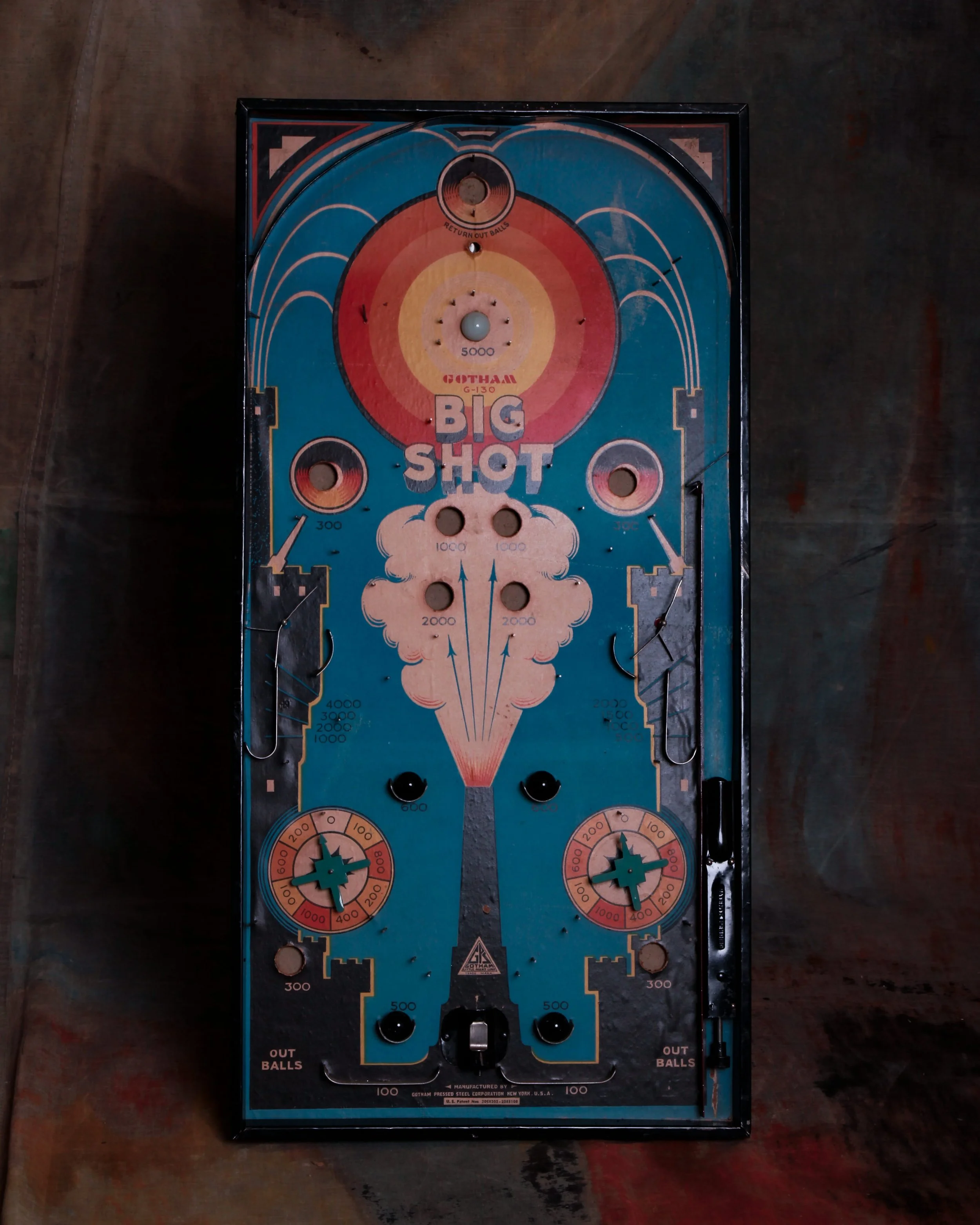
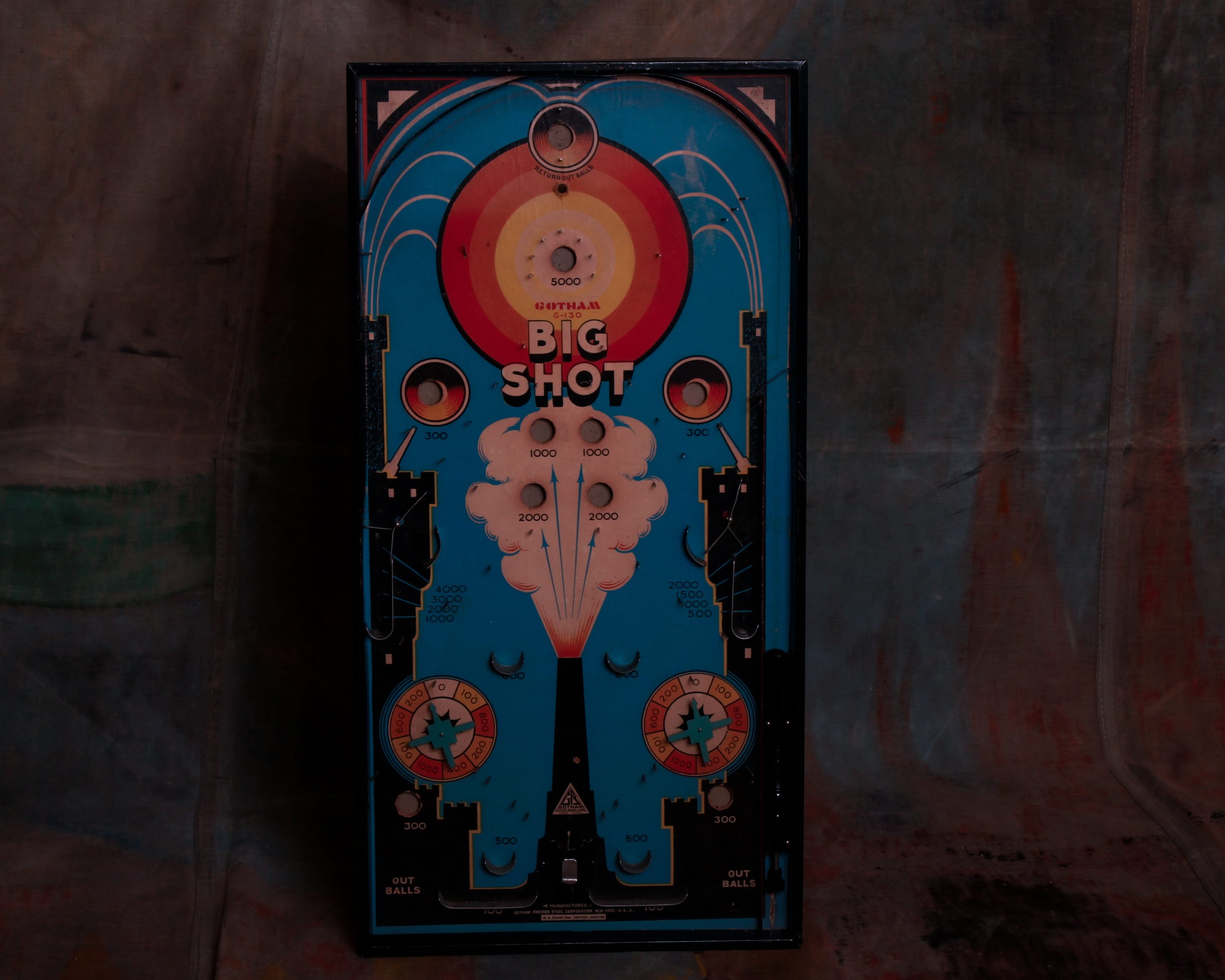
There’s something wonderfully theatrical about this 1937 Gotham G-130 Big Shot tabletop pinball game. The moment you look at it, the board reads like a tiny Art Deco stage set—it’s bold, colorful, and unapologetically graphic in that way only pre-war lithography seems to manage.
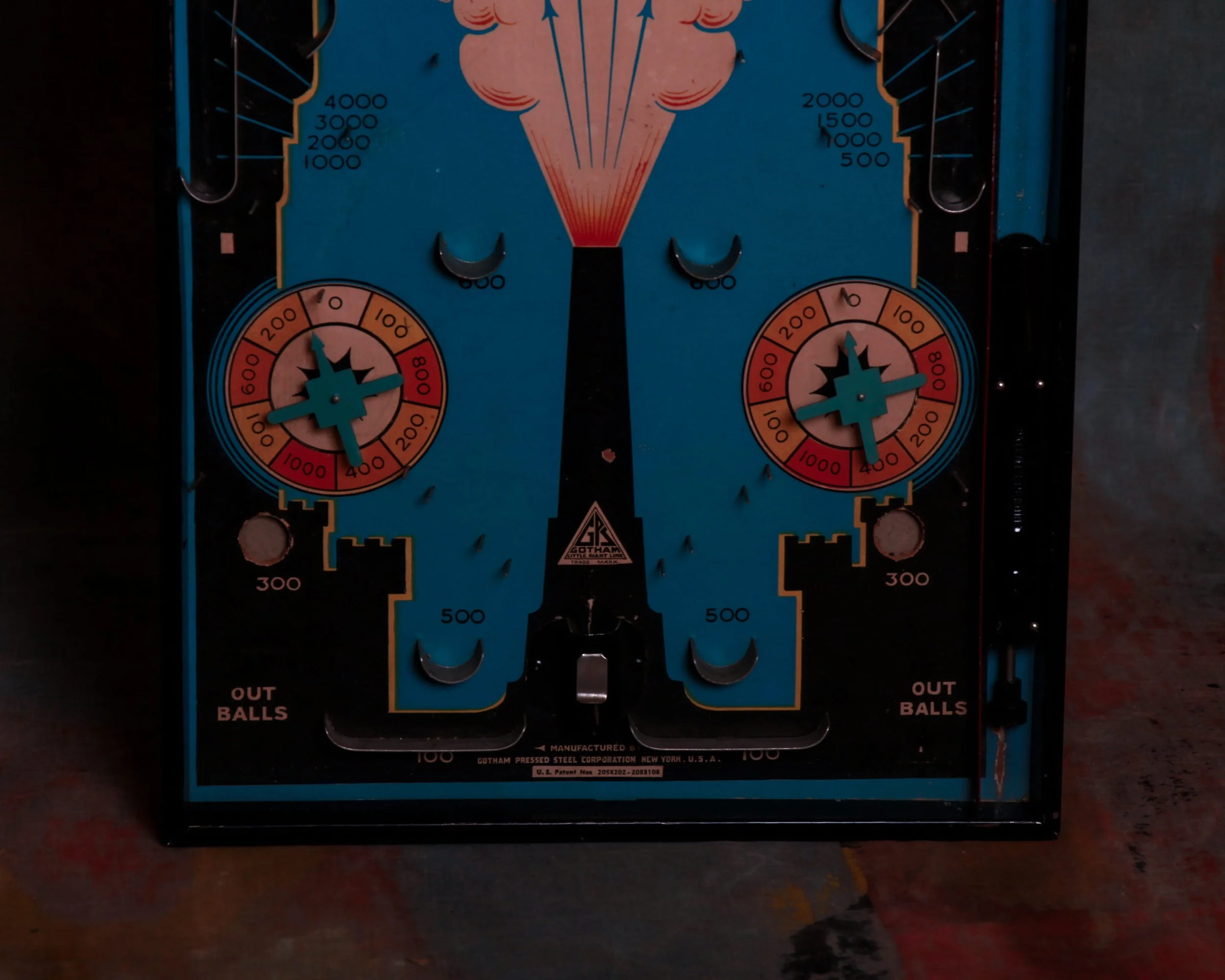
Manufactured by Gotham Pressed Steel Corporation in New York, the game is a classic bagatelle-style pinball toy from the era before electric machines took over arcades. Instead of lights and buzzers, everything here is mechanical and immediate: launch the steel ball, let gravity do the rest, and watch it ricochet off pins toward the scoring pockets.
Category History
Vintage tabletop pinball games sit right at the beginning of arcade culture—before flashing lights, before electricity, before anything buzzed or blinked. Often called bagatelle games, they relied on simple physics: a spring-loaded plunger sends a steel ball into a field of pins, bumpers, and scoring holes, and from there it’s all gravity and chance.
Most were made from wood with lithographed metal playfields, especially from the 1920s through the 1940s. The graphics did a lot of the heavy lifting—bold colors, targets, numbers, sometimes dramatic themes—designed to keep your eye moving as the ball bounced unpredictably across the board.
What makes them compelling is how tactile they are. No circuits, no sound effects—just the click of the plunger and the soft rattle of the ball finding its way. You can follow every movement, every near miss, every lucky shot.
They were often played casually on tabletops in homes, bars, or small shops, making them more personal than the larger arcade machines that came later.
Today, they read as both game and graphic object. Slight wear to the surface, a bit of patina on the metal, all adding to the experience. Simple, direct, and surprisingly engaging—proof that a good idea doesn’t need much to work.
There’s something wonderfully theatrical about this 1937 Gotham G-130 Big Shot tabletop pinball game. The moment you look at it, the board reads like a tiny Art Deco stage set—it’s bold, colorful, and unapologetically graphic in that way only pre-war lithography seems to manage.
Manufactured by Gotham Pressed Steel Corporation in New York, the game is a classic bagatelle-style pinball toy from the era before electric machines took over arcades. Instead of lights and buzzers, everything here is mechanical and immediate: launch the steel ball, let gravity do the rest, and watch it ricochet off pins toward the scoring pockets.
Category History
Vintage tabletop pinball games sit right at the beginning of arcade culture—before flashing lights, before electricity, before anything buzzed or blinked. Often called bagatelle games, they relied on simple physics: a spring-loaded plunger sends a steel ball into a field of pins, bumpers, and scoring holes, and from there it’s all gravity and chance.
Most were made from wood with lithographed metal playfields, especially from the 1920s through the 1940s. The graphics did a lot of the heavy lifting—bold colors, targets, numbers, sometimes dramatic themes—designed to keep your eye moving as the ball bounced unpredictably across the board.
What makes them compelling is how tactile they are. No circuits, no sound effects—just the click of the plunger and the soft rattle of the ball finding its way. You can follow every movement, every near miss, every lucky shot.
They were often played casually on tabletops in homes, bars, or small shops, making them more personal than the larger arcade machines that came later.
Today, they read as both game and graphic object. Slight wear to the surface, a bit of patina on the metal, all adding to the experience. Simple, direct, and surprisingly engaging—proof that a good idea doesn’t need much to work.