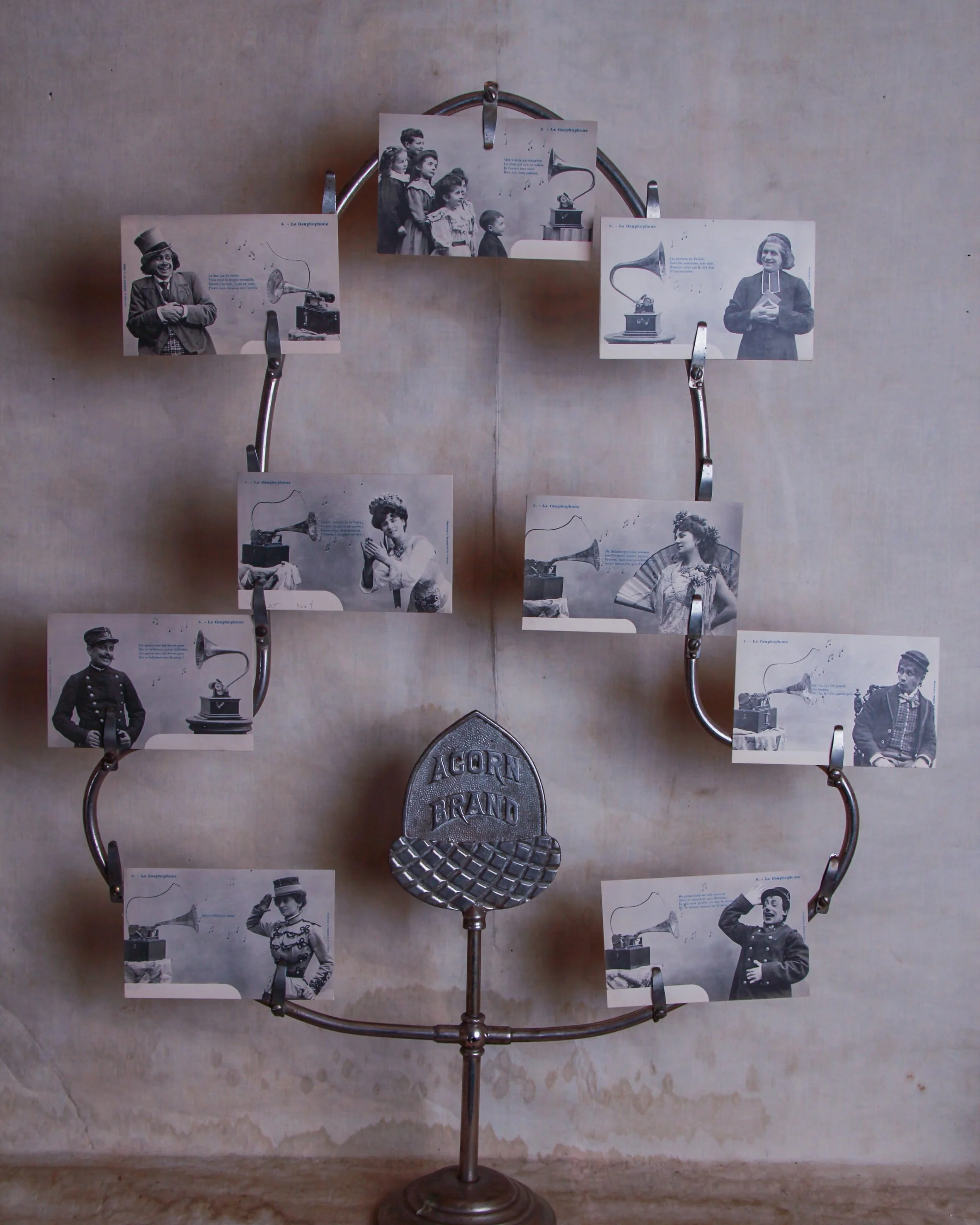
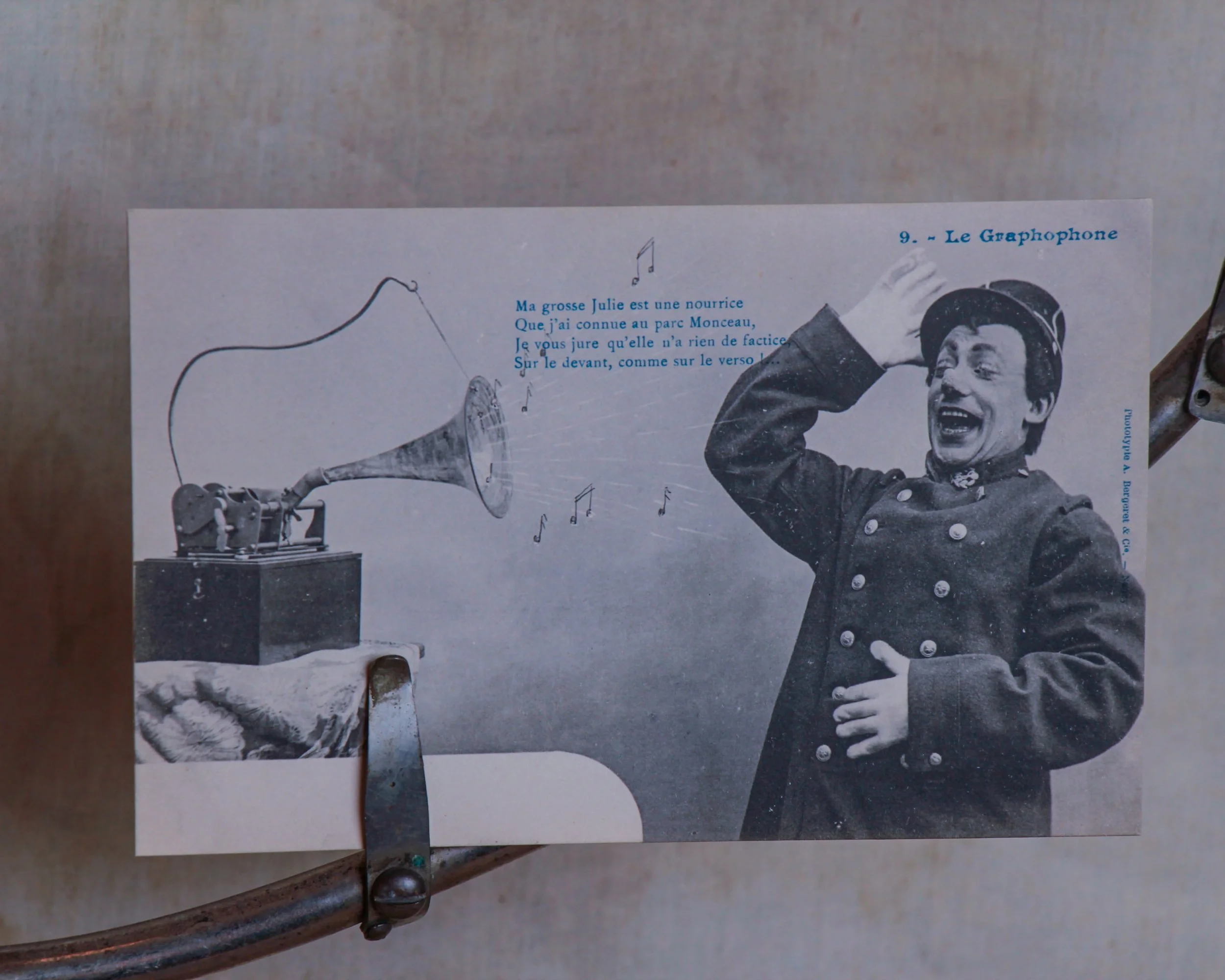
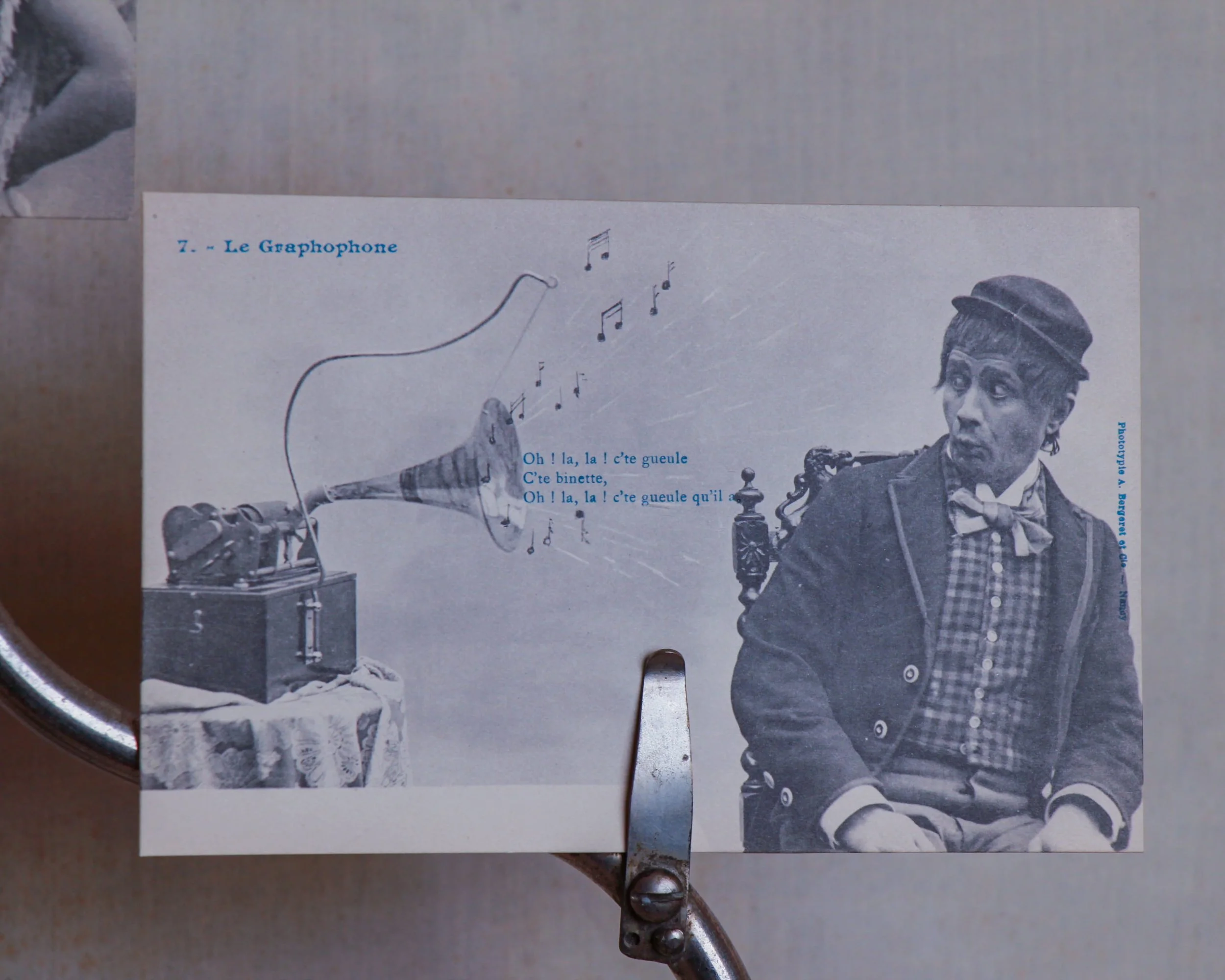
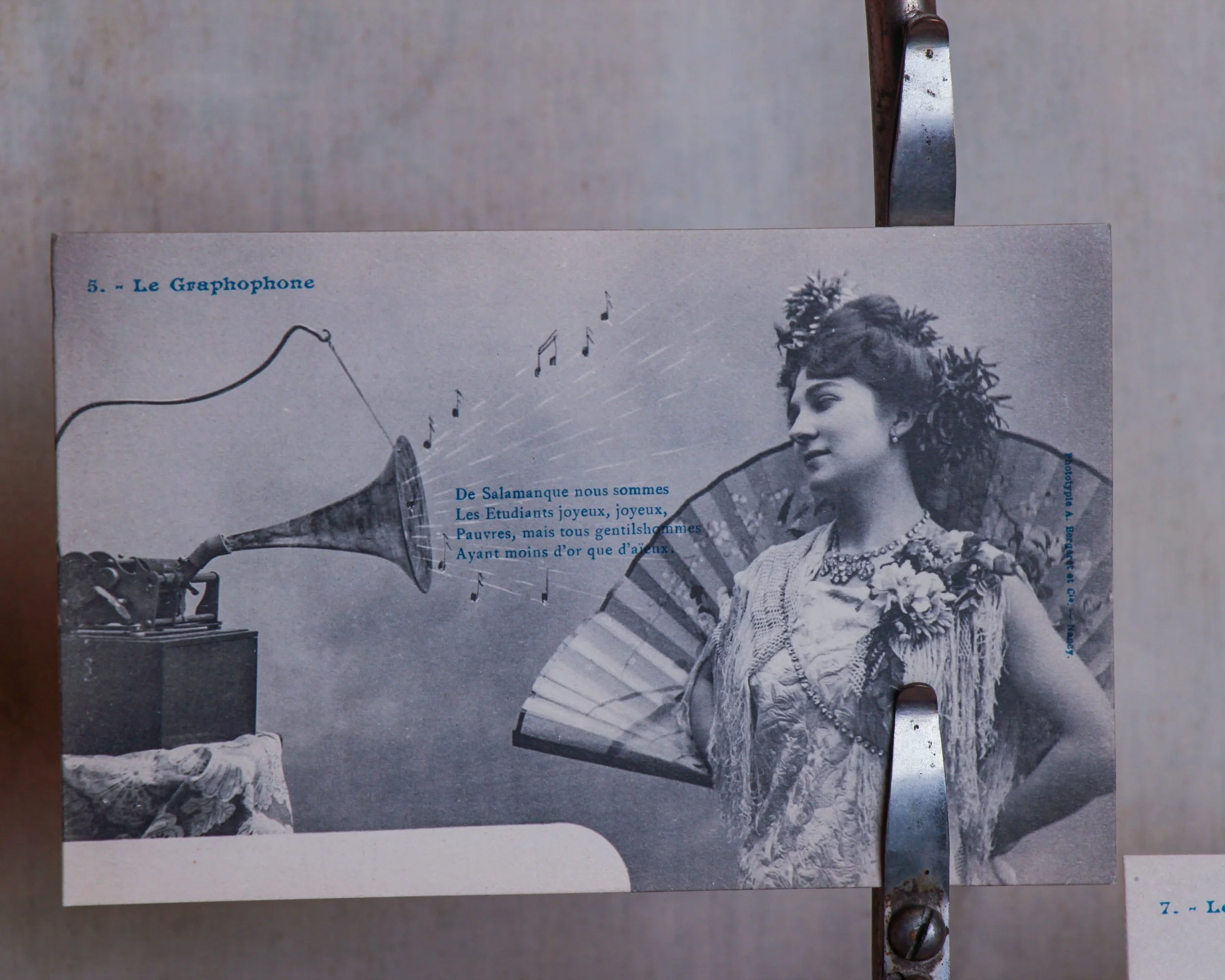
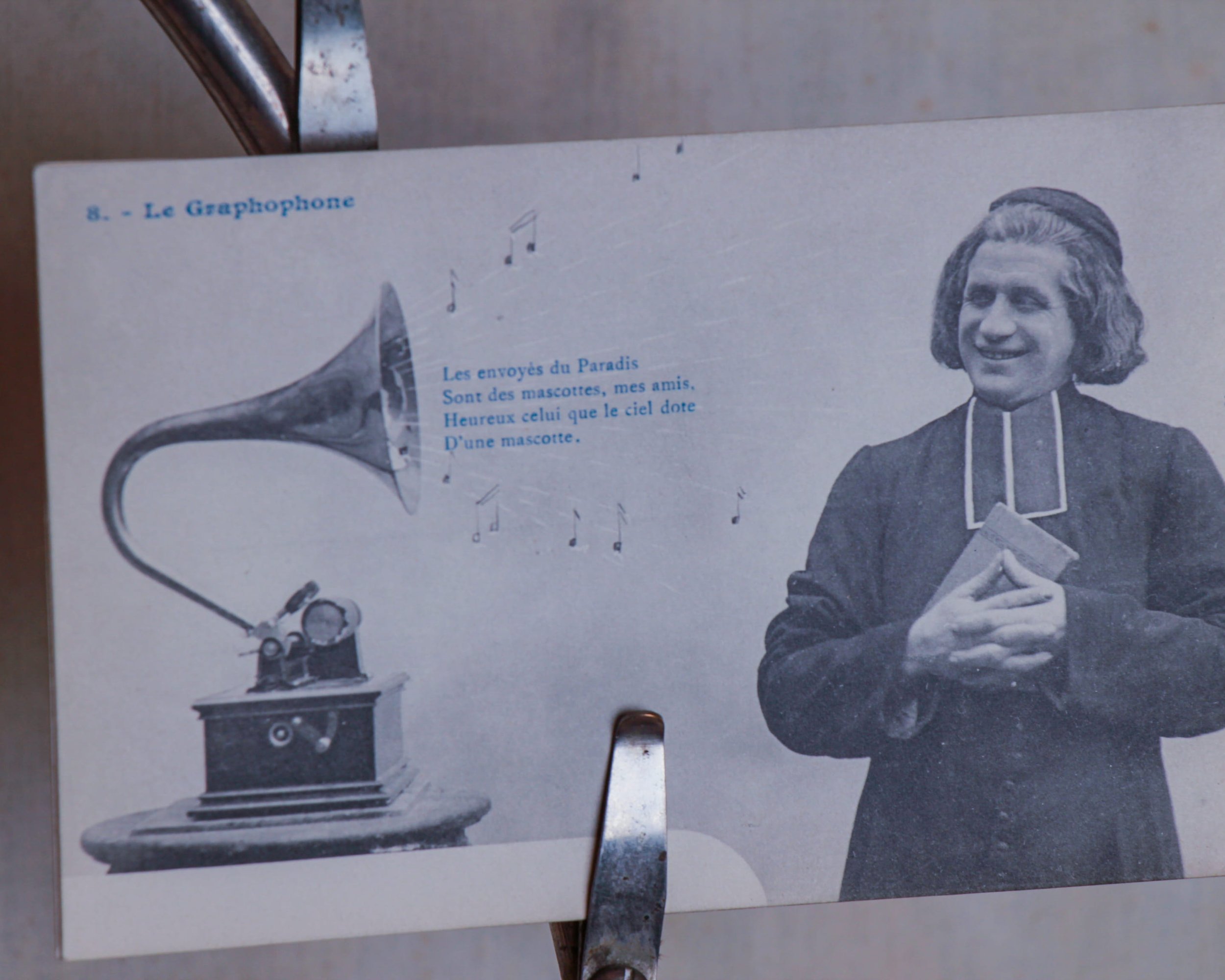
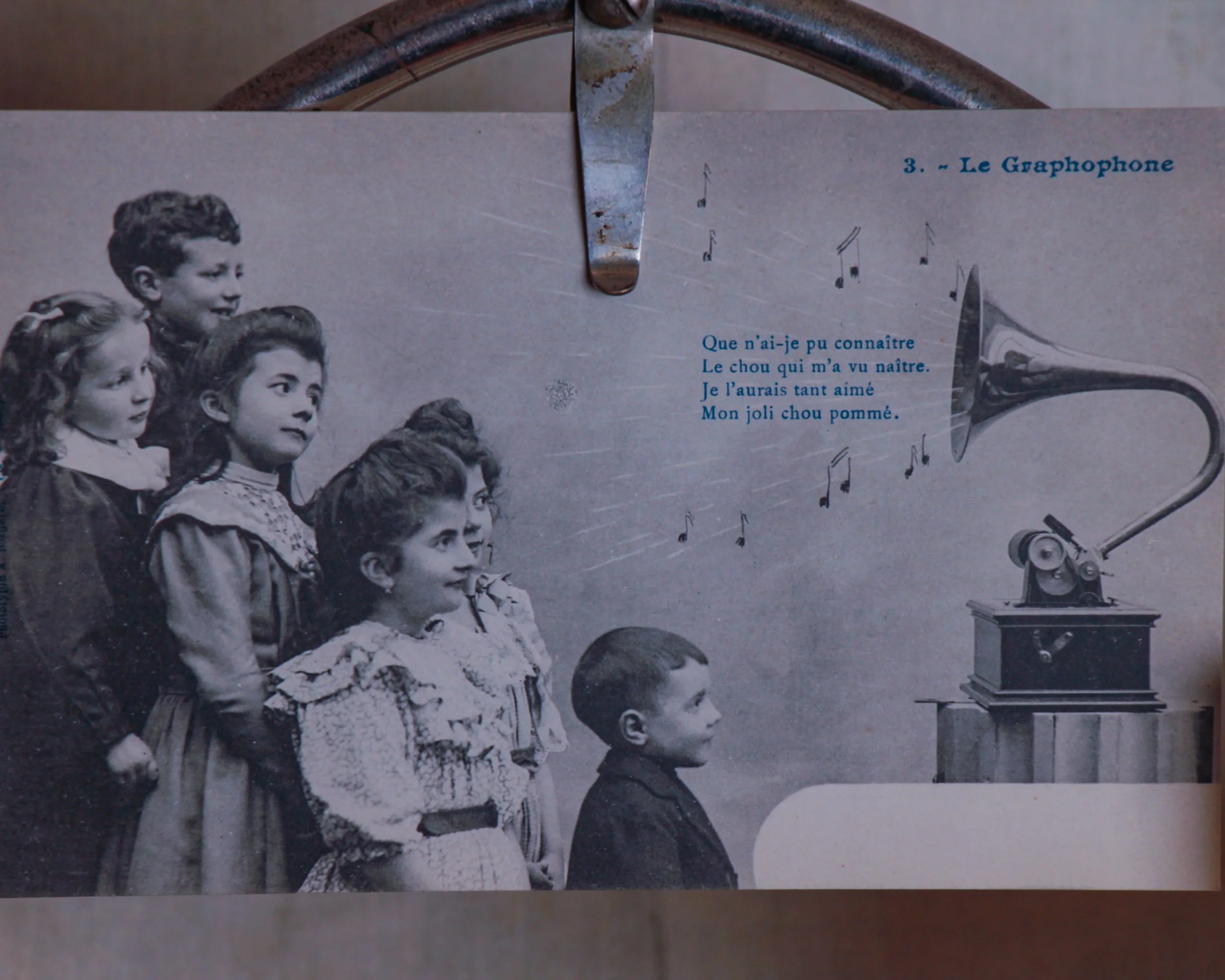
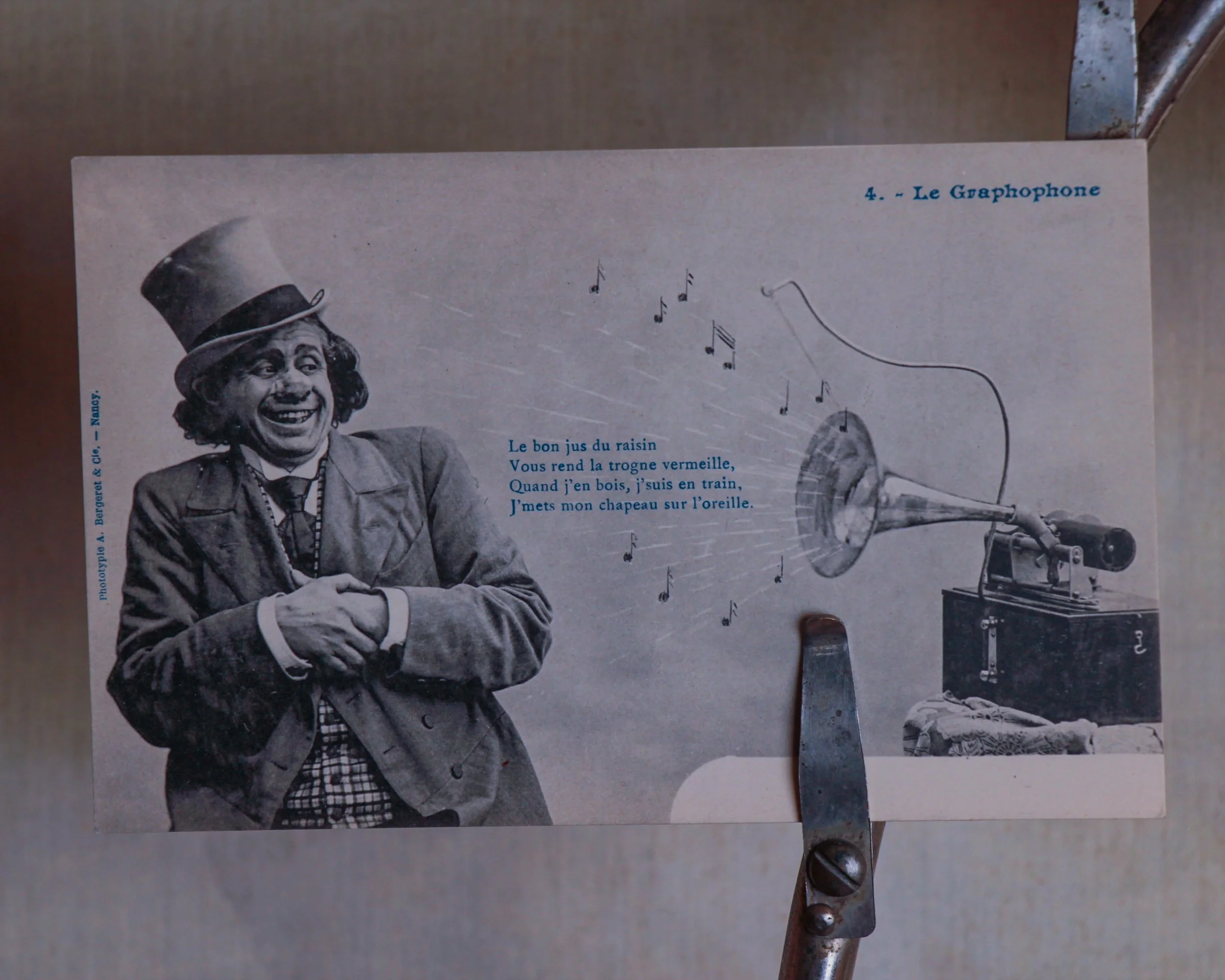
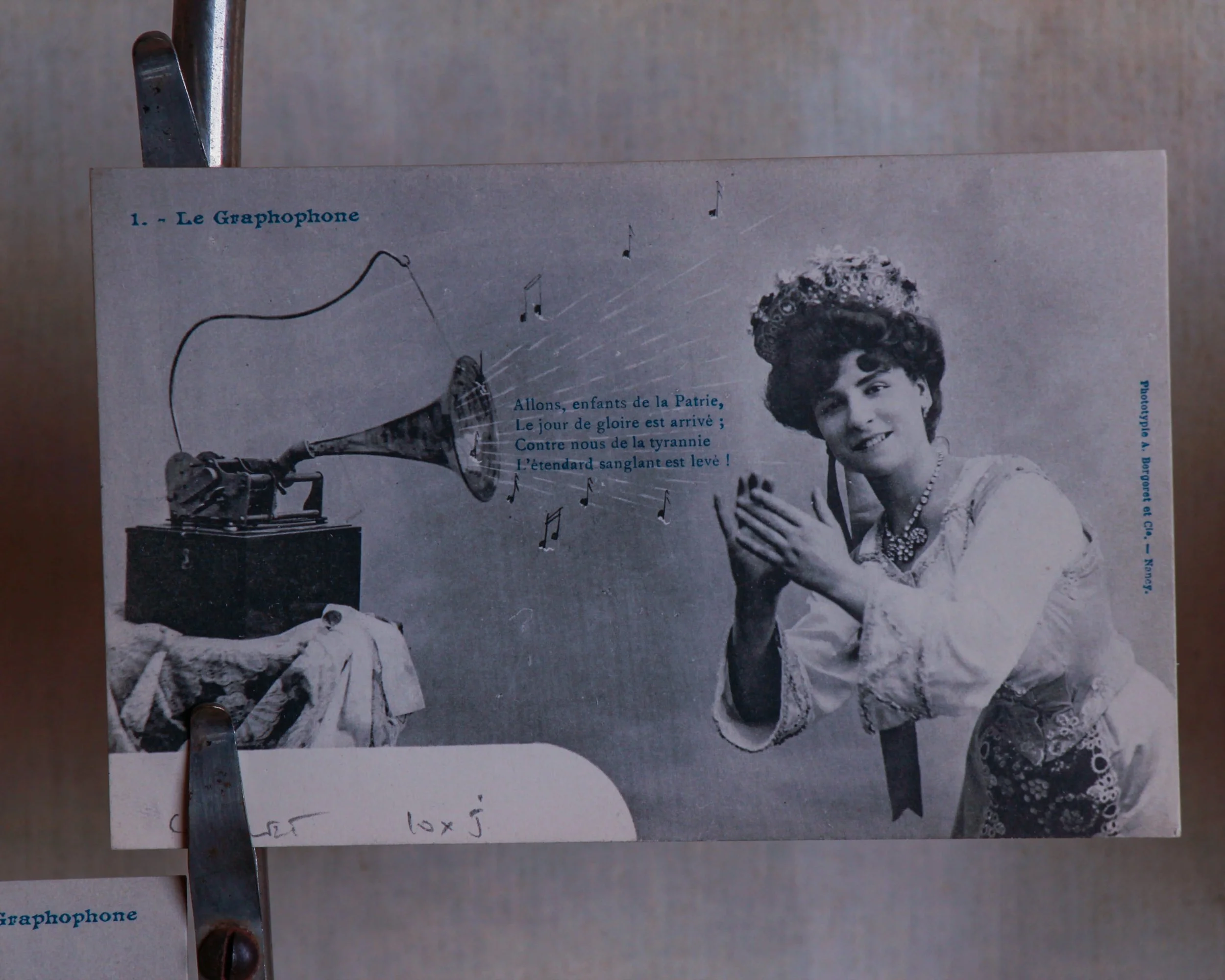
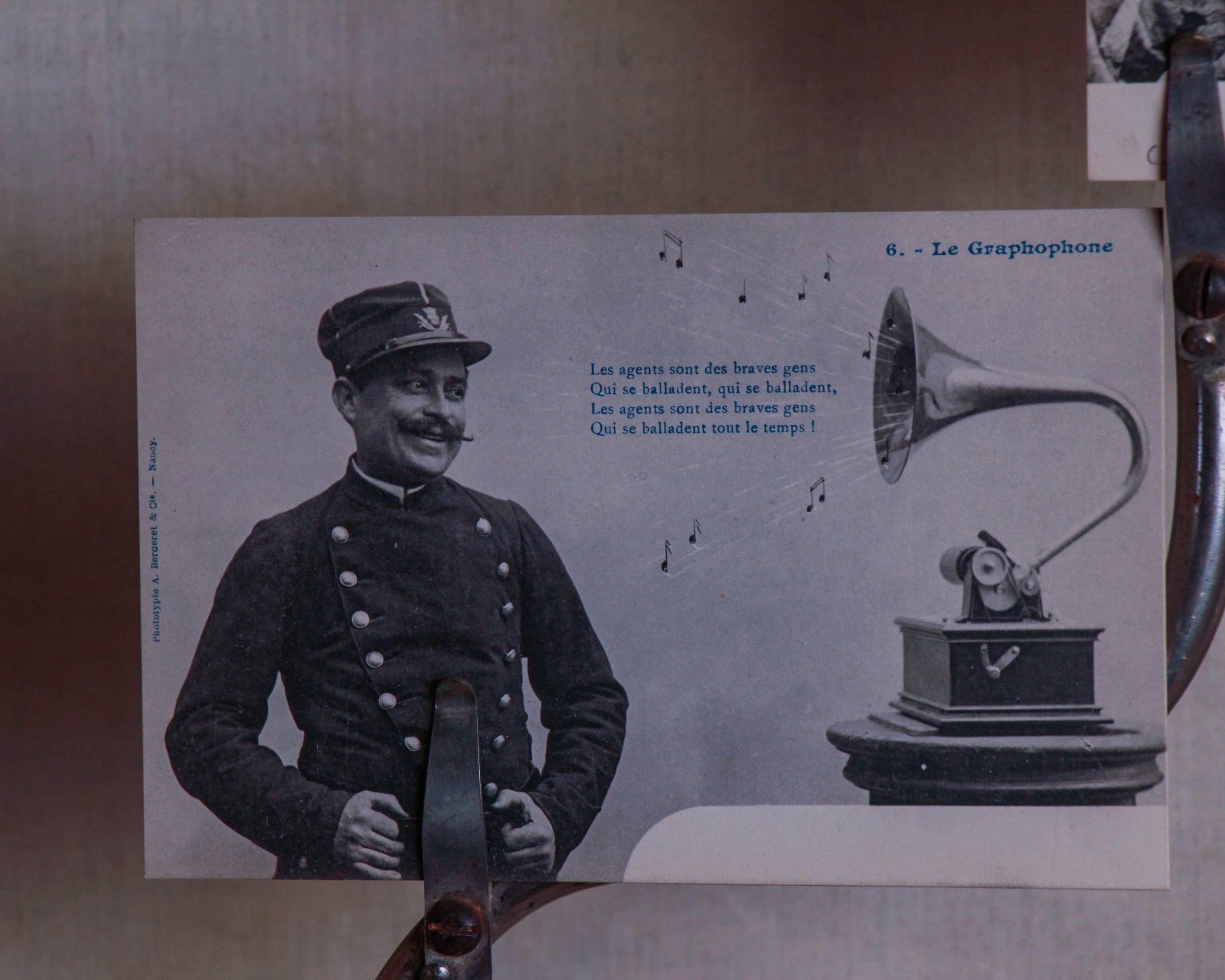
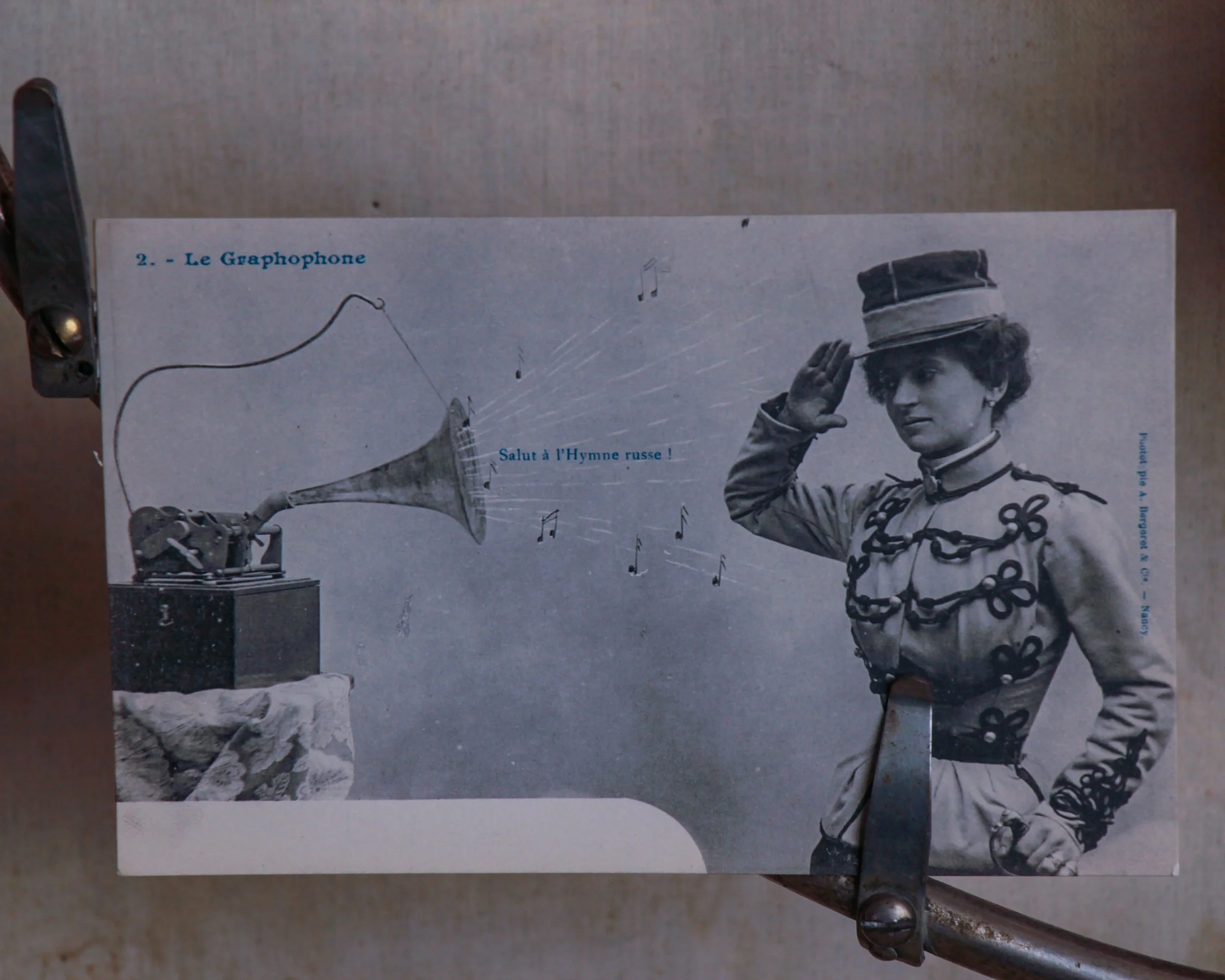
A full cast of early sound-era charm, this complete set of nine French postcards for “Le Graphophone” plays like a paper vaudeville. Each card pairs a gramophone with a different character—soldiers, singers, children, a priest—caught mid-reaction as music spills out of the horn in illustrated notes and snippets of French verse.
Likely produced in the early 1900s, they’re equal parts advertisement and entertainment, capturing that moment when recorded sound still felt a little magical. The imagery is crisp and theatrical, with just enough humor and personality to keep each scene distinct.
Together, the set reads as a narrative series rather than loose singles, which is exactly what makes it so satisfying to keep intact. Light, honest age to the cards, consistent with use and handling.
Display not included.
Graphophone
The graphophone is one of those early machines that feels almost magical in its simplicity—sound captured, stored, and played back with nothing more than grooves and motion. Developed in the late 19th century by Alexander Graham Bell’s Volta Laboratory, it improved on earlier phonographs by using wax cylinders instead of tinfoil, allowing for clearer recording and reuse.
At its core, the process is mechanical. A diaphragm vibrates with sound, a stylus translates those vibrations into grooves, and the cylinder holds that information. Play it back, and the process reverses—grooves become sound again. No electricity required.
Graphophones were used for dictation, business, and entertainment, bridging the gap between invention and everyday use. They brought recorded sound into offices and homes, turning voices into something repeatable.
What makes them compelling now is how visible the process is. You can follow the path from sound to object and back again. The materials—wood cabinets, brass fittings, rotating cylinders—carry a physical presence that modern audio has largely shed.
They’re not just machines, but early attempts at preserving a moment in time—fragile, mechanical, and surprisingly direct.
A full cast of early sound-era charm, this complete set of nine French postcards for “Le Graphophone” plays like a paper vaudeville. Each card pairs a gramophone with a different character—soldiers, singers, children, a priest—caught mid-reaction as music spills out of the horn in illustrated notes and snippets of French verse.
Likely produced in the early 1900s, they’re equal parts advertisement and entertainment, capturing that moment when recorded sound still felt a little magical. The imagery is crisp and theatrical, with just enough humor and personality to keep each scene distinct.
Together, the set reads as a narrative series rather than loose singles, which is exactly what makes it so satisfying to keep intact. Light, honest age to the cards, consistent with use and handling.
Display not included.
Graphophone
The graphophone is one of those early machines that feels almost magical in its simplicity—sound captured, stored, and played back with nothing more than grooves and motion. Developed in the late 19th century by Alexander Graham Bell’s Volta Laboratory, it improved on earlier phonographs by using wax cylinders instead of tinfoil, allowing for clearer recording and reuse.
At its core, the process is mechanical. A diaphragm vibrates with sound, a stylus translates those vibrations into grooves, and the cylinder holds that information. Play it back, and the process reverses—grooves become sound again. No electricity required.
Graphophones were used for dictation, business, and entertainment, bridging the gap between invention and everyday use. They brought recorded sound into offices and homes, turning voices into something repeatable.
What makes them compelling now is how visible the process is. You can follow the path from sound to object and back again. The materials—wood cabinets, brass fittings, rotating cylinders—carry a physical presence that modern audio has largely shed.
They’re not just machines, but early attempts at preserving a moment in time—fragile, mechanical, and surprisingly direct.