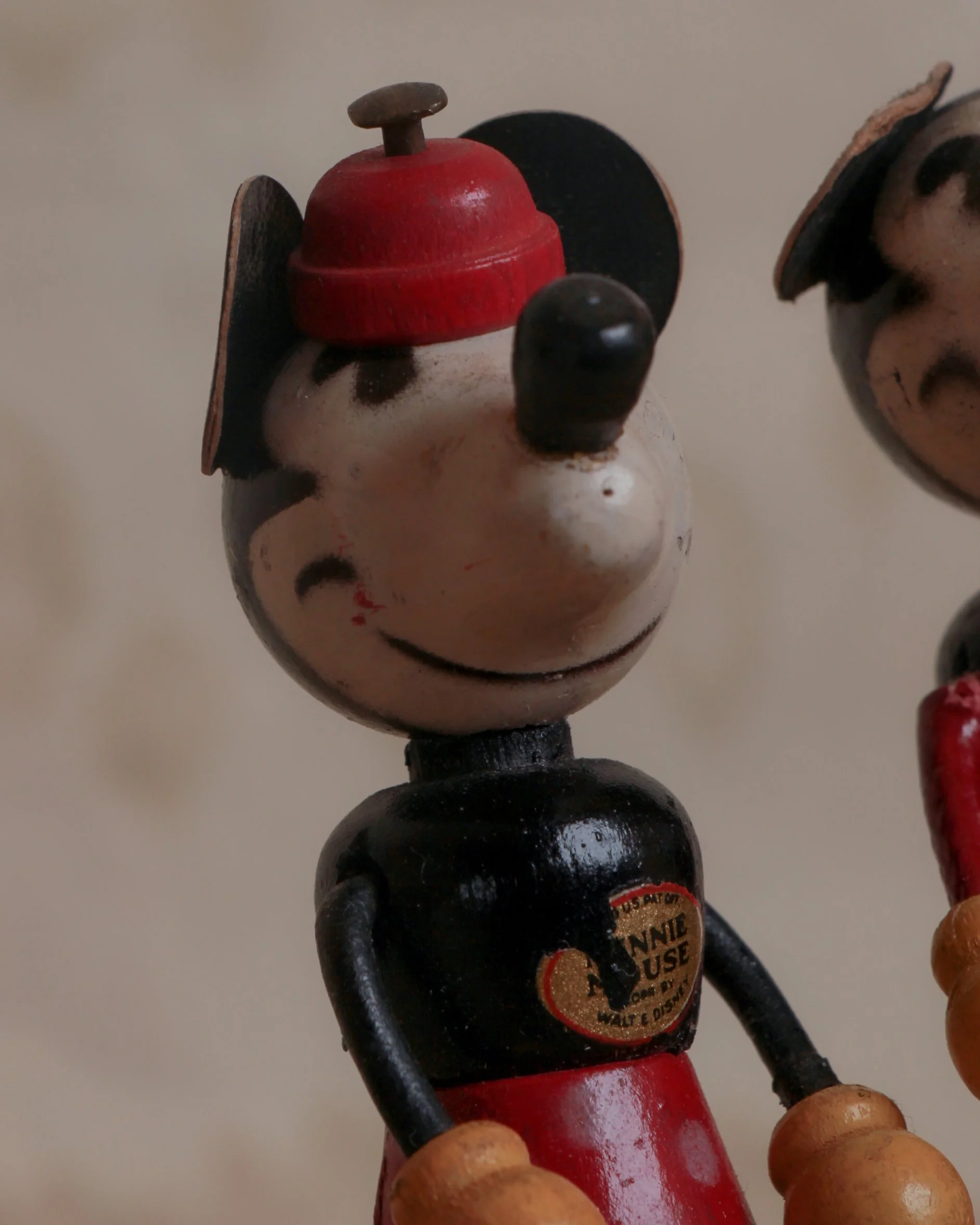
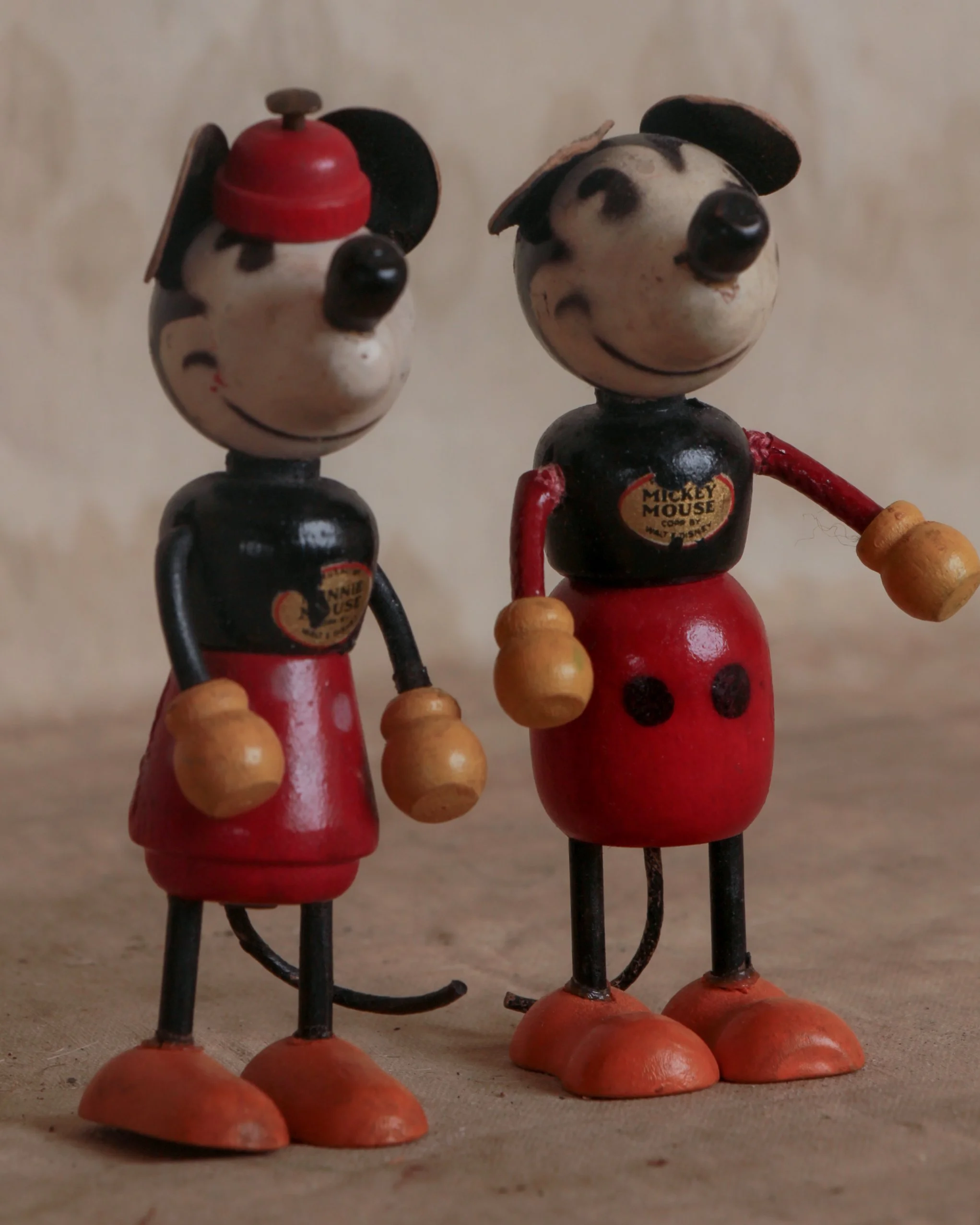
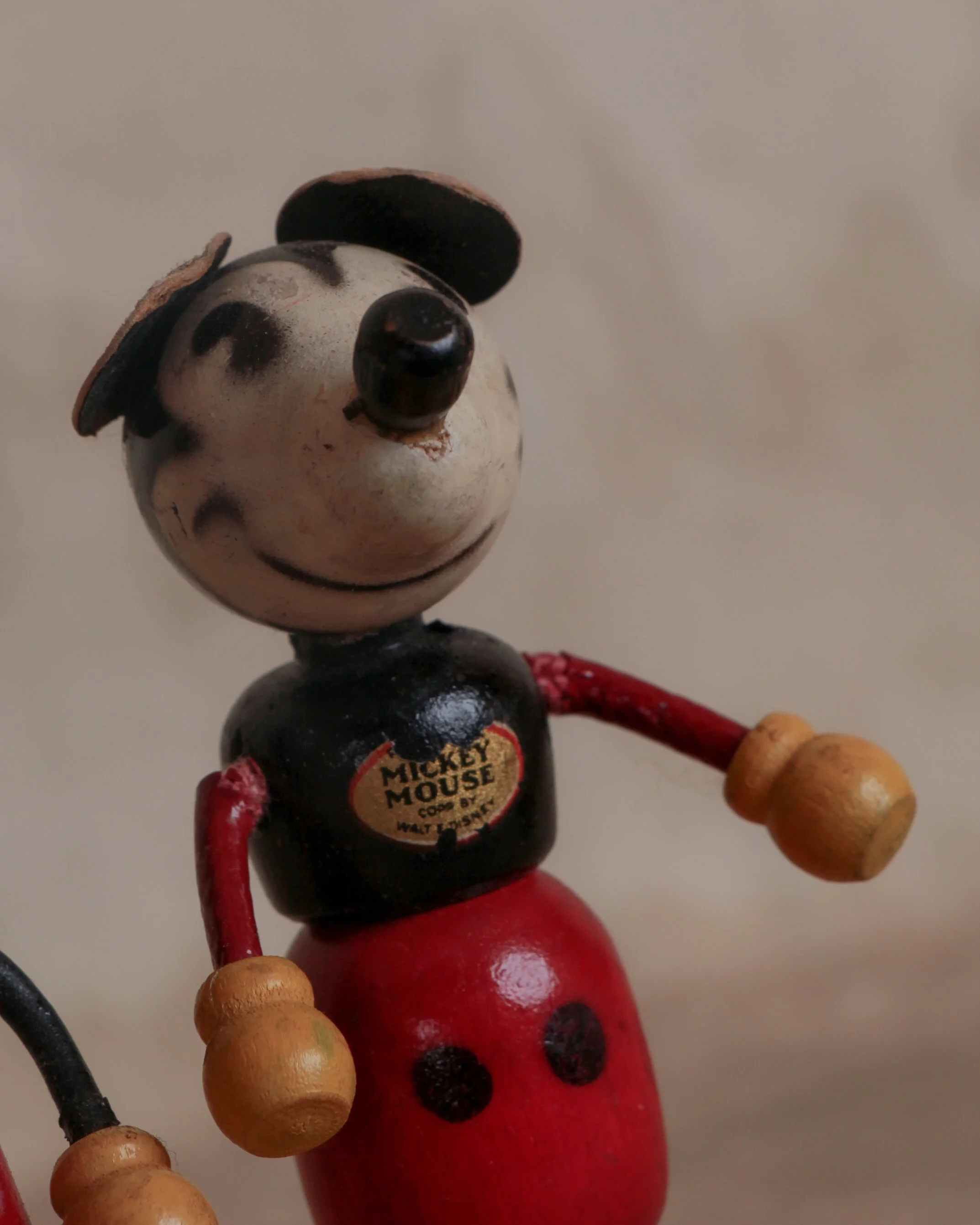
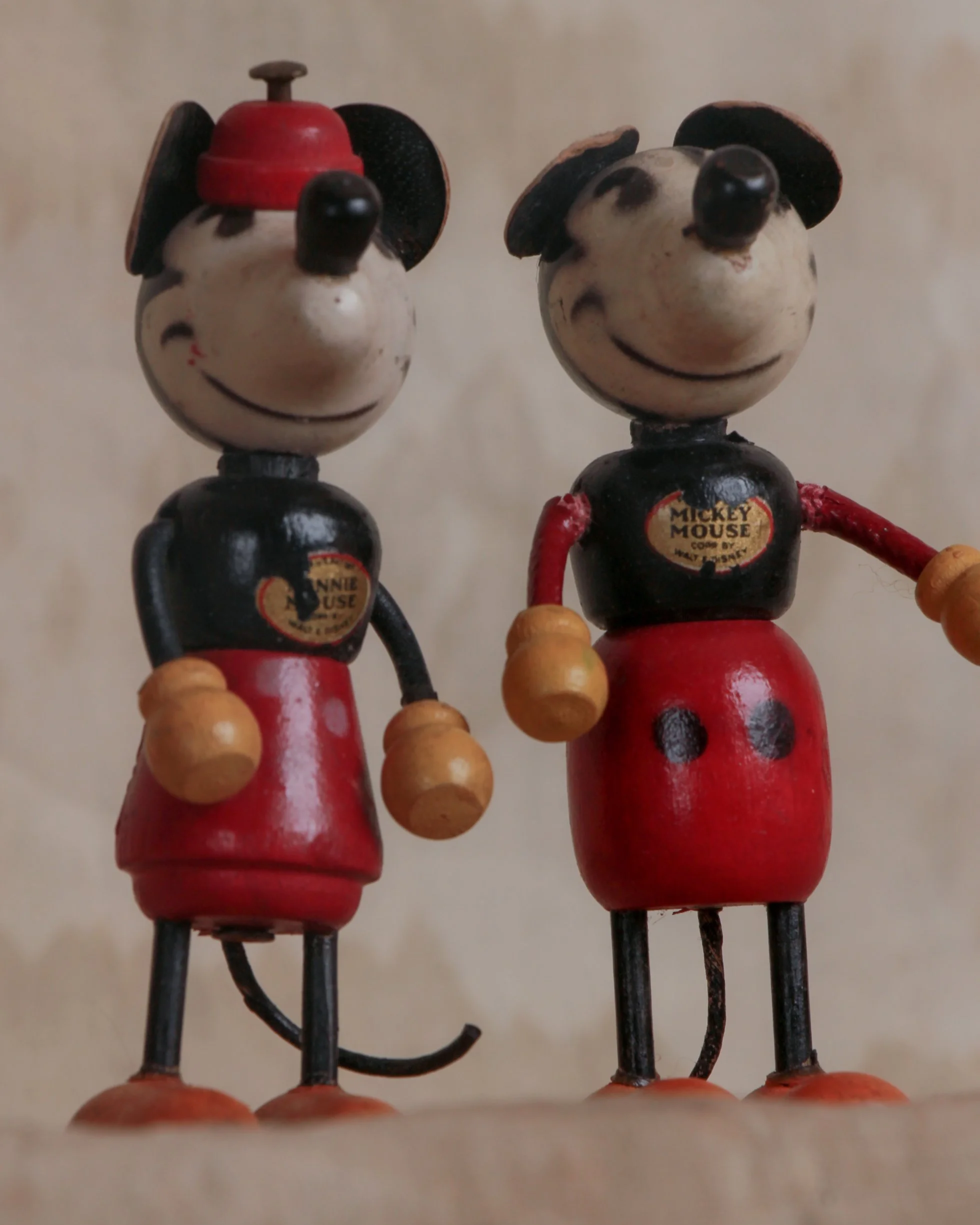
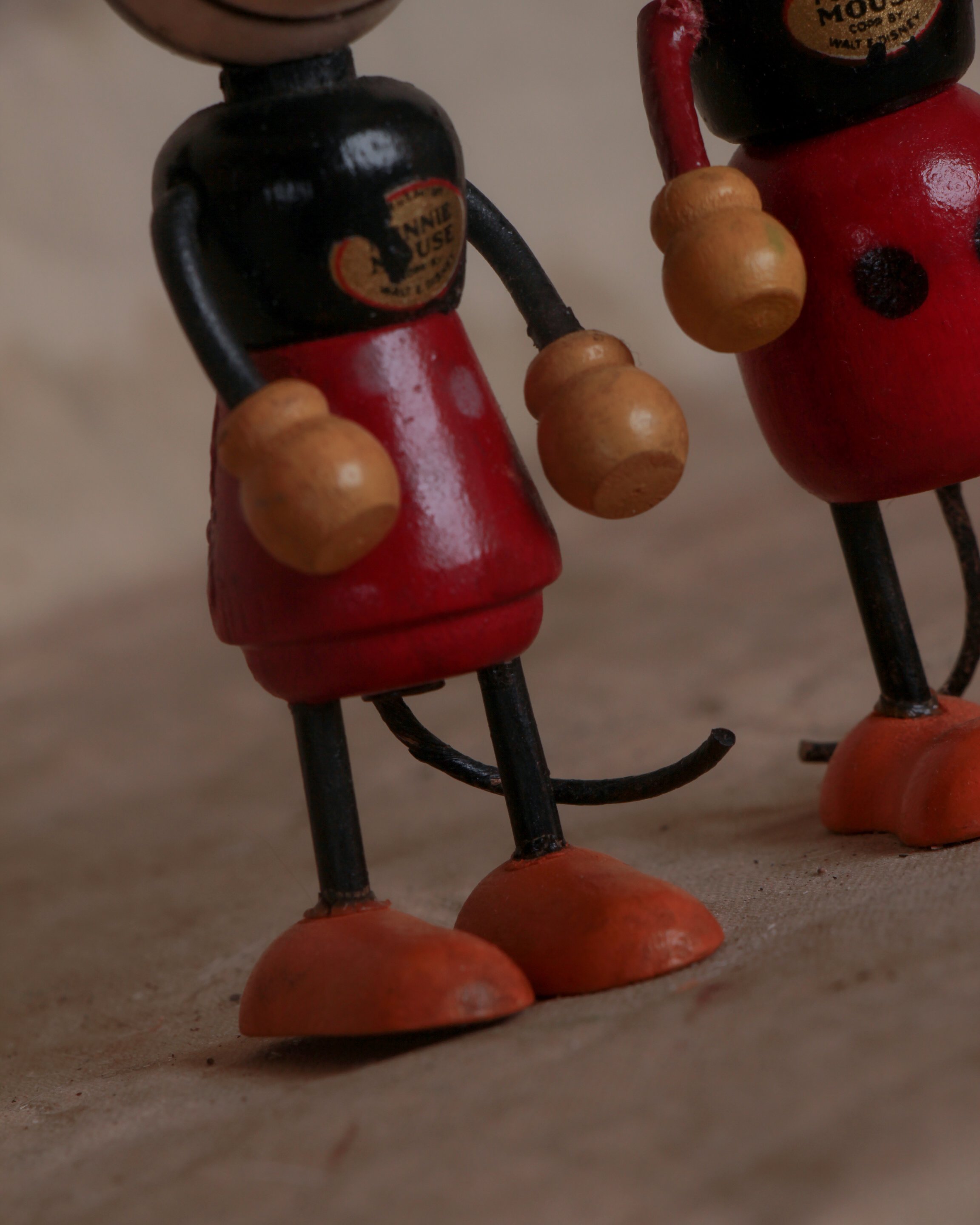
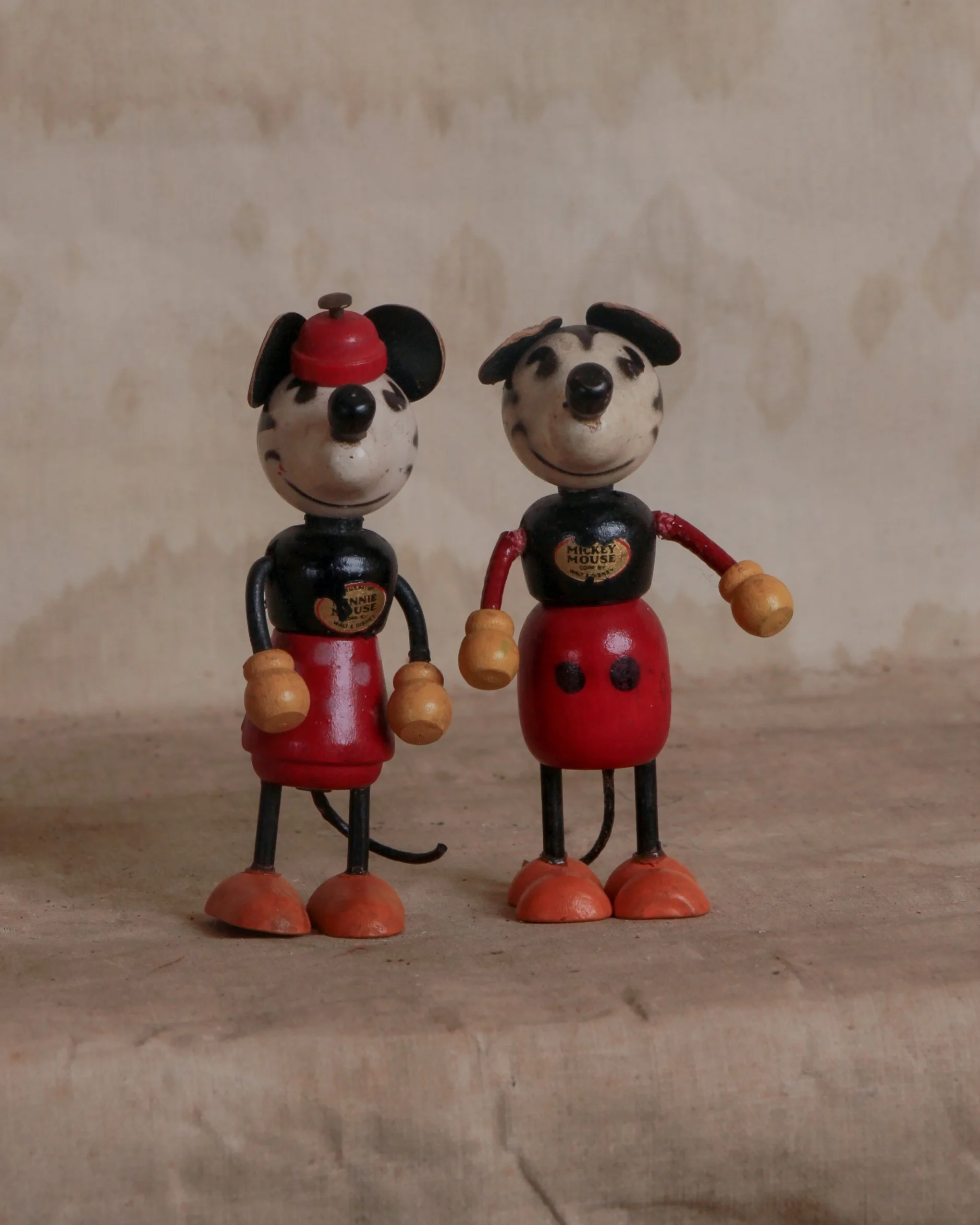
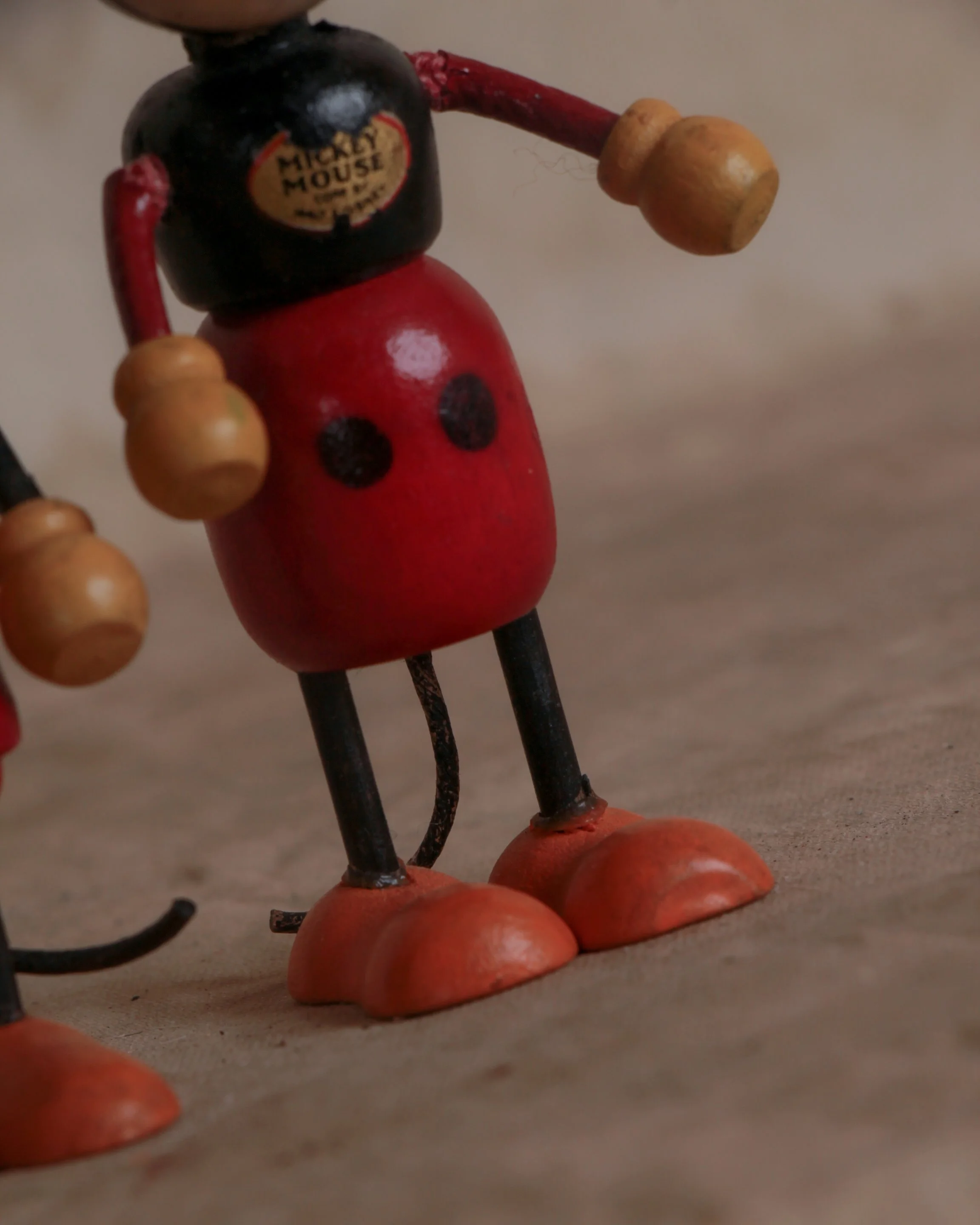
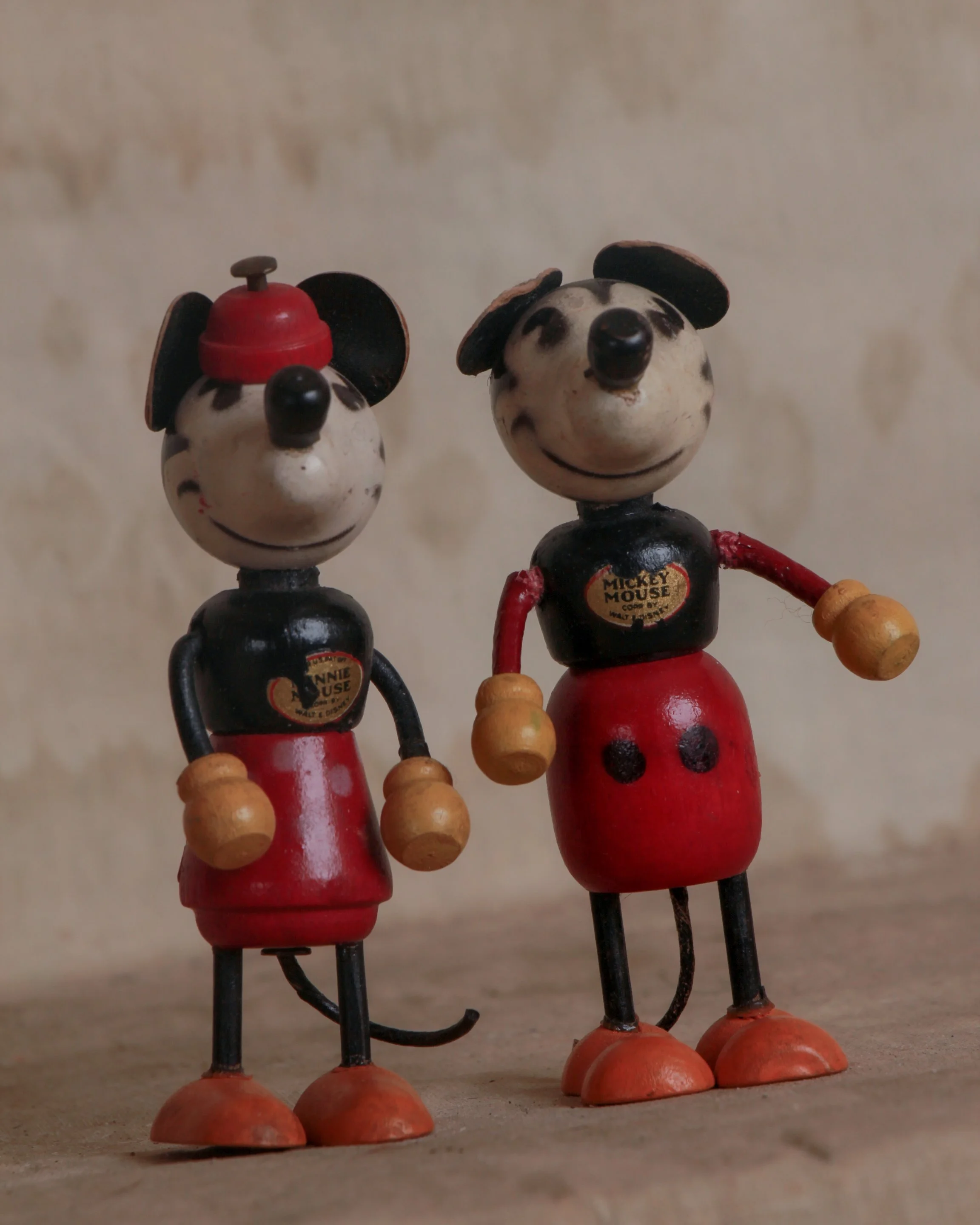
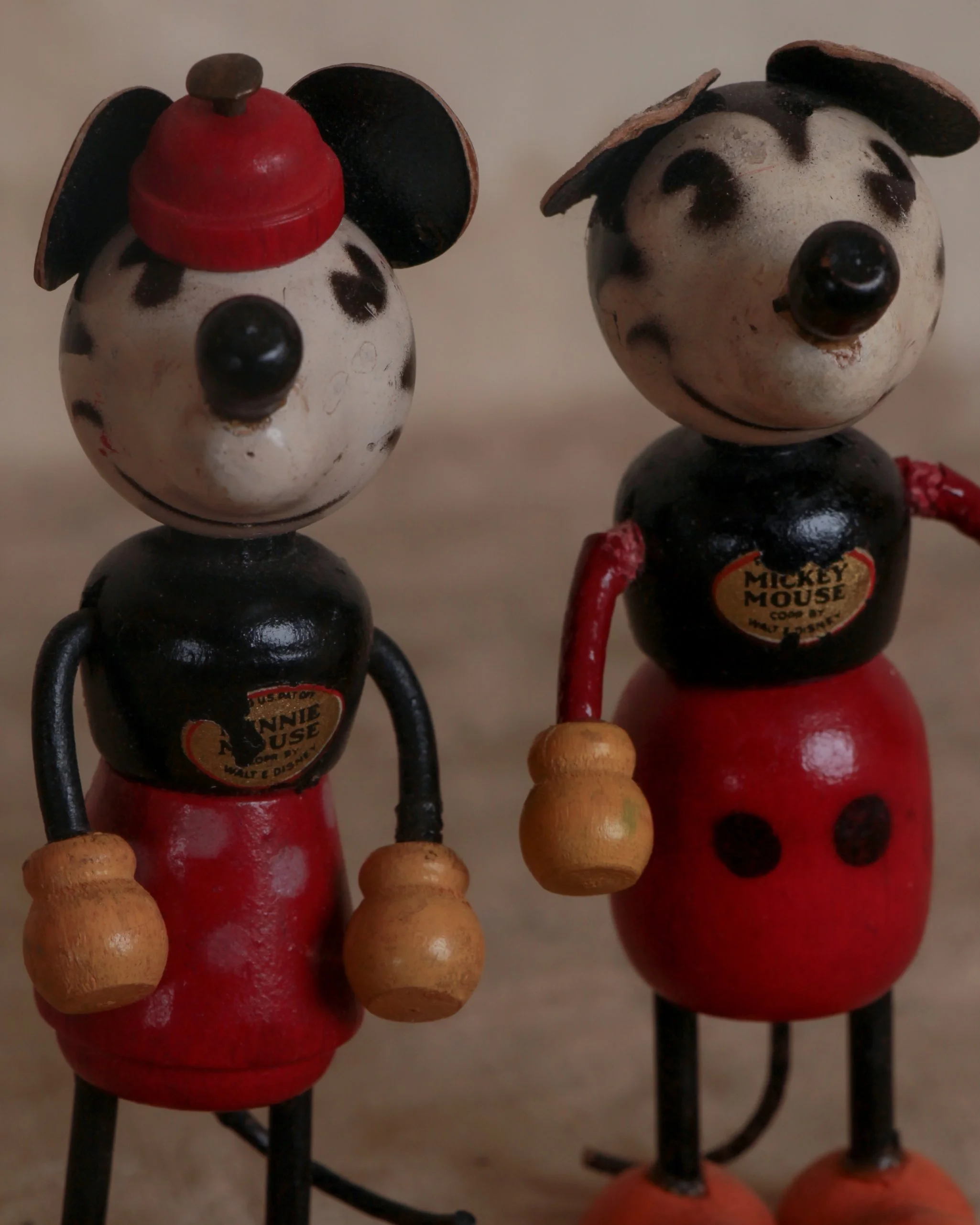
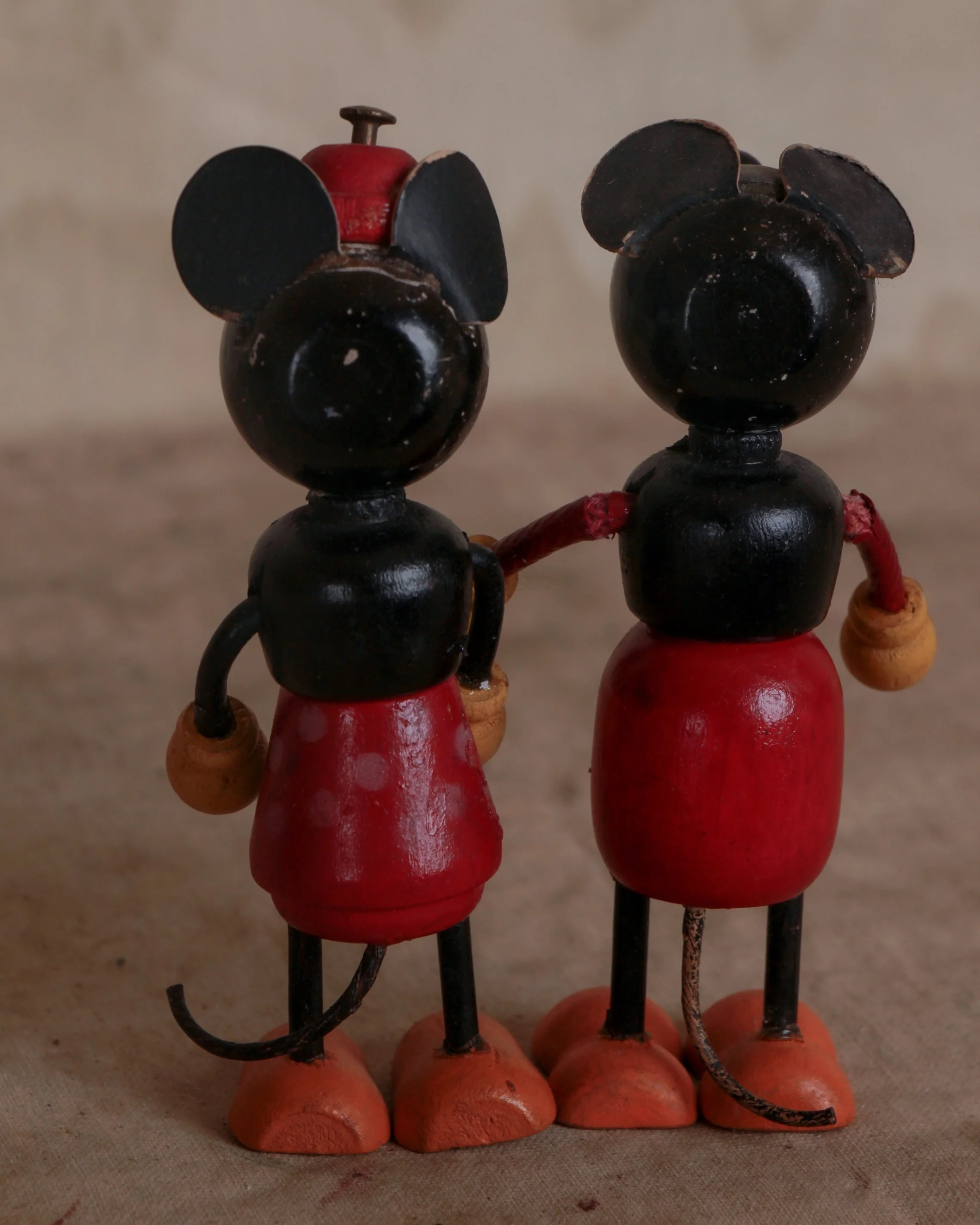
This pair of Fun-E-Flex wooden Mickey and Minnie Mouse figures dates to the 1930s and has the wonderfully quirky look of early licensed Disney merchandise. Both are built from turned and shaped wooden parts, with flexible cord joints at the arms and legs that let the figures be posed. Their oversized round heads, long projecting noses, flat ears, yellow hands, red lower bodies, and black torsos capture the simplified graphic language of early Mickey animation. Minnie wears a small red hat, while Mickey has the familiar two-button detail on his red shorts. Each still retains part of its original paper chest label identifying the character and Walt Disney connection.
The wear is exactly what you would hope to see on toys of this age: rubbing to the painted surfaces, losses along the ear edges, fading, scuffs, and some deterioration around the flexible joints. Nothing feels over-restored or overly precious. They still look like toys that were actually handled.
Mickey Mouse made his public debut in 1928, and his success quickly created one of the earliest large-scale character merchandising phenomena. By the early 1930s, Mickey was appearing on everything from watches and books to dolls, toys, school supplies, and household objects. Minnie followed right alongside him.
Fun-E-Flex figures are especially charming because they sit between doll, toy, and early animation souvenir. Their jointed construction gave children a way to physically pose characters they had previously only seen moving on screen.
That connection to animation is what makes these so appealing today. They are not slick later reproductions of an established icon. They come from the period when Mickey and Minnie were still relatively new characters, and manufacturers were figuring out how to translate those elastic cartoon bodies into three-dimensional form. The result is slightly crude, highly graphic, and full of personality.
This pair of Fun-E-Flex wooden Mickey and Minnie Mouse figures dates to the 1930s and has the wonderfully quirky look of early licensed Disney merchandise. Both are built from turned and shaped wooden parts, with flexible cord joints at the arms and legs that let the figures be posed. Their oversized round heads, long projecting noses, flat ears, yellow hands, red lower bodies, and black torsos capture the simplified graphic language of early Mickey animation. Minnie wears a small red hat, while Mickey has the familiar two-button detail on his red shorts. Each still retains part of its original paper chest label identifying the character and Walt Disney connection.
The wear is exactly what you would hope to see on toys of this age: rubbing to the painted surfaces, losses along the ear edges, fading, scuffs, and some deterioration around the flexible joints. Nothing feels over-restored or overly precious. They still look like toys that were actually handled.
Mickey Mouse made his public debut in 1928, and his success quickly created one of the earliest large-scale character merchandising phenomena. By the early 1930s, Mickey was appearing on everything from watches and books to dolls, toys, school supplies, and household objects. Minnie followed right alongside him.
Fun-E-Flex figures are especially charming because they sit between doll, toy, and early animation souvenir. Their jointed construction gave children a way to physically pose characters they had previously only seen moving on screen.
That connection to animation is what makes these so appealing today. They are not slick later reproductions of an established icon. They come from the period when Mickey and Minnie were still relatively new characters, and manufacturers were figuring out how to translate those elastic cartoon bodies into three-dimensional form. The result is slightly crude, highly graphic, and full of personality.