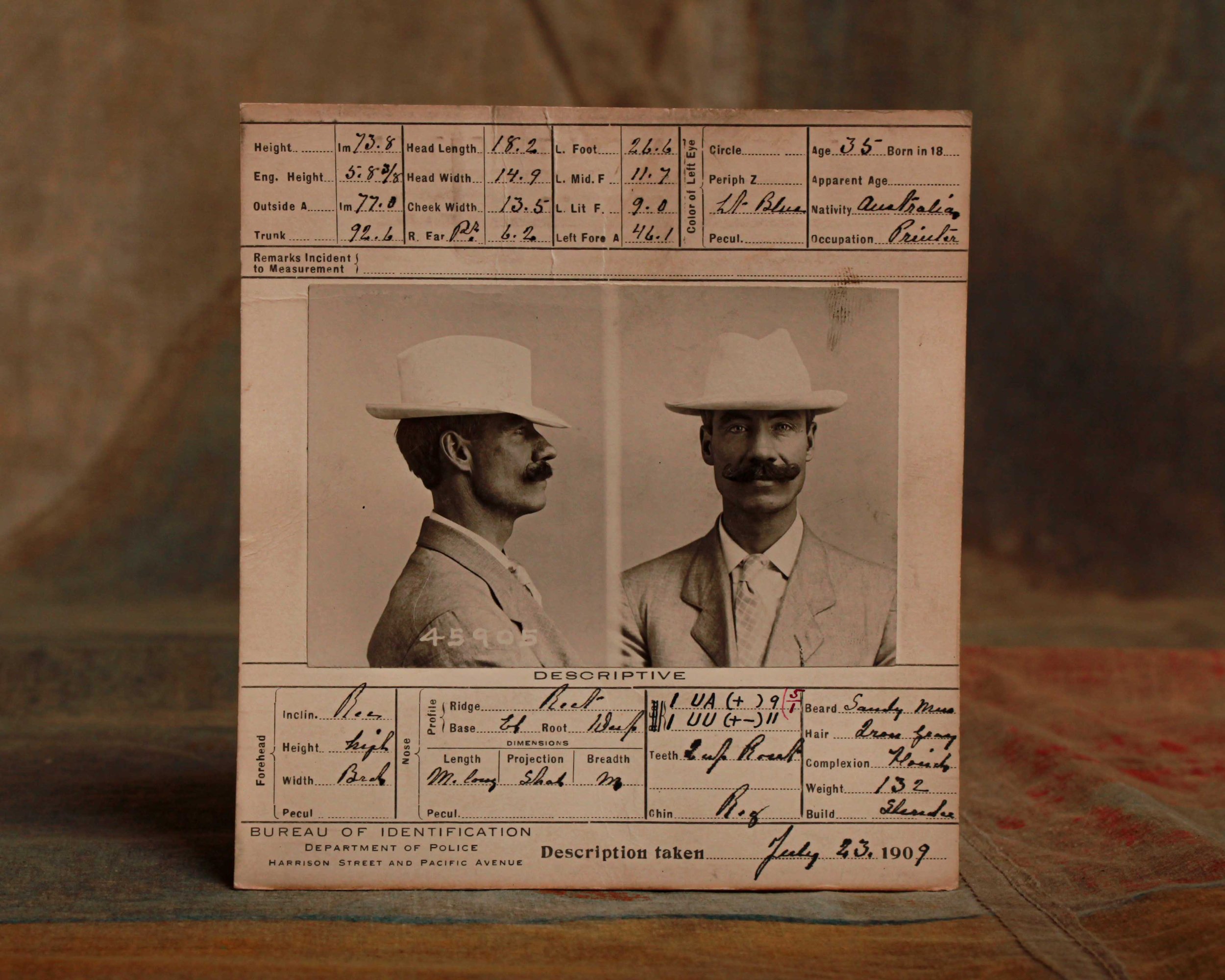
An original 1909 police identification card issued by the Bureau of Identification, Department of Police, San Francisco, California. Dated July 23, 1909, the card features two photographs of a sharply dressed, mustachioed gentleman wearing a light-colored suit and hat, shown in both profile and frontal views. Surrounding the photographs are handwritten physical measurements and descriptive details, including his age of 35, Australian nationality, occupation as a printer, and weight of 132 pounds. A fascinating piece of early police history, complete with period handwriting, original photographs, and signs of age.
This type of identification card is commonly known as a Bertillon card, named after French criminologist Alphonse Bertillon, who developed a revolutionary system of criminal identification in Paris during the late 19th century.
Introduced in 1879, the Bertillon system relied on carefully recorded body measurements, physical descriptions, and standardized photographs to establish a person's identity. Before fingerprinting became widely adopted, police departments struggled to identify repeat offenders, particularly those operating under different names.
The system involved measuring everything from head length and ear dimensions to finger lengths and forearm measurements. Officers also recorded eye color, complexion, scars, tattoos, and other distinguishing features. Each card was then organized into an elaborate filing system designed to help investigators match individuals against existing records.
By the 1890s, Bertillon's methods had spread throughout Europe and the United States, becoming an important part of modern police work. The familiar combination of frontal and profile mugshots originated with this approach and remains standard practice today.
During the early 20th century, fingerprint identification gradually replaced anthropometric measurements because it offered a more reliable and practical means of establishing identity. By the 1920s and 1930s, Bertillon's elaborate measuring system was largely obsolete, although its influence on police photography and recordkeeping continued for decades.