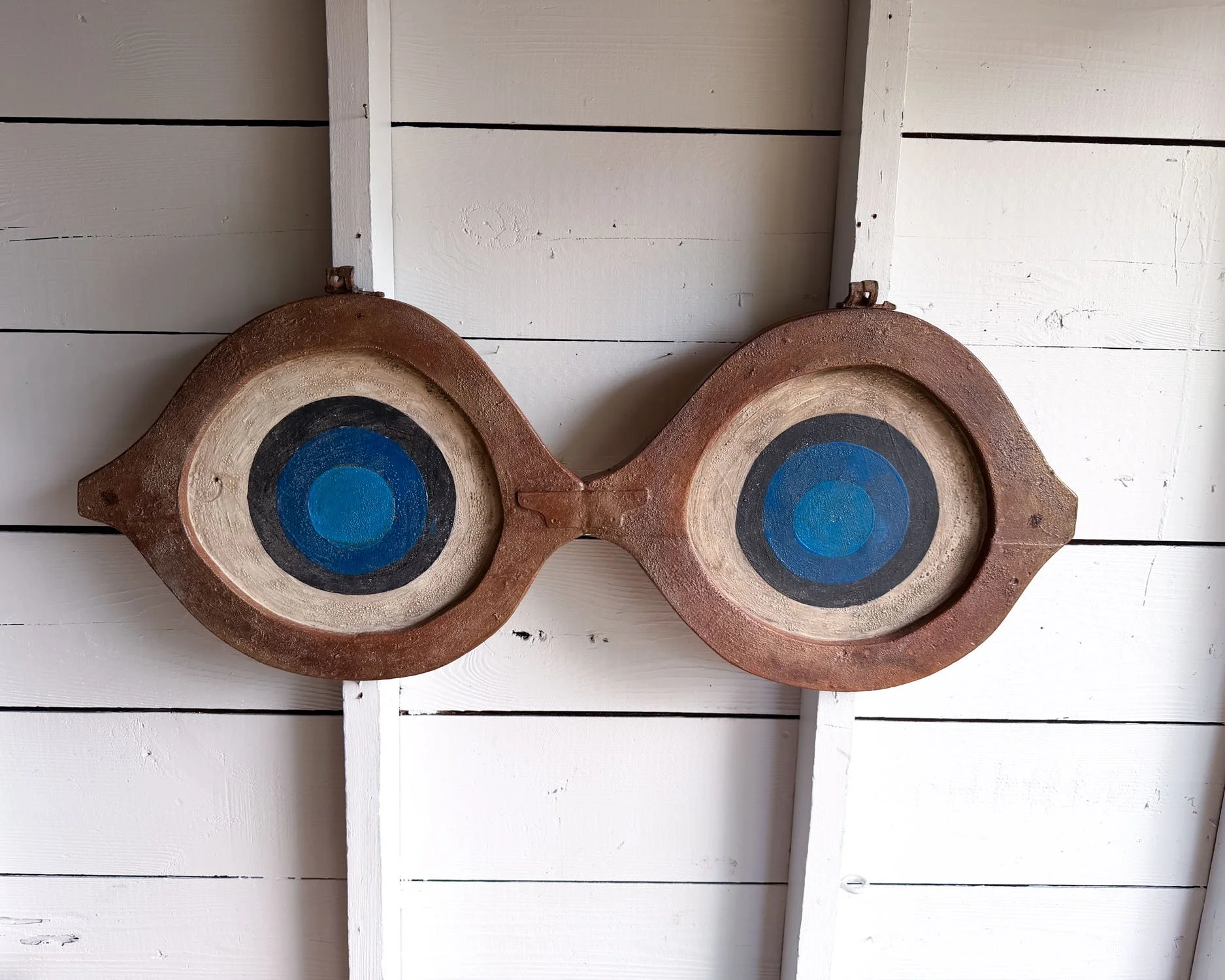

Single-sided wooden optometrist trade sign in the form of an oversized pair of eyes. The sign is carved from wood with two large recessed circular eyes, painted in cream, black, and bright blue, and joined by a simple central bridge. The surrounding frame has a warm brown finish with plenty of surface wear, small losses, and age throughout. Two old hanging brackets remain along the top edge, while the reverse is left plain, showing the straightforward construction of the piece.
Trade signs like this were once an important part of everyday street advertising. Before neon, printed vinyl, and standardized storefront graphics, businesses often relied on large, instantly recognizable symbols to tell people what kind of service was being offered. An eye or pair of spectacles could identify an optician just as easily as a barber pole identified a barber or a mortar and pestle marked an apothecary.
Optical signs became especially common in the late 19th and early 20th centuries as eyeglasses became more widely available and optometry developed into a more established profession. Many early opticians also worked as jewelers or instrument makers, so bold visual signs helped distinguish eye care from other services offered under the same roof.
Wood was a practical material for signs like these because it was inexpensive, easy to carve, and light enough to hang outside a storefront. Painted details could then be refreshed as needed, which is why surviving examples often show layers of wear, repainting, and weathering.
By the early 20th century, oversized eyes had become a familiar symbol of vision care. Their directness made them effective advertising, while their handmade construction gave each example its own personality. Today, signs of this type are collected both as early commercial advertising and as vernacular folk art, especially when they retain original paint and hardware.
Single-sided wooden optometrist trade sign in the form of an oversized pair of eyes. The sign is carved from wood with two large recessed circular eyes, painted in cream, black, and bright blue, and joined by a simple central bridge. The surrounding frame has a warm brown finish with plenty of surface wear, small losses, and age throughout. Two old hanging brackets remain along the top edge, while the reverse is left plain, showing the straightforward construction of the piece.
Trade signs like this were once an important part of everyday street advertising. Before neon, printed vinyl, and standardized storefront graphics, businesses often relied on large, instantly recognizable symbols to tell people what kind of service was being offered. An eye or pair of spectacles could identify an optician just as easily as a barber pole identified a barber or a mortar and pestle marked an apothecary.
Optical signs became especially common in the late 19th and early 20th centuries as eyeglasses became more widely available and optometry developed into a more established profession. Many early opticians also worked as jewelers or instrument makers, so bold visual signs helped distinguish eye care from other services offered under the same roof.
Wood was a practical material for signs like these because it was inexpensive, easy to carve, and light enough to hang outside a storefront. Painted details could then be refreshed as needed, which is why surviving examples often show layers of wear, repainting, and weathering.
By the early 20th century, oversized eyes had become a familiar symbol of vision care. Their directness made them effective advertising, while their handmade construction gave each example its own personality. Today, signs of this type are collected both as early commercial advertising and as vernacular folk art, especially when they retain original paint and hardware.