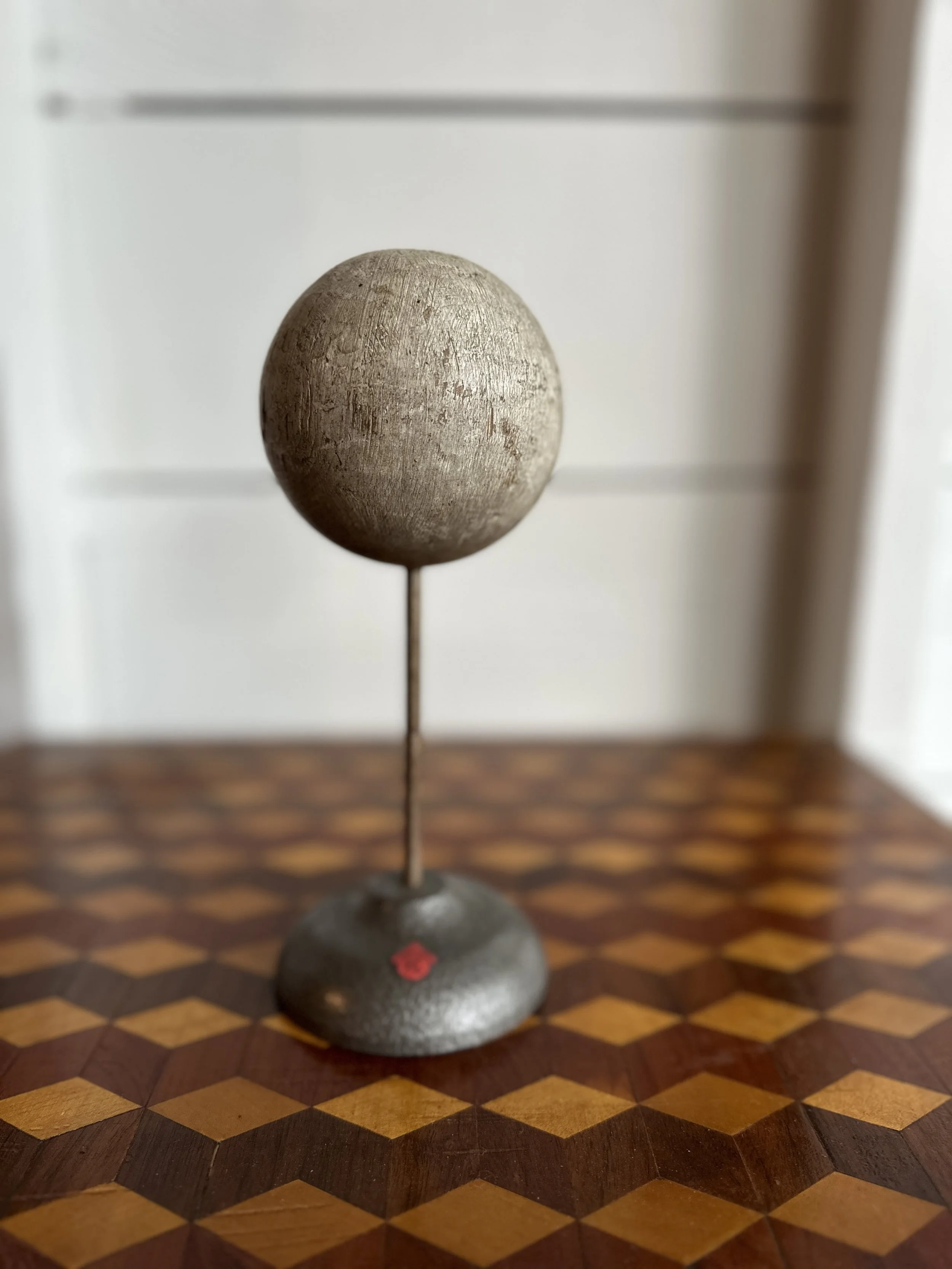

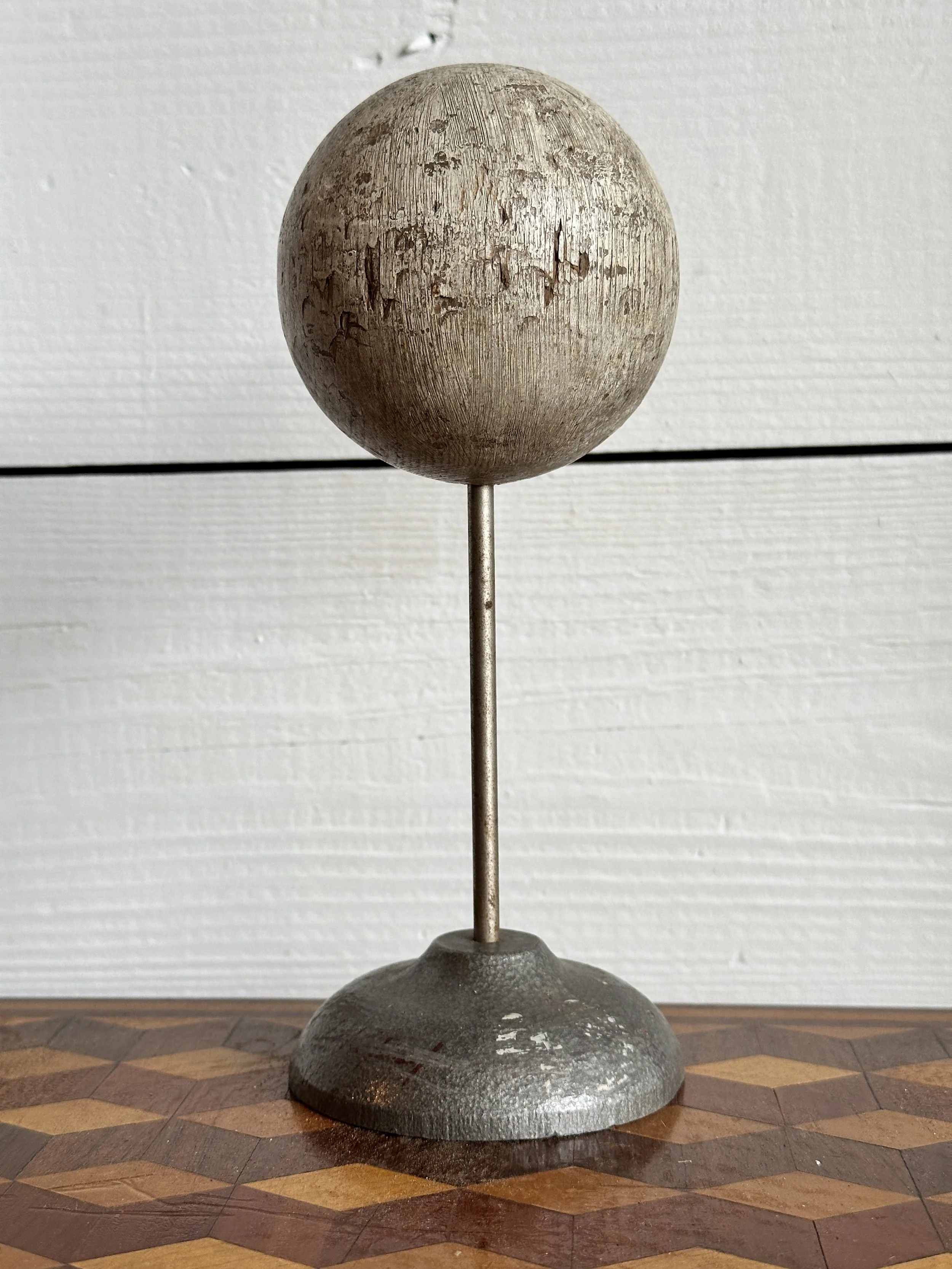

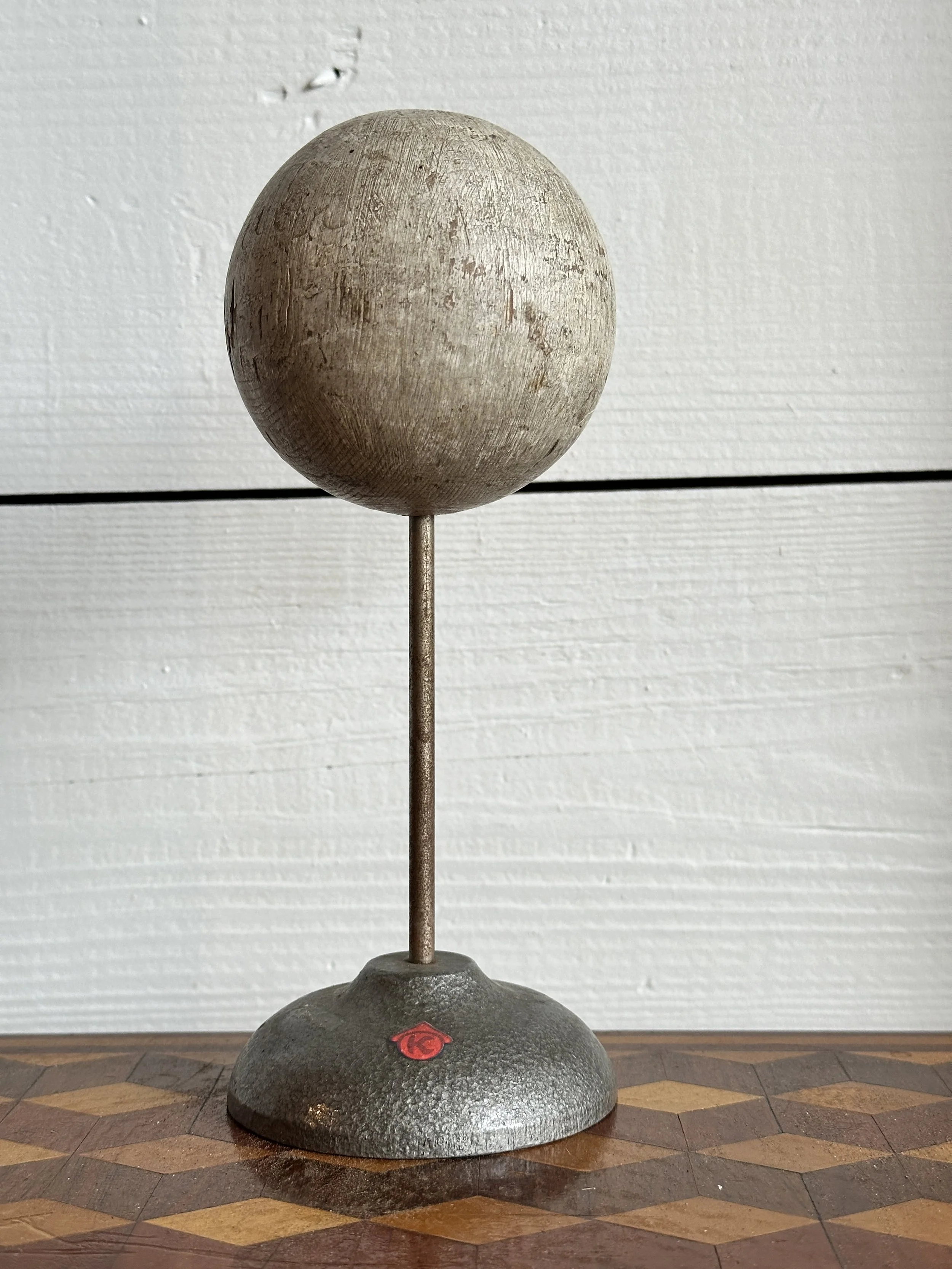
You’re looking at a potassium atom like you’ve never seen it before—perched proudly on a metal stand like it’s auditioning for a minimalist sci-fi movie. This sculptural form was once part of a mid-century medical or chemistry teaching set, likely German or French, designed to help students visualize atomic structure before everything went digital.
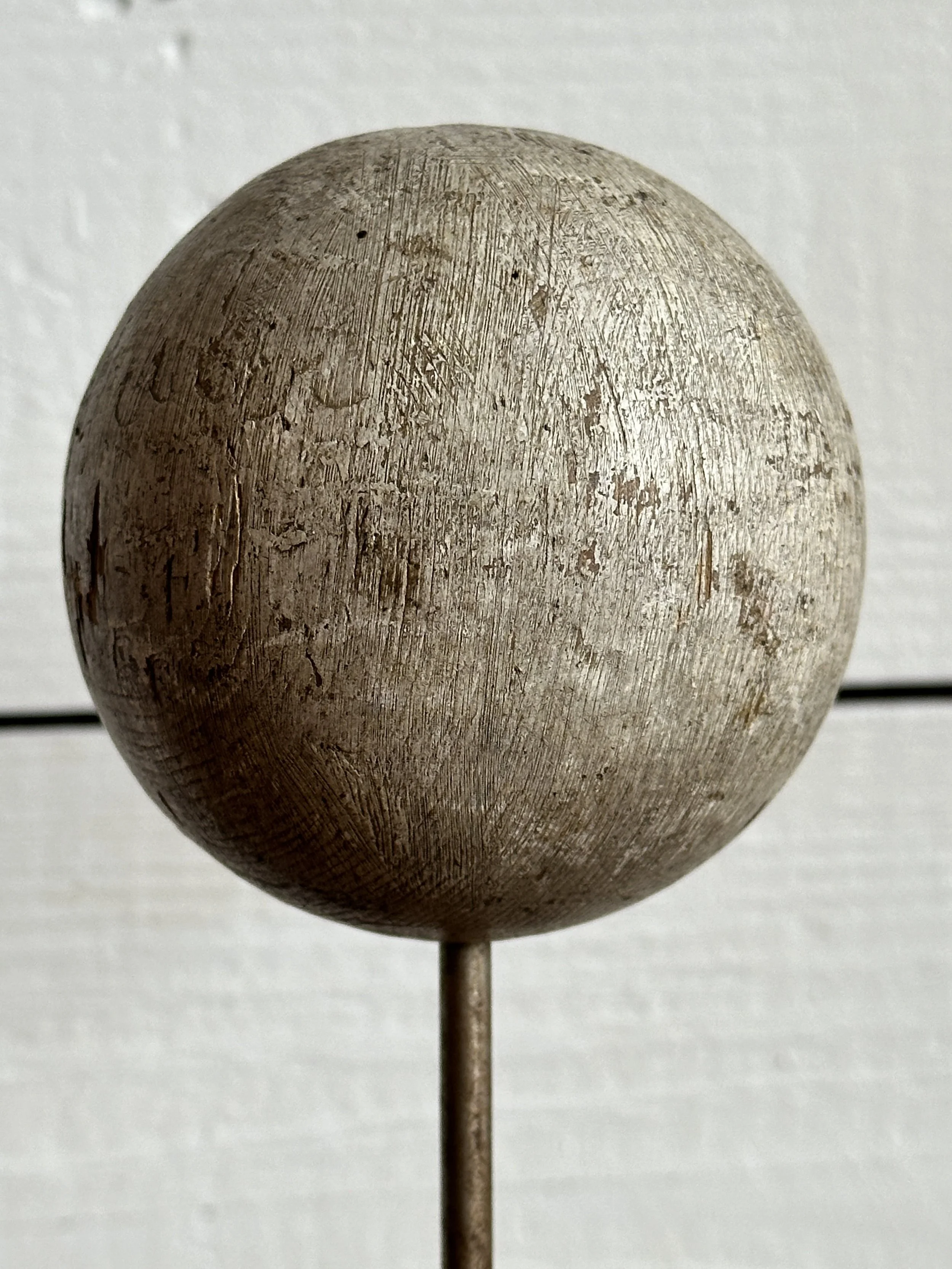
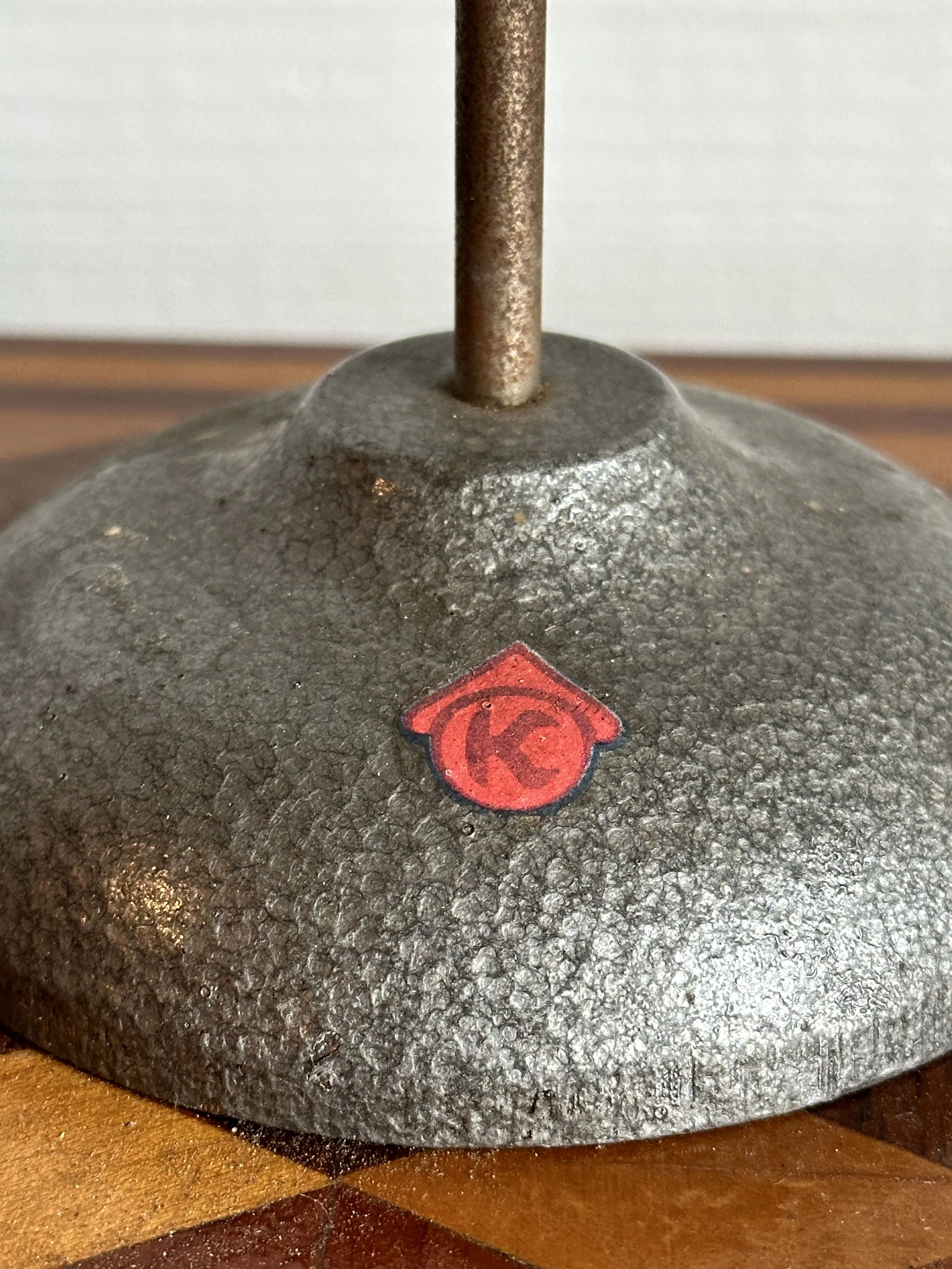
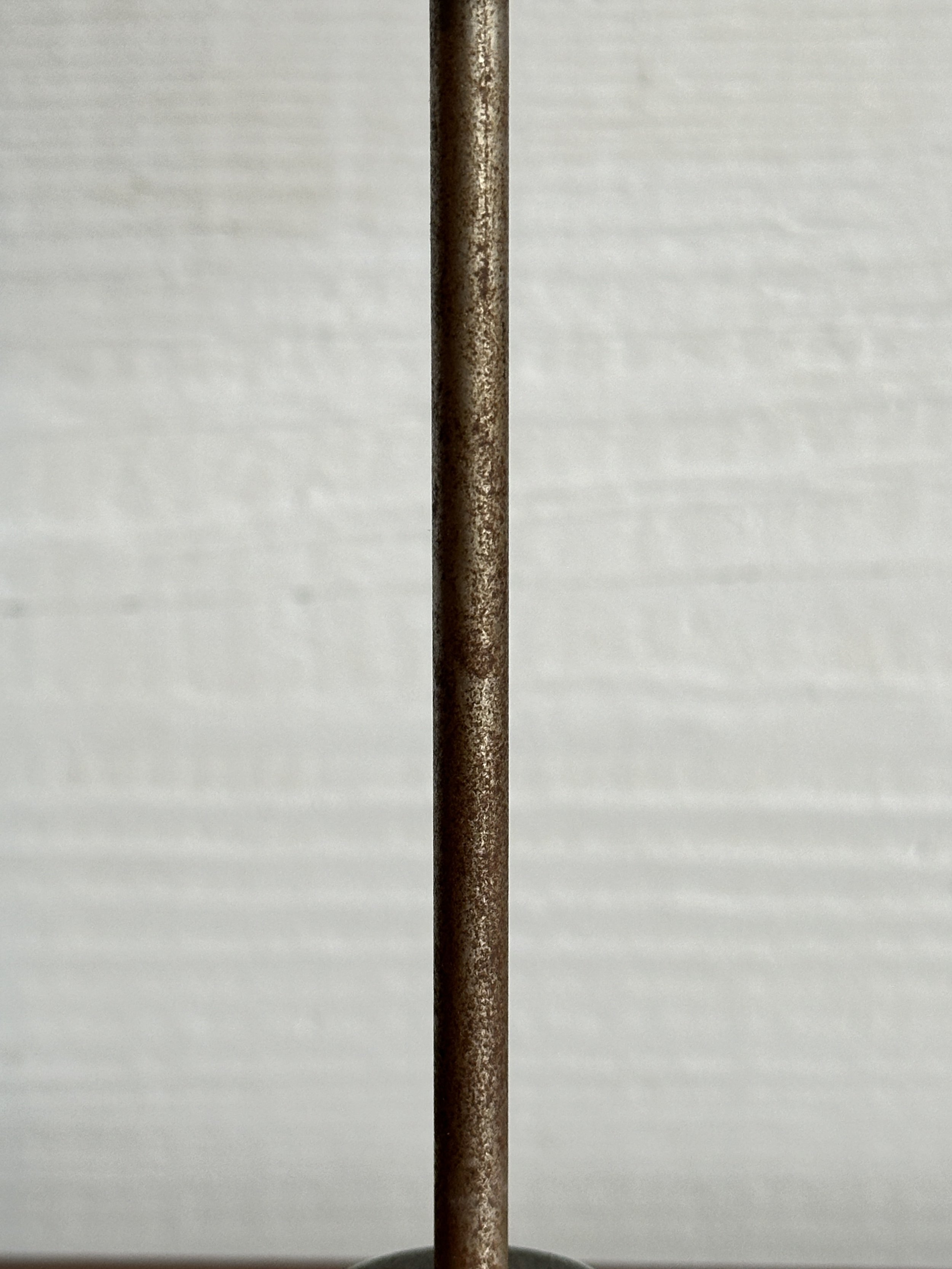
The spherical “atom” has a beautiful, timeworn texture—scratched, rubbed, and slightly pitted like it’s been through a few lab experiments (or maybe just a few decades of shelf life). It’s mounted on a simple steel rod rising from a weighty cast metal base, which features a small red K decal (symbol for potassium).
Category History
Before screens and simulations, science was something you could pick up, turn over, and pass around a classroom. Early scientific models—used from the 19th into the early 20th century—were built to make abstract ideas tangible. Anatomy, botany, chemistry, astronomy—each got its own set of objects, often crafted from plaster, wood, papier-mâché, glass, or metal.
Some of the most striking examples came from European makers who specialized in teaching tools: dissectible human organs, enlarged flowers that could be taken apart petal by petal, or geometric solids that made complex math feel graspable. Accuracy mattered, but so did durability. These pieces were handled constantly, so they were built to survive curious hands.
What’s interesting is how they balance clarity with artistry. Colors were often exaggerated to highlight function, textures simplified to emphasize structure. They weren’t trying to replicate nature perfectly—they were trying to explain it.
Today, they read as both educational artifacts and sculptural objects. Hinges, labels, and wear marks tell you exactly how they were used. They carry a kind of optimism too—the belief that if you could hold something in your hands, you could understand it.
You’re looking at a potassium atom like you’ve never seen it before—perched proudly on a metal stand like it’s auditioning for a minimalist sci-fi movie. This sculptural form was once part of a mid-century medical or chemistry teaching set, likely German or French, designed to help students visualize atomic structure before everything went digital.
The spherical “atom” has a beautiful, timeworn texture—scratched, rubbed, and slightly pitted like it’s been through a few lab experiments (or maybe just a few decades of shelf life). It’s mounted on a simple steel rod rising from a weighty cast metal base, which features a small red K decal (symbol for potassium).
Category History
Before screens and simulations, science was something you could pick up, turn over, and pass around a classroom. Early scientific models—used from the 19th into the early 20th century—were built to make abstract ideas tangible. Anatomy, botany, chemistry, astronomy—each got its own set of objects, often crafted from plaster, wood, papier-mâché, glass, or metal.
Some of the most striking examples came from European makers who specialized in teaching tools: dissectible human organs, enlarged flowers that could be taken apart petal by petal, or geometric solids that made complex math feel graspable. Accuracy mattered, but so did durability. These pieces were handled constantly, so they were built to survive curious hands.
What’s interesting is how they balance clarity with artistry. Colors were often exaggerated to highlight function, textures simplified to emphasize structure. They weren’t trying to replicate nature perfectly—they were trying to explain it.
Today, they read as both educational artifacts and sculptural objects. Hinges, labels, and wear marks tell you exactly how they were used. They carry a kind of optimism too—the belief that if you could hold something in your hands, you could understand it.