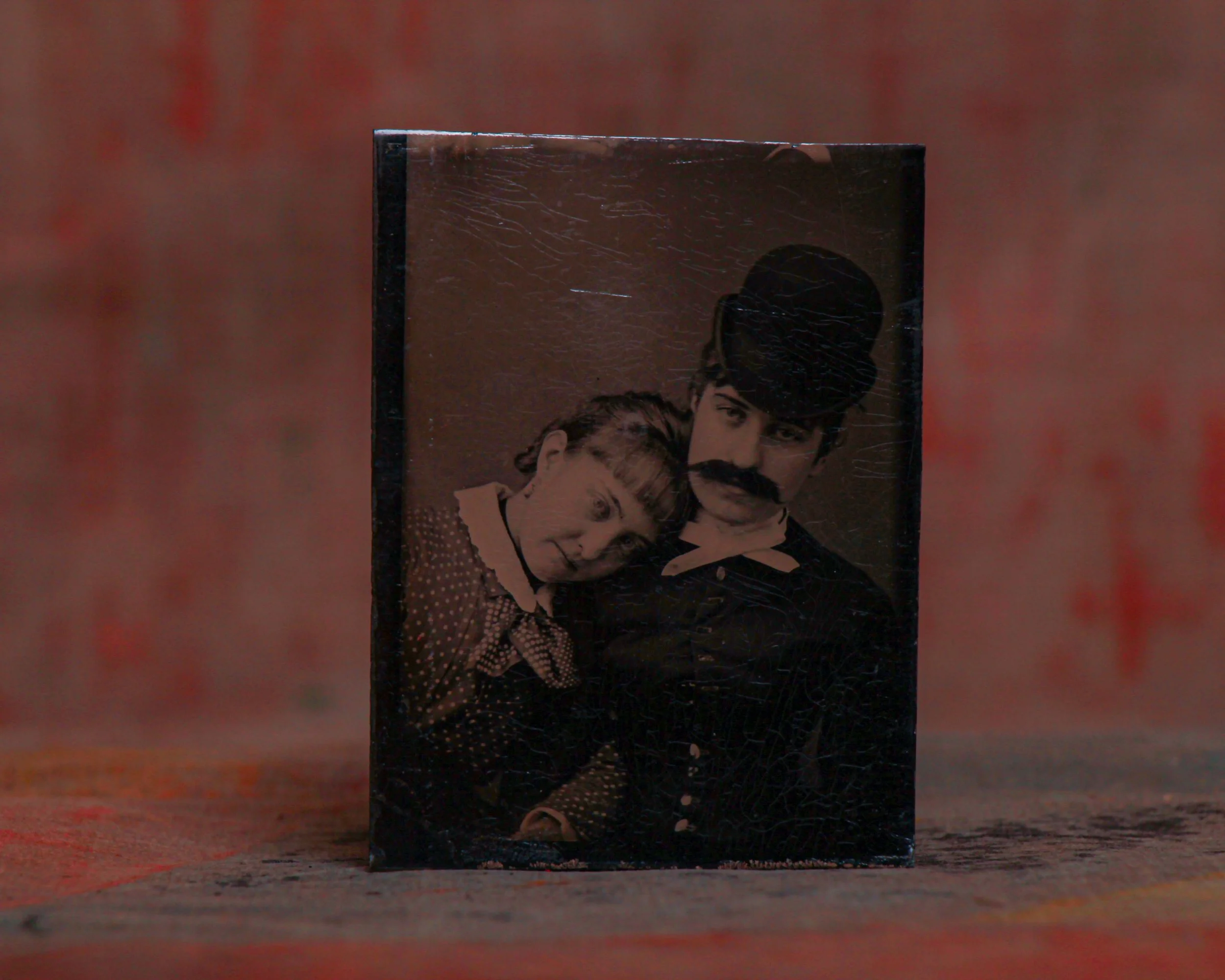
A young couple, dressed in what feels like playful costume rather than strict everyday wear, sit pressed together in a way that feels unguarded and gently defiant. She rests her head against her shoulder, eyes soft, expression calm and settled, like this was the most natural place to be. She meets the camera head-on, mustache perfectly assertive, hat tipped just enough to suggest intention.
The clothing adds an extra layer of intrigue. The dark jacket and tall cap one one of them reads as theatrical, almost uniform-like, while the patterned dress and crisp collar of the other soften the scene.
What really carries the piece is the closeness. Tintypes often keep people politely separated, hands folded, bodies squared to the lens. Not here. This is intimacy, plain and simple, recorded on a small sheet of iron. It’s a tender image that slipped past formality and landed somewhere human.
Circa third quarter 19th century.
Category History
Tintype photography is one of those processes that feels both scrappy and ingenious. Introduced in the 1850s, it wasn’t actually made on tin but on thin sheets of iron coated with a dark lacquer. The image—created through the wet plate collodion process—appeared directly on that surface, producing a one-of-a-kind photograph that was durable, affordable, and quick to make.
That combination made tintypes wildly popular. Street photographers, traveling fairs, and small studios could produce portraits in minutes. No negatives, no waiting—just a finished image handed over on the spot. They became the everyday photograph of their time, capturing soldiers, families, and individuals who might never have sat for a more formal portrait.
What makes tintypes compelling now is their immediacy. Slight imperfections—soft focus, uneven exposure, a bit of ghosting—aren’t flaws so much as fingerprints of the process. They feel direct, almost unfiltered.
Small, sturdy, and deeply personal, tintypes carry a quiet presence—little pieces of time fixed onto metal, meant to last.
A young couple, dressed in what feels like playful costume rather than strict everyday wear, sit pressed together in a way that feels unguarded and gently defiant. She rests her head against her shoulder, eyes soft, expression calm and settled, like this was the most natural place to be. She meets the camera head-on, mustache perfectly assertive, hat tipped just enough to suggest intention.
The clothing adds an extra layer of intrigue. The dark jacket and tall cap one one of them reads as theatrical, almost uniform-like, while the patterned dress and crisp collar of the other soften the scene.
What really carries the piece is the closeness. Tintypes often keep people politely separated, hands folded, bodies squared to the lens. Not here. This is intimacy, plain and simple, recorded on a small sheet of iron. It’s a tender image that slipped past formality and landed somewhere human.
Circa third quarter 19th century.
Category History
Tintype photography is one of those processes that feels both scrappy and ingenious. Introduced in the 1850s, it wasn’t actually made on tin but on thin sheets of iron coated with a dark lacquer. The image—created through the wet plate collodion process—appeared directly on that surface, producing a one-of-a-kind photograph that was durable, affordable, and quick to make.
That combination made tintypes wildly popular. Street photographers, traveling fairs, and small studios could produce portraits in minutes. No negatives, no waiting—just a finished image handed over on the spot. They became the everyday photograph of their time, capturing soldiers, families, and individuals who might never have sat for a more formal portrait.
What makes tintypes compelling now is their immediacy. Slight imperfections—soft focus, uneven exposure, a bit of ghosting—aren’t flaws so much as fingerprints of the process. They feel direct, almost unfiltered.
Small, sturdy, and deeply personal, tintypes carry a quiet presence—little pieces of time fixed onto metal, meant to last.