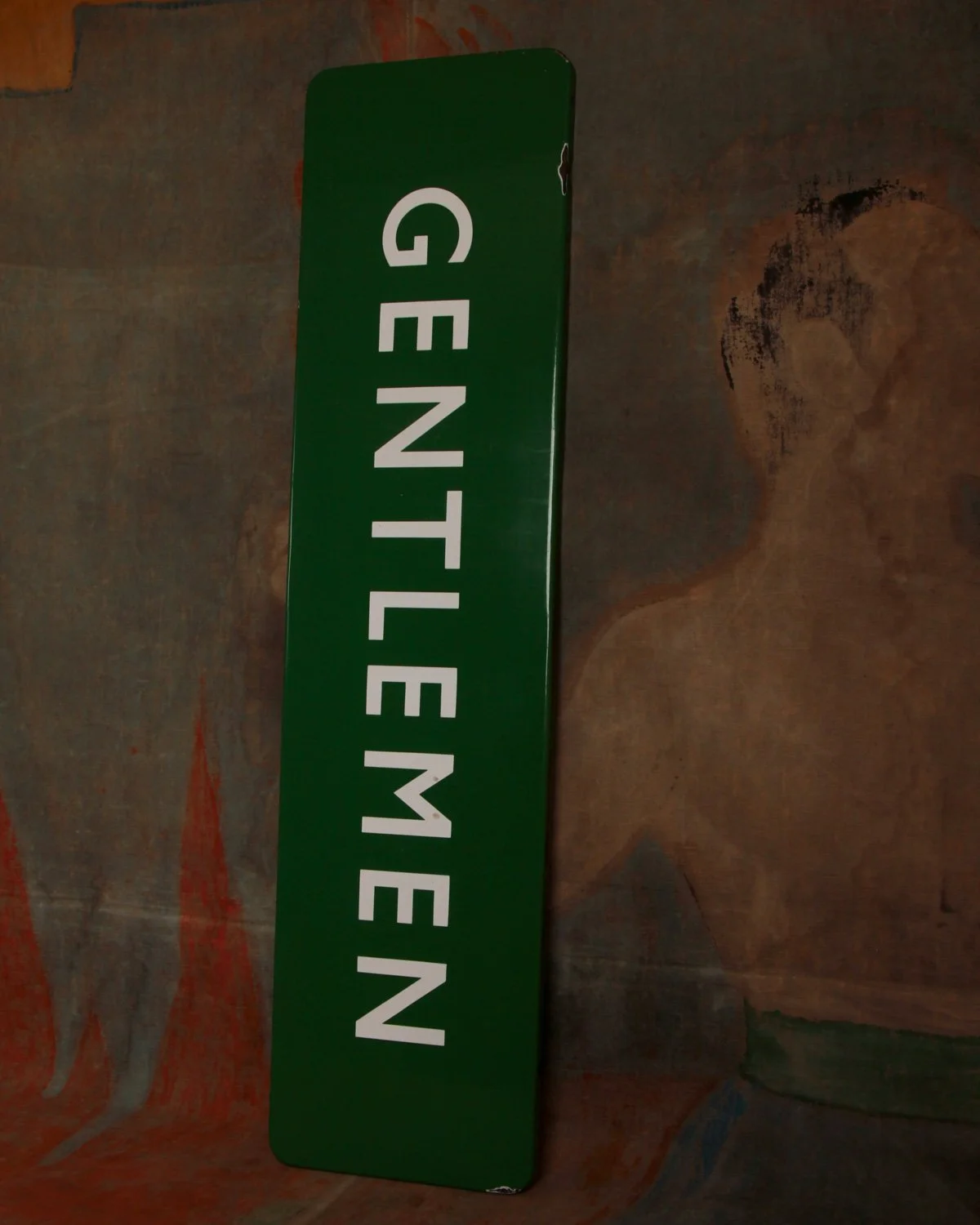

Single-sided porcelain enamel British railway sign with the word “GENTLEMEN” spelled vertically in white block lettering against a deep green background. Made from enamel-coated metal, the sign has a long, narrow shape with rounded corners and raised edges. The surface retains a glossy finish, with a few small chips and areas of wear, particularly along the edges. The reverse is finished in black enamel. Likely dating to the mid-20th century, it would have been used to direct passengers toward the men's toilets at a British railway station.
Porcelain enamel signs were widely used throughout Britain's railway network from the late Victorian period well into the 20th century. Made by fusing powdered glass onto metal at high temperatures, the process produced a durable, weather-resistant surface that could withstand years of exposure to the elements, soot, and heavy use.
Railway companies adopted enamel signage for everything from station names and platform numbers to advertisements, directional instructions, and public facilities. Their durability made them particularly practical in busy stations, where signs needed to remain legible and require little maintenance.
Before the nationalization of Britain's railways in 1948, individual railway companies developed their own signage systems, often incorporating distinctive colors, lettering, and company identities. The formation of British Railways brought a gradual move toward standardized designs, although older signs frequently remained in service for decades.
During the 1950s and 1960s, British railway signage became increasingly streamlined, favoring simple typography, clear instructions, and standardized color schemes. Enamel signs continued to appear alongside newer materials, including painted metal, plastics, and illuminated panels.
As stations were modernized and older fittings replaced, many enamel signs were removed from service. Today, surviving examples offer a glimpse into the everyday visual language of Britain's railway history.
Tighten the description and historyMake the condition language more precise