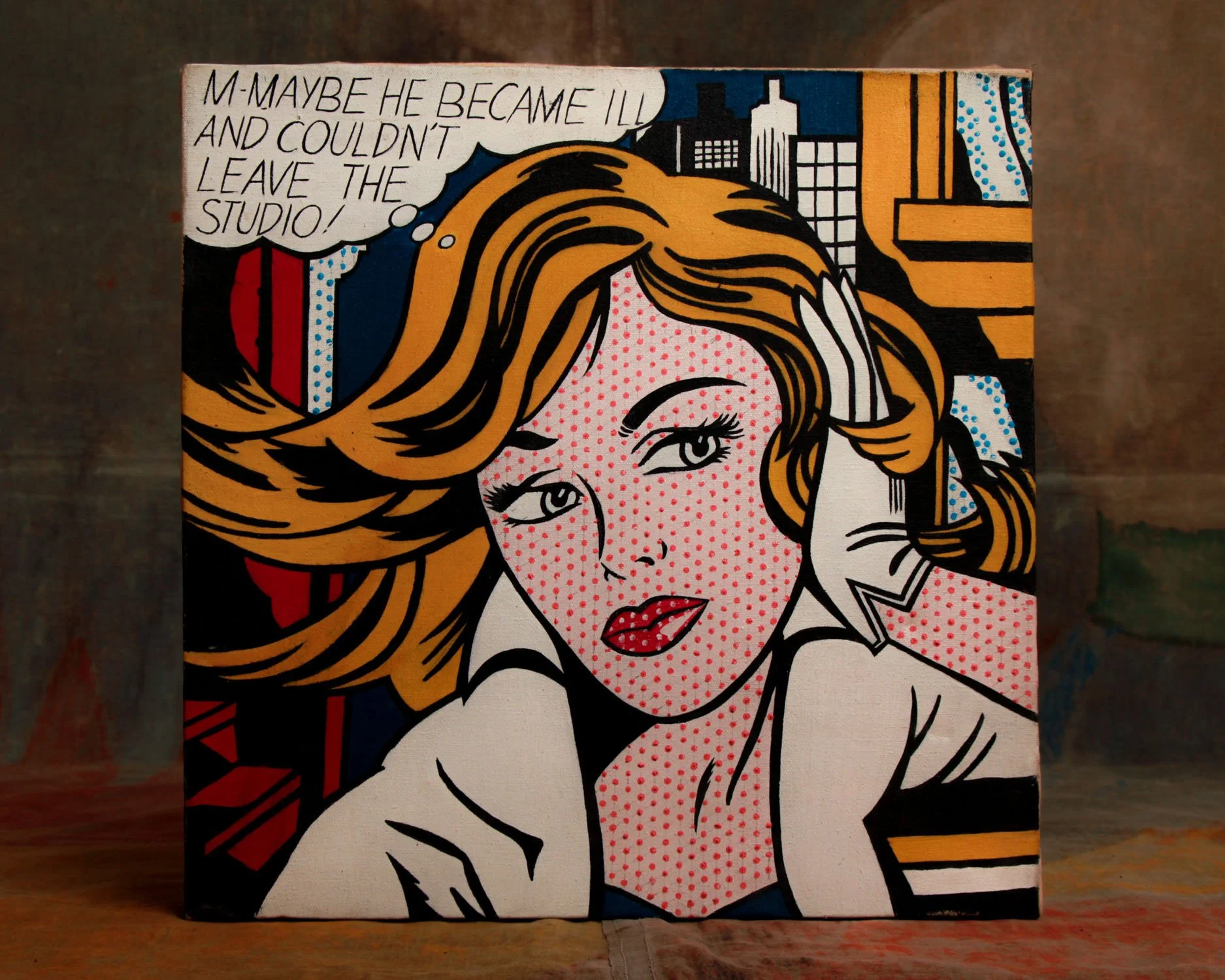
This colorful, hand-painted canvas is a reproduction inspired by the work of American Pop artist Roy Lichtenstein, one of the most recognizable figures of the 20th-century art world. Featuring a glamorous blonde woman, bold black outlines, bright primary colors, and the familiar Ben-Day dots, the painting captures the unmistakable look of Lichtenstein’s comic book-inspired artwork. A thought bubble reads, “M-Maybe he became ill and couldn’t leave the studio!” The canvas is stretched over a wooden frame and shows some age and wear. This is not an original Roy Lichtenstein painting, but an unsigned reproduction painted in his style.
Roy Lichtenstein (1923–1997) helped define the Pop Art movement during the early 1960s, alongside artists such as Andy Warhol, James Rosenquist, and Claes Oldenburg. At a time when Abstract Expressionism dominated the American art scene, Lichtenstein turned his attention to something entirely different: comic strips, newspaper advertisements, and everyday commercial imagery.
His breakthrough came in 1961 with paintings that borrowed heavily from the visual language of American comic books. Using thick outlines, simplified colors, speech bubbles, and mechanically inspired dot patterns, he transformed mass-produced illustrations into large-scale works of fine art.
Many of his best-known paintings featured beautiful women caught in moments of romantic tension, heartbreak, or melodrama. Works such as Drowning Girl (1963) and Oh, Jeff...I Love You, Too...But... (1964) became defining examples of this approach.
Although initially criticized for borrowing imagery from commercial illustrators, Lichtenstein eventually became one of the most celebrated American artists of his generation. His work challenged traditional ideas about originality, popular culture, and what deserved a place in a museum.
Today, his distinctive visual style remains enormously influential across contemporary art, graphic design, fashion, and advertising.